
Reading time: 6 minutes
Immediate response
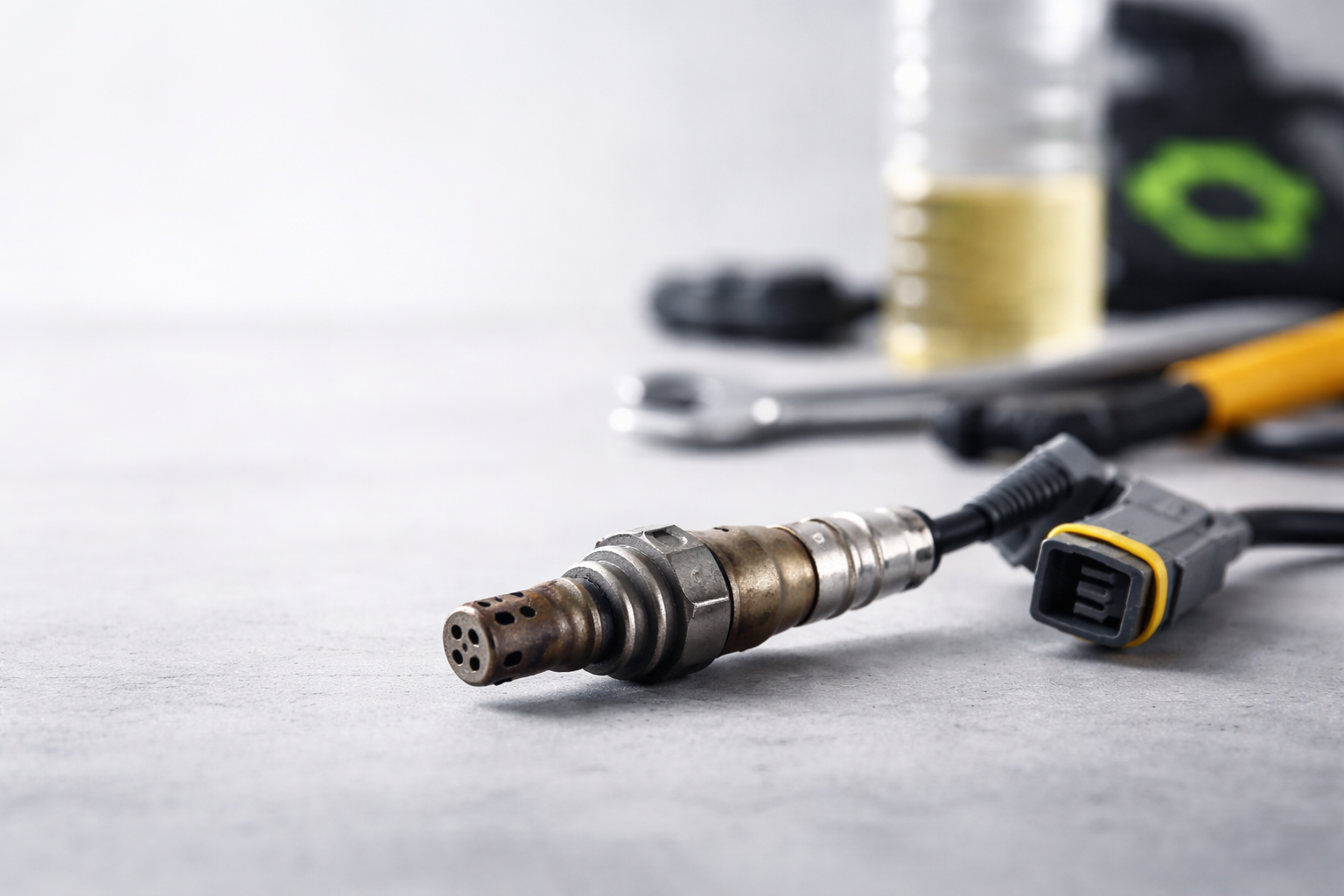
A faulty lambda probe It can alter the air-fuel mixture and contribute to increased fuel consumption and emissions. It can also cause an engine warning light, rough idling, loss of power, or less smooth operation.
These symptoms, however, they do not automatically indicate a fault in the lambda probe. Injectors, air flow sensors, air intakes, ignition, wiring, and other issues can produce similar signals. It's therefore important to diagnose the problem before replacing the sensor.
What you will learn:
- What is the lambda probe used for?.
- What symptoms can it cause when it malfunctions?.
- Because it can affect consumption.
- How to interpret OBD2 error codes and data.
- The difference between narrowband and wideband probe.
- When to check it and when to replace it.
- How to avoid a misdiagnosis.
Index
What is the lambda probe and how does it work?
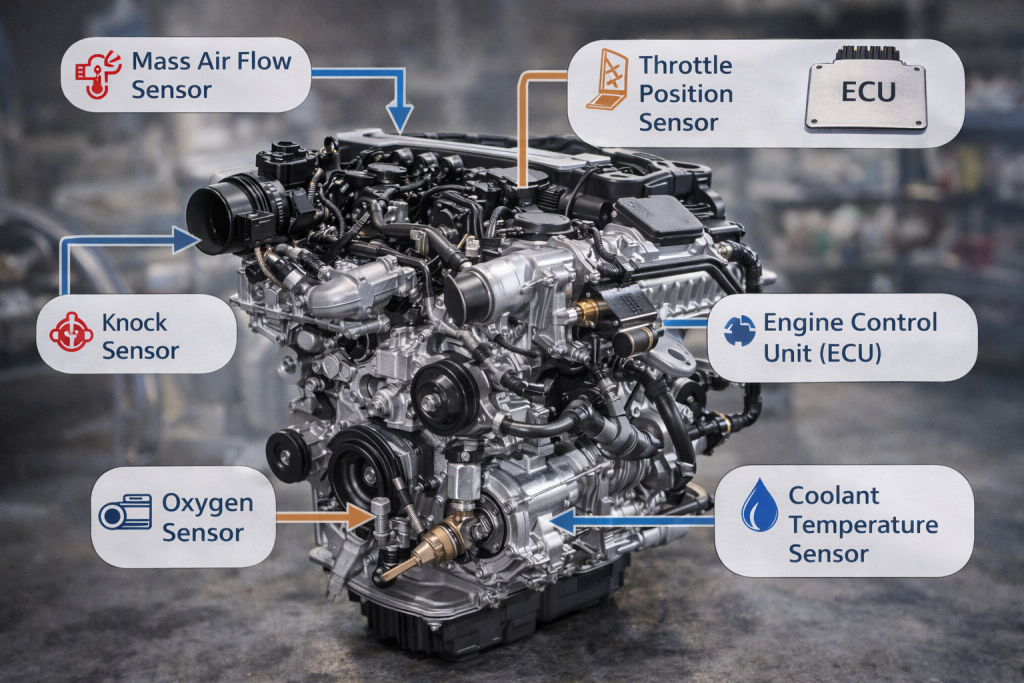
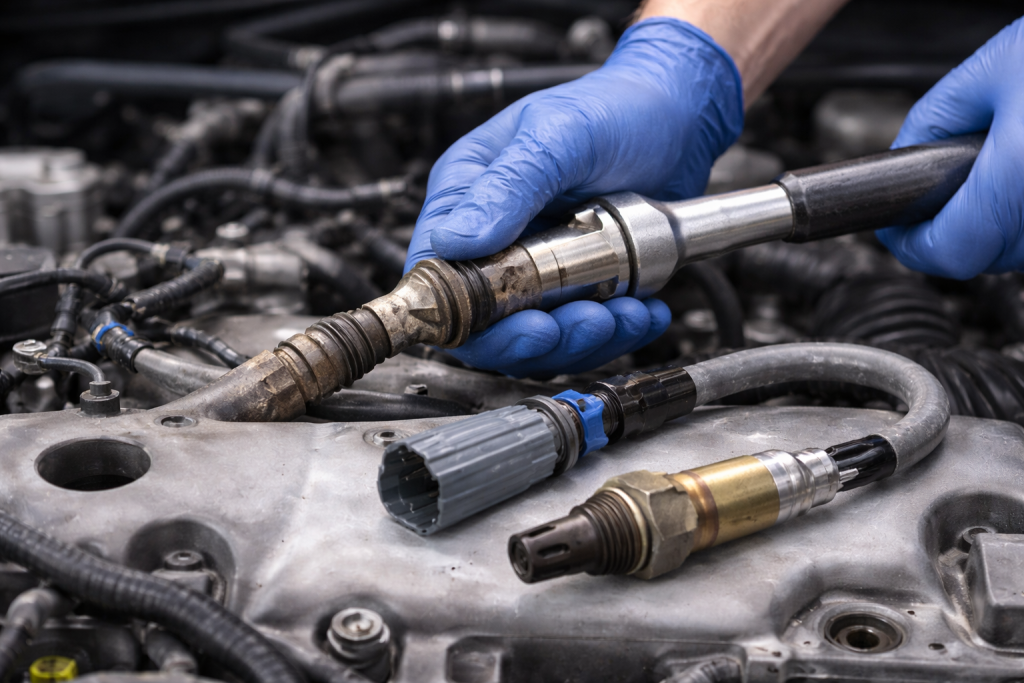
The lambda probe, also called oxygen sensor, is installed in the exhaust system and allows the engine control unit to obtain information on the amount of oxygen present in the exhaust gases.
This data is used, together with data from other sensors, to correctly manage combustion and fuel injection.
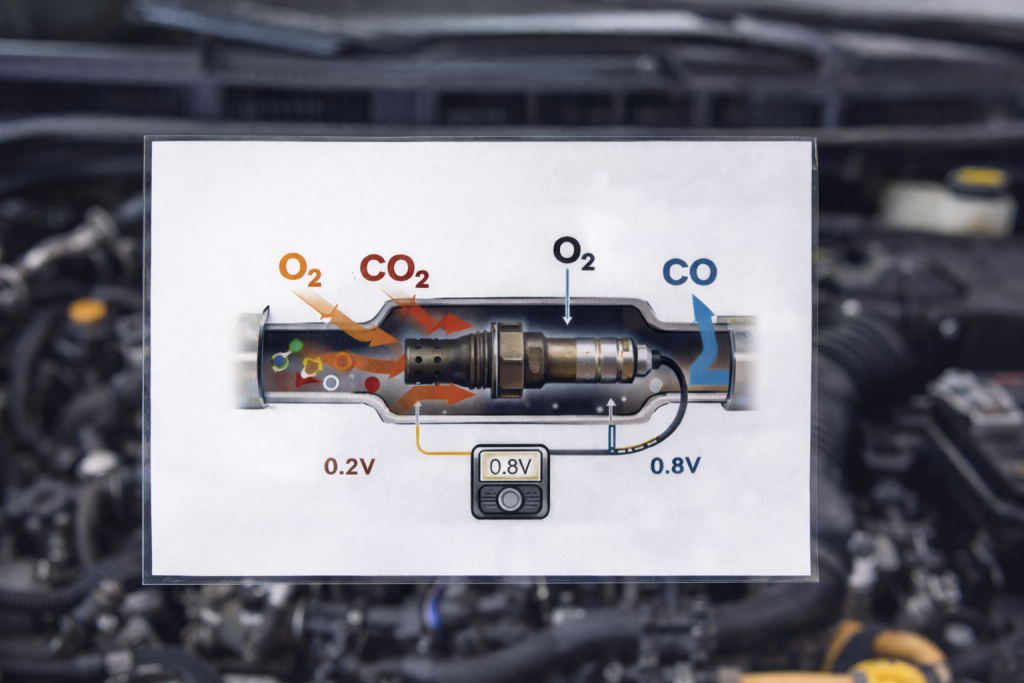
In a simplified way:
- combustion occurs;
- gases pass through the exhaust;
- the probe detects the presence of oxygen;
- the signal is processed by the control unit;
- Engine management can correct fuel delivery.
Precise operation depends on the type of sensor and the system used by the vehicle.
What happens when the lambda probe malfunctions?
If the probe signal is incorrect, slow, inconsistent, or absent, mixture management may be impaired.
Depending on the vehicle and the type of fault, the following may appear:
- abnormal mixture corrections;
- increased emissions;
- higher consumption;
- irregular functioning;
- loss of performance;
- engine light comes on.
However, it's incorrect to assume that a faulty sensor will always automatically cause a rich mixture. The ECU's reaction depends on the fault, the system, and the manufacturer's strategies.
Symptoms of a faulty lambda sensor
Common signs may include:
- engine light on;
- abnormal increase in consumption;
- irregular idle;
- less smooth acceleration;
- loss of power;
- abnormal odor from the exhaust;
- high emissions;
- irregular engine operation.
A single symptom is not enough to diagnose the probe.
For example, a car that uses more fuel but still runs perfectly may have a completely different problem.
Faulty lambda sensor and fuel consumption: what's the connection?
A A faulty lambda probe can affect fuel consumption, because its signal participates in the management of the air-fuel mixture.
If the information received by the control unit does not correspond to real conditions, fuel management may become less efficient.
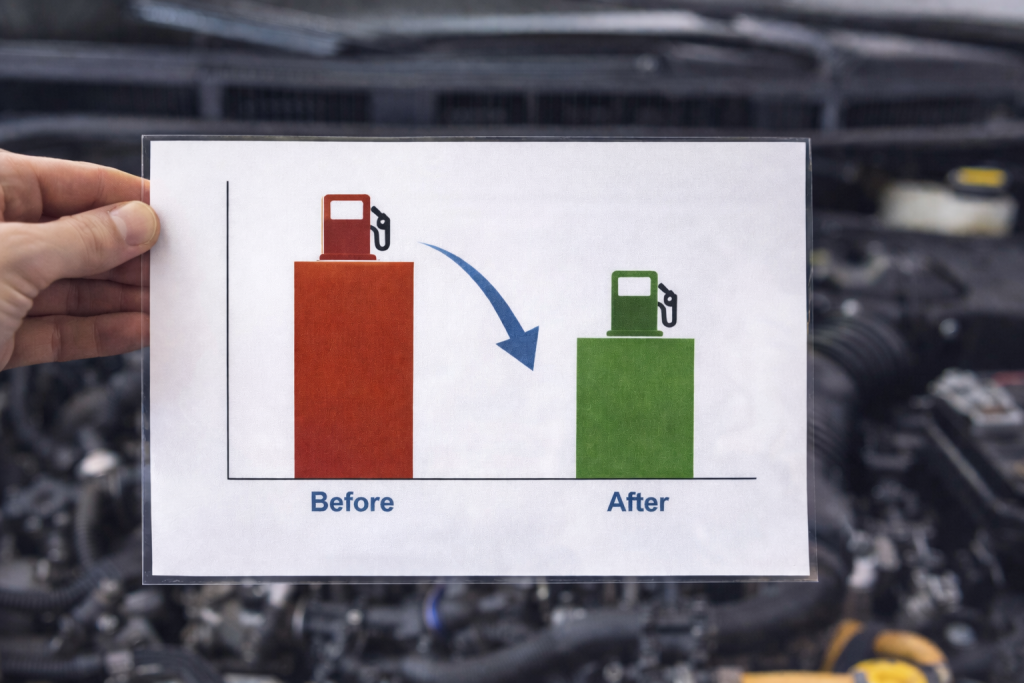
However, there is no universal percentage increase in fuel consumption that is valid for all cars.
The effect depends on several factors:
- probe type;
- sensor position;
- type of failure;
- motor;
- management system;
- terms of use;
- presence of other problems.
For this reason, an increase in consumption alone, It does not prove that the lambda probe is faulty.
Read also: Cars that consume too much fuel: 12 causes and what to check.
How to understand if it's really the lambda probe
Before replacing the component, it is best to start with three elements:
1. Symptoms
Check to see if the fuel consumption warning light, rough idling, loss of power, or other changes in the car's behavior have appeared along with it.
2. Error codes
An electronic diagnosis may show codes related to the sensor circuit, its signal, or the mixture management.
Among the OBD-II family codes associated with the oxygen sensor circuit, there may be, for example, P0130, P0131, P0132, P0133 or P0134.
But beware: An error code does not automatically mean “change the probe”.
The problem could also be related to wiring, connectors, power supply, exhaust leaks or engine conditions that alter the detected signal.
3. Real-time data
When available, live data allows you to observe sensor behavior during engine operation.
Their interpretation must however take into account the type of probe installed.
OBD2 Diagnostics: What It Can Really Tell You
An OBD2 reader can be useful for checking:
- stored error codes;
- engine light status;
- available probe data;
- fuel corrections;
- other engine management parameters.
However, a single value should not be used as a definitive diagnosis.
For example, the classic voltage range associated with narrowband probes It cannot be applied indiscriminately to all modern lambda probes.
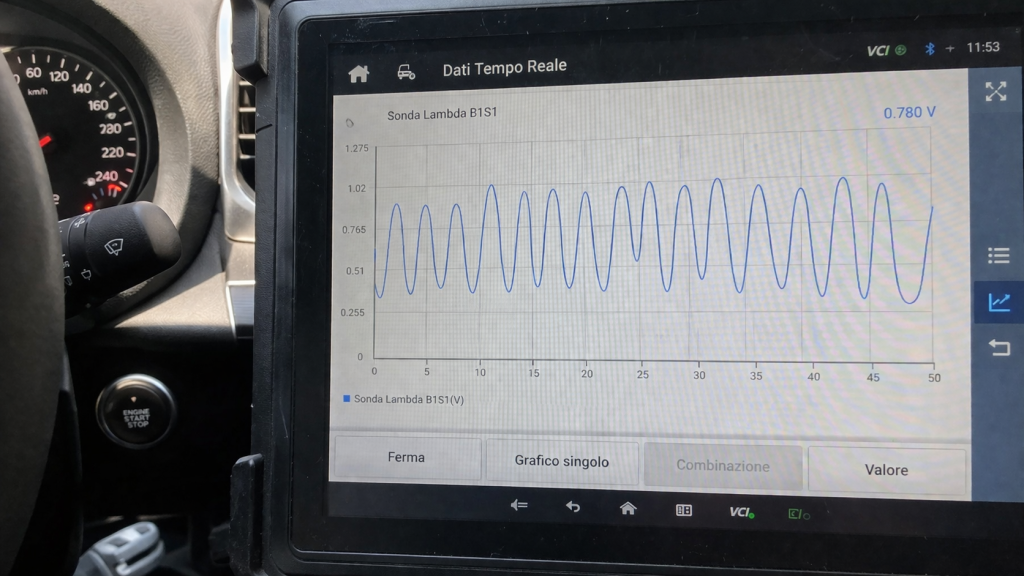
The correct diagnosis considers together:
error codes + live data + symptoms + sensor type + engine condition.
An OBD2 reader can therefore be a good first tool for understanding what the control unit is recording, without having to replace components by trial and error.
HELPFUL TIP
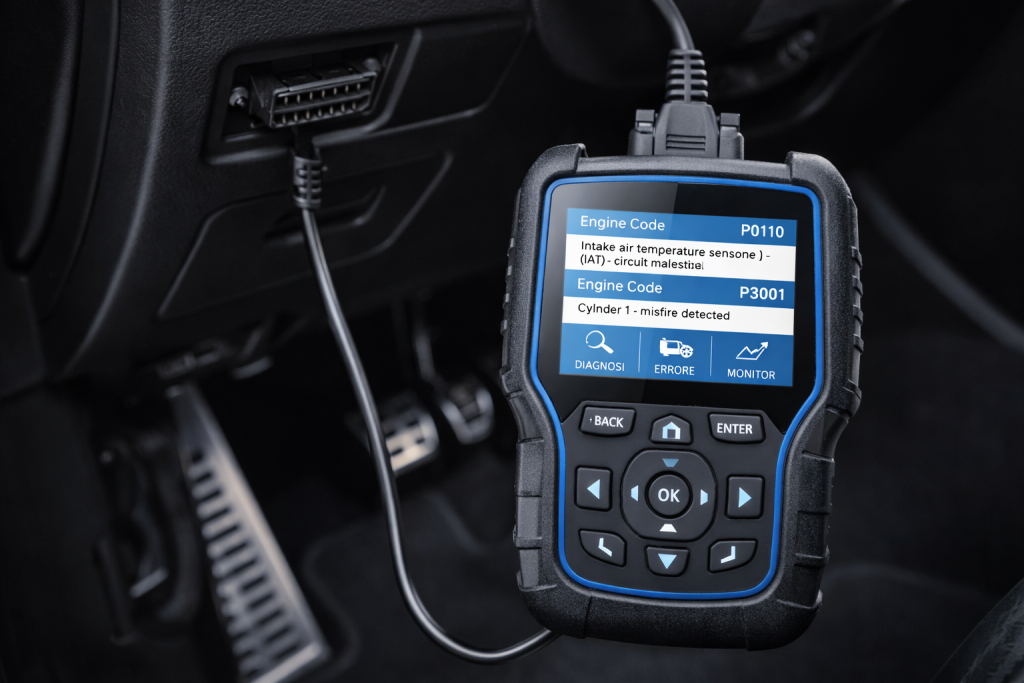
OBD2 diagnostic scanner
See on Amazon →
Narrowband and wideband: what's the difference?
Not all lambda probes work the same way.
Narrowband probe
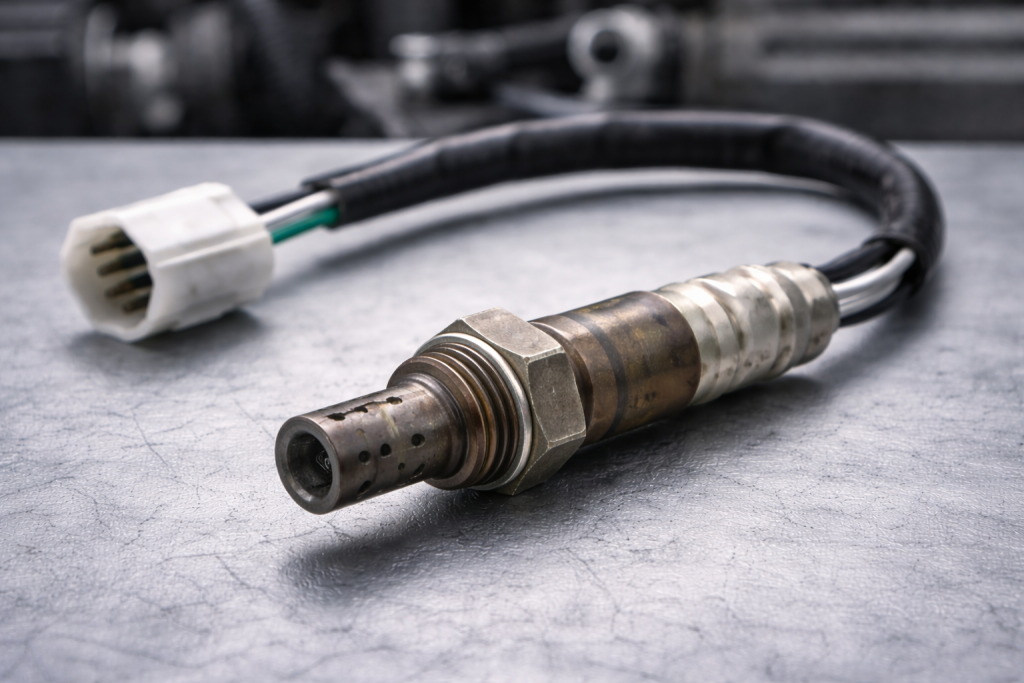
The traditional narrow band probe is mainly used to indicate to the control unit whether the mixture is on one side or the other of the stoichiometric ratio.
Its signal is often observed during diagnosis to check its activity and response.
Wideband probe
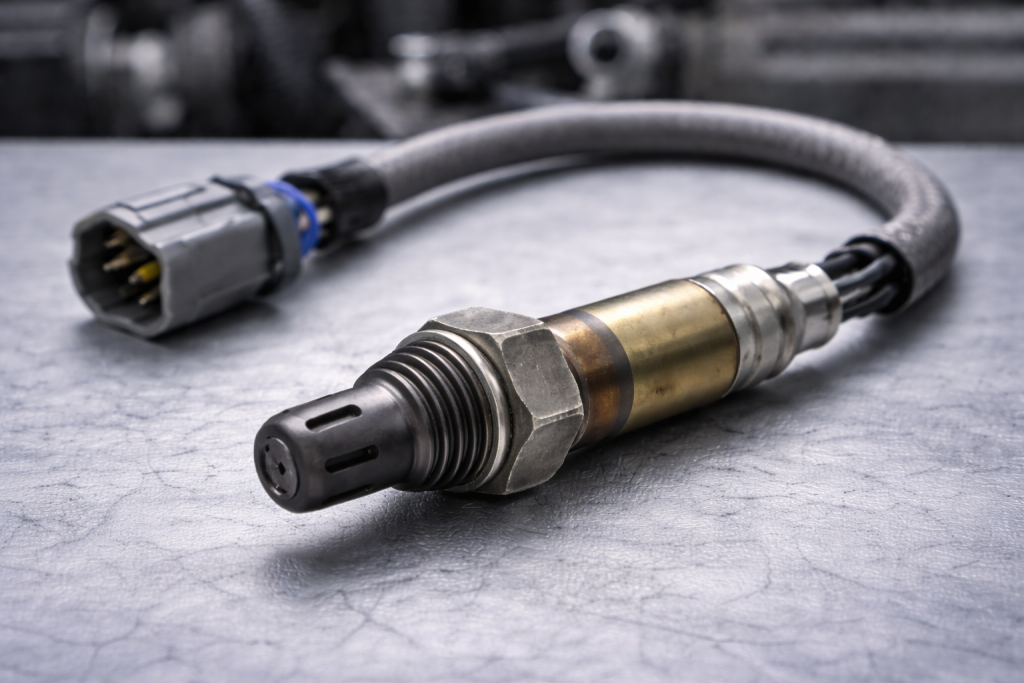
Wideband probes allow for a much broader and more precise measurement of the composition of the mixture.
The operating principle and above all the diagnostic data should not be interpreted as those of a simple narrowband.
This distinction is important when using OBD scanners and applications.
How the lambda probe works with the control unit
When the system uses the feedback from the probe to correct the mixture management, the control unit can work in closed loop.
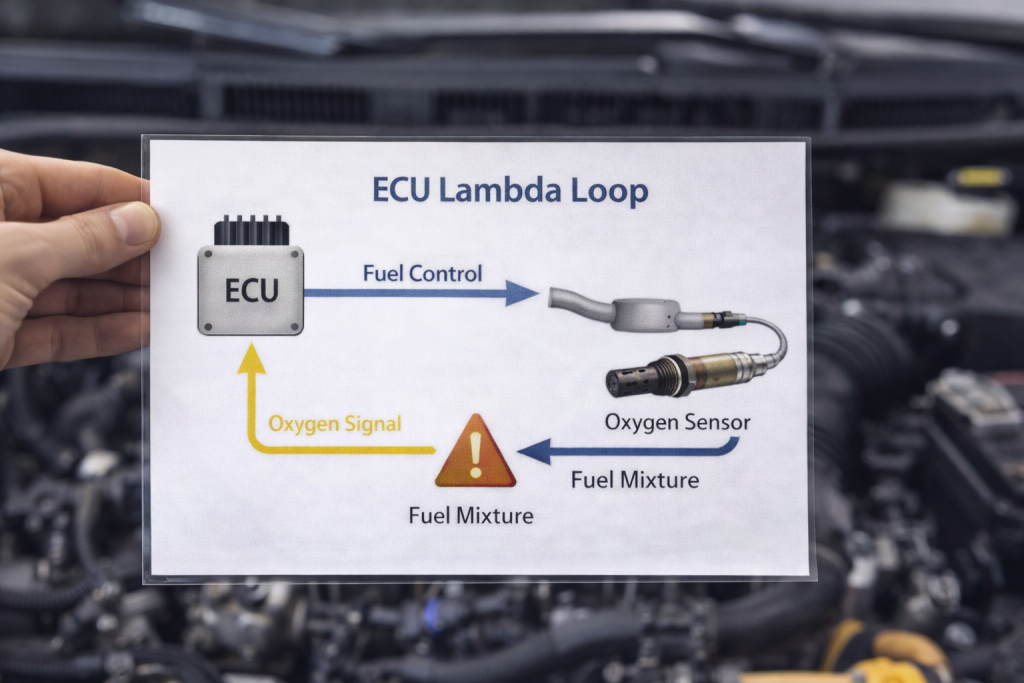
In a simplified way:
combustion → exhaust gas → lambda probe → ECU → fuel correction
The lambda value represents the ratio between the air actually present and that required for stoichiometric combustion:
λ = real air / theoretical air
In general terms:
- λ = 1 indicates stoichiometric conditions;
- λ > 1 indicates a leaner mixture than stoichiometric;
- λ < 1 indicates a richer mixture.
This does not mean that the engine must always work exactly at λ = 1: the strategy can change depending on the engine and operating conditions.
Lambda sensor or other problem?
This is one of the most important points of diagnosis.
Similar symptoms can be caused by:
- injectors;
- MAF flow meter;
- ignition problems;
- unwanted air intake;
- fuel pressure;
- engine temperature sensor;
- wiring and connectors;
- leaks in the exhaust system.
For example, an anomalous mixture detected by the probe It doesn't necessarily mean that the probe creates it.. The sensor may simply be registering a real problem with the engine.
Read also: Dirty injectors: do they really increase fuel consumption?
If instead consumption increases especially in the first few kilometres:
Read also: Cars consume too much fuel when cold: causes, symptoms, and solutions
Can the lambda probe damage the catalytic converter?
Improper combustion management can increase emissions and, under certain conditions, contribute to catalytic converter problems.
The important point, however, is to understand why the mixture is out of control.
Simply changing the probe without identifying the cause may not solve the problem.
If the engine light is on flashes, If the engine runs very poorly or you smell a strong fuel odor, it is wise to reduce your use of the car and have it checked.
When to replace the lambda probe
There is no universal mileage at which all lambda sensors should be replaced.
The duration depends on:
- sensor type;
- motor;
- operating temperature;
- combustion conditions;
- contamination;
- engine problems;
- condition of wiring and connectors.
A sensor should not be replaced just because the car has reached a certain mileage.
Replacement makes sense when the diagnosis indicates that the sensor or its circuit is not working properly and other possible causes have been evaluated.
Is it necessary to clean the lambda probe?
Cleaning should not be considered a one-size-fits-all solution.
A probe can become contaminated by residues due to combustion problems, oil consumption, coolant consumption, or other anomalies. In these cases, simply remove the deposit. it does not necessarily solve the cause that produced it.
Furthermore, an electrically faulty, worn or incorrectly responding sensor cannot be repaired simply by cleaning it.
Before attempting to intervene on the sensor, it is therefore more useful to understand why its functioning is abnormal.
How much does it cost to replace a lambda probe?
There is no one-size-fits-all price for all cars.
The cost may change based on:
- vehicle model;
- probe type;
- position;
- accessibility;
- original or compatible spare part;
- need for further checks;
- labor.
Some vehicles also have multiple sensors.
Before purchasing the spare part it is important to check code, position and compatibility with your engine.
How to avoid lambda sensor problems
Not all failures are preventable, but it is helpful to avoid conditions that can damage or contaminate the sensor.
In particular:
- don't ignore ignition problems;
- resolve any abnormal oil or coolant consumption;
- comply with the maintenance required by the manufacturer;
- use parts and fluids that conform to specifications;
- check wiring and connectors when errors appear;
- Don't ignore a persistent check engine light.
However, it is not necessary to perform OBD checks at arbitrary intervals just to “prevent” the probe from failing.
Common mistakes to avoid
Change the probe as soon as an error code appears
The code identifies the anomaly detected by the control unit, not necessarily the component to be replaced.
Interpret all sensors the same way
Narrowband and wideband work differently. A normal value for one technology may not be normal for another.
Focus only on consumption
An increase in consumption can depend on many causes.
Ignore wiring and connectors
An electrical problem can produce errors similar to those of a faulty sensor.
Clear the error and consider the problem solved
Deleting the code does not eliminate the cause that generated it.
Read also:
👉 Dirty injectors: how they affect fuel consumption (a complete and practical guide)
👉 Cars that consume too much fuel? 12 real causes + how to reduce fuel consumption immediately.
In summary
A faulty lambda probe It can affect fuel consumption, emissions and engine operation, but its symptoms can also be caused by other problems.
Before replacing it:
- check the symptoms;
- read any error codes;
- check the type of probe;
- look at the available data;
- check wiring and connectors;
- consider other possible causes.
The goal is not simply to find a code related to the probe, but to understand why did that code appear.

FAQ Faulty lambda probe
How to understand if the lambda probe is faulty?
An engine light, high fuel consumption, rough idling, and loss of performance may indicate a problem with the oxygen sensor. However, none of these symptoms alone are sufficient. Error codes and diagnostic data help pinpoint the cause.
Does a faulty lambda probe increase fuel consumption?
It can. If the signal used by the control unit to manage the mixture is incorrect, fuel consumption can increase. However, there is no universal percentage that applies to all cars and all types of failures.
Can I drive with a faulty lambda sensor?
It depends on the type of fault and the car's behavior. If the engine is running normally and the light is solid, it's still a good idea to have a diagnosis performed. If the light is flashing, the engine is running very poorly, or you smell strong fuel, it's wise to stop safely and have the vehicle checked.
When should the lambda probe be changed?
When a diagnosis confirms a problem with the sensor or its circuit that requires replacement. There is no universal mileage interval that applies to all vehicles.
Can you clean a lambda probe instead of replacing it?
Cleaning won't fix an electrical fault or a malfunctioning sensor. If contamination is present, you also need to determine the underlying problem.
Does a P0130 code mean I need to change the probe?
No. The code indicates a fault with the sensor circuit, but connections, wiring, and other possible causes should also be considered before replacing.
Can the lambda probe cause problems with the catalytic converter?
Improper combustion or mixture management can increase stress on the aftertreatment system. It's therefore important to diagnose the cause, especially if the engine warning light is present and the engine is running erratically.
Conclusion
La faulty lambda probe It can be one of the causes of high fuel consumption, engine warning light and abnormal emissions, but replacing it without a diagnosis can mean spending money without solving the problem.
Start with the data: check for errors, observe engine behavior, and verify the type of sensor installed. If the information actually points to the lambda sensor, you can evaluate the correct replacement for your vehicle.


 Italian
  English