
Reading time: 6 minutes
Immediate response
The low coolant It can be indicated by a level below MIN in the reservoir, higher than normal engine temperature, temperature warning light or traces of leaks in the engine compartment or under the car.
Check the level only with cold engine. If it's below MIN, don't just top up without asking why it's low: check for leaks and use coolant that meets the specifications for your car.
If the temperature rises above normal, an overheat warning appears, or steam comes from the engine compartment, stop safely and let the engine cool.
What you will learn:
- What are the symptoms of low coolant?.
- Because the level may decrease.
- What to check before topping up.
- When it is best not to continue driving.
- How to top up correctly.
- When a workshop check is needed.
Index
What is coolant used for?
The coolant circulates in the cooling system and allows the heat produced by the engine to be transferred to the radiator.
It doesn't just help manage temperature: the right fluid also contains additives designed to protect the circuit components.
When the level is insufficient, the system may not function under the expected conditions.
Low coolant: symptoms to watch for
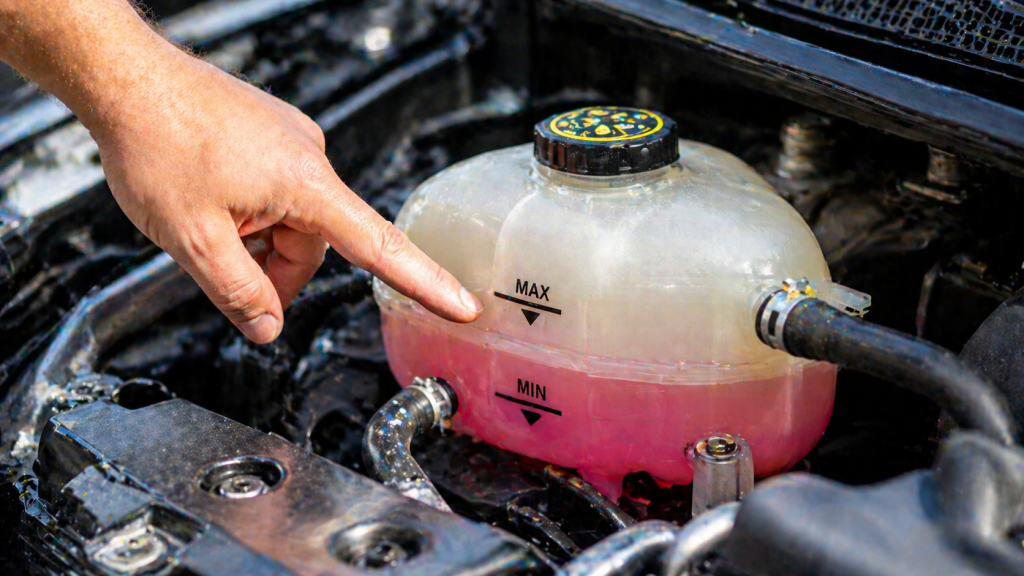
1. Level below MIN in the tray
It is the most direct control.
With the engine completely cold, check the level in the expansion tank. Normally the reference marks are present. MIN and MAX.
If the level is below MIN, we need to understand why it dropped.
Do not open the cap when the circuit is hot.
2. Engine temperature higher than normal
A temperature that tends to rise above the car's usual behavior may indicate a problem with the cooling system.
Low fuel level is one possible cause, but not the only one: the radiator, fan, thermostat, water pump, and other components can cause similar problems.
3. Temperature warning light or overheat warning
A temperature warning light or message requires attention.
The light does not automatically identify low refrigerant as the cause: it indicates that the system needs to be checked.
If the warning light appears or the temperature rises too much, read Car Overheating: What to Do Right Away.
4. Traces of refrigerant
Check if there are any traces:
- under the car;
- around the tray;
- on the sleeves;
- near the radiator;
- in the water pump area.
A small leak may be difficult to see and only appear under certain conditions.
5. Unusual smell in the engine compartment
A hot coolant leak can produce a characteristic odor.
Smell alone is not enough to diagnose a leak, but if it is coupled with a decreasing level, it warrants a checkup.
6. Fan working harder than usual
If the fan is running much more frequently than your car normally does, the system may be trying to manage a high temperature.
This too It is not a specific symptom of low coolant and requires you to check the entire system.
And the air conditioner that cools less?
An air conditioner that doesn't cool well doesn't mean your engine coolant is low.
Under some high engine temperature conditions, the vehicle management can modify the A/C operation, but if the main problem is that the air is not cold enough, the air conditioning itself must also be checked.
If the problem is mainly cold air, read Car air conditioning not cooling? Causes and solutions.
Why does the coolant level drop?
A decreasing level is worth checking, especially if you have to top up repeatedly.
Radiator leaks
Corrosion, damage, or problems with the joints can cause leaks. If you're also checking your radiator, read Dirty car radiator: symptoms and what to do immediately.
Sleeves and fittings
Over time, hoses, clamps and fittings can deteriorate and allow coolant to leak.
Tank or circuit cap
The cap helps maintain the pressure conditions required by the system.
If it is not working properly it can contribute to refrigerant loss.
Water pump
A leaking water pump can leave traces of coolant in the engine compartment or underside of the car.
Internal losses
Not all leaks are immediately visible from the outside.
In some cases, coolant levels can be low due to an internal engine problem. If the level continues to drop without visible leaks, especially along with other abnormal symptoms, it's a good idea to have the vehicle checked.
What to check right away if your coolant is low
Before you just top up:
- let the engine cool completely;
- check the level in the tank;
- look for any traces of liquid;
- visually check accessible sleeves and fittings;
- observe whether the engine temperature behaves normally;
- Check what refrigerant specification your car requires.

How to top up the coolant
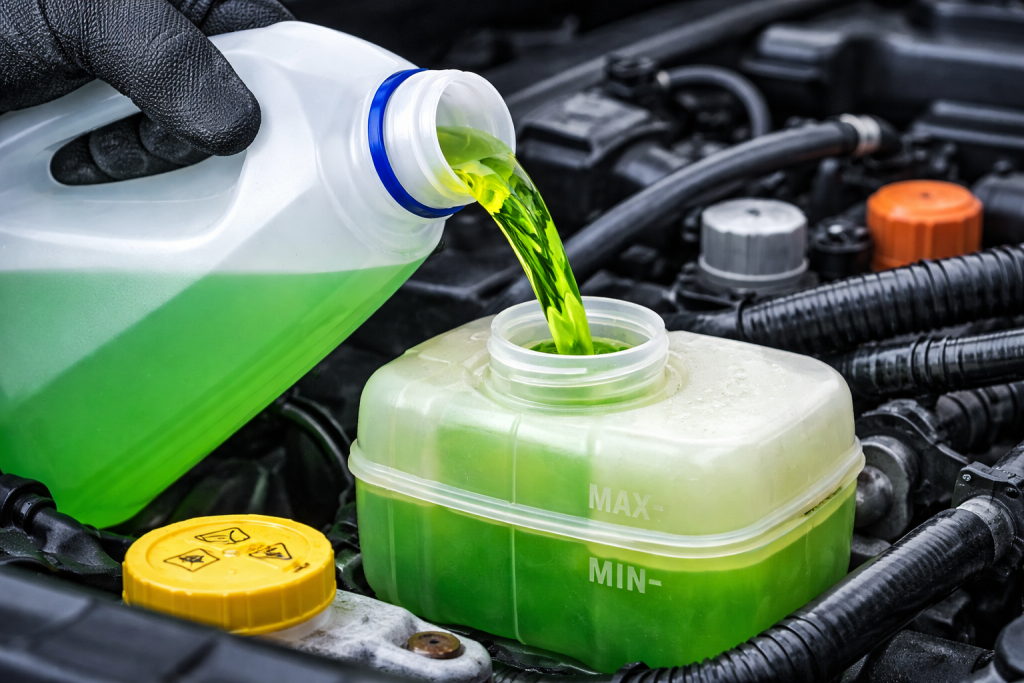
Top-up must be done cold engine and following the instructions provided for the vehicle.
1. Check the correct refrigerant
Don't choose the product simply based on the color.
Refrigerants of the same color may have different specifications, and products of different colors should not be automatically considered compatible or incompatible simply because of their appearance.
Check your car manual or the manufacturer's instructions.
2. Check if it is ready to use or concentrated
A ready-to-use coolant should not be treated as a concentrate.
If the product is concentrated, it must be prepared according to the instructions provided by the manufacturer and the vehicle.
3. Bring the level to the intended area
Don't just fill the tray to the brim.
Follow the references indicated on the tank and the manufacturer's instructions.
Can I top up with water?
For normal topping up, use the fluid recommended by the manufacturer.
Using water alone alters the concentration and protection offered by the refrigerant; emergency solutions are no substitute for properly restoring the circuit.
Can you drive with low coolant?
It depends on the level, the presence of leaks and above all the engine temperature.
There is no distance that can be considered safe in every situation.
If the temperature is normal and you simply find a level slightly below the reference, the situation is different from an engine that is already overheating.
When to stop
Stop as soon as it is safe to do so if:
- the temperature is above normal;
- the overheating light or warning appears;
- steam comes out of the engine compartment;
- you find a major leak;
- the engine shows obvious signs of overheating.
Do not open the circuit cap when it is hot.
When topping up isn't enough
If after having correctly reset the level the coolant starts to decrease again, the cause must be identified.
Have your car checked especially if:
- you have to top up repeatedly;
- you find liquid under the car;
- there are obvious leaks;
- the temperature continues to rise;
- a warning appears frequently;
- you can't figure out where the coolant goes.
A top-up restores the level. It doesn't fix a leak.
How much does it cost to fix the problem?
The cost depends on the cause.
A plug, hose, or small leak may require a relatively simple fix; water pump, radiator, or internal engine problems may require much more extensive work.
For this reason, it is more useful to identify the cause of the drop in level than to estimate the cost from the symptom alone.
Mistakes to avoid
Open the tank when the engine is hot
It is one of the most dangerous mistakes.
The hot circuit may be pressurized and cause the escape of high temperature liquid or steam.
Continue driving as the temperature rises
If your engine is overheating, continuing to drive can quickly make the problem worse.
Top up without looking for the cause
If the level continues to decrease, adding more fluid will not solve the problem.
Choose the refrigerant only by color
Check the specification required by your car.
Mixing products without checking their compatibility
Not all refrigerants are designed to be mixed with each other.
What to keep in the car?
Compatible coolant
Keeping a small amount of the coolant provided for your car can be helpful, especially when traveling.
The key thing is to check the correct specification, don't just buy it based on the color.
HELPFUL TIP

Compatible coolant
See on Amazon →
Funnel for refilling
If access to the reservoir is difficult, a small funnel can help you top up without spilling fluid into the engine compartment.
HELPFUL TIP

drip funnel
See on Amazon →
In summary
The low coolant It should not be ignored, especially if the level continues to decline.
Check it with a cold engine and look for any leaks before considering the problem solved with a simple top-up.
If the temperature rises above normal, an overheat warning appears, or steam comes from the engine compartment, stop safely.
If you have to top up repeatedly, you need to identify the cause of the drop in level.

FAQ – Frequently Asked Questions
Where do you check the coolant?
Normally in the expansion tank of the cooling system, where the MIN and MAX references are located. The check must be carried out according to the manufacturer's instructions and with a cold engine.
How long does coolant last?
The replacement interval depends on the type of refrigerant and the maintenance schedule provided by the manufacturer.
Check your car's manual or maintenance schedule.
Why is the coolant dropping but I don't see any leaks?
A leak may be small, occur only when hot, or be located in an inconspicuous spot. If the level continues to decrease without any obvious cause, it's a good idea to check the circuit.
Can the air conditioner stop cooling if the engine coolant is low?
It's not a reliable indicator on its own. If the engine reaches abnormal temperatures, the A/C's operation may be affected, but a lack of cooling can have many other causes.
Can I top up the coolant myself?
If you know the correct product and procedure for your car, a routine top-up can be simple.
Only do this with a cold engine.
Can I use water instead of coolant?
For normal use, the mixture recommended by the manufacturer should be maintained. Water alone does not offer the same characteristics as the correct coolant.
Is it normal to top up the coolant frequently?
A level that requires frequent top-ups deserves a check. You need to understand where the fluid is going instead of simply continuing to add it.
Conclusion
A low level does not automatically mean that the engine has already suffered damage, but it should not be ignored.
Check the coolant when the engine is cold, use the product recommended for your car, and see if the level starts to drop again.
If a low level is accompanied by an abnormal temperature, an obvious leak, or an overheating warning, the priority isn't getting to your destination: it's preventing a cooling system problem from becoming more serious.


 Italian
  English