

What you will learn:
- why does the radiator fan always stay on
- when it is normal behavior
- What faults can cause the problem?
- What to check before going to the workshop
- How much could the repair cost?
If you just turned off your car and still hear the fan running, you probably don't notice.
But if the fan keeps running for a long time, starts as soon as you start the engine, or seems to never turn off, it's normal to start worrying.
Will the battery run out?
Can I continue driving?
Is something breaking?
In most cases it is not an emergency, but it is a sign that should not be ignored.
Understanding the cause early can avoid more costly breakdowns and overheating problems.
Immediate response
If the radiator fan stays on all the time, the most common causes are a faulty temperature sensor, a stuck relay, a problem with the control unit, the air conditioning running, or an engine running at constant high temperatures. In some cases, this behavior is normal; in others, it may indicate a fault requiring inspection.
How to understand if the fan is always on due to a fault
The fan may have a problem if:
- cold engine start
- continues to spin for a long time after switching off
- It always remains active even in winter
- the battery tends to run out
- a warning light appears on the dashboard
Index
The 5 most common causes
In most cases the problem depends on:
- Defective temperature sensor
- Fan relay stuck
- Control unit receiving incorrect data
- Active climate control
- Problems in the cooling system
Starting from these checks often allows you to quickly identify the cause without replacing components unnecessarily.
Is it normal for the radiator fan to be always on?
It depends on the situation.
If you've just parked after a long summer trip, it's normal for the fan to continue running for a few minutes.
The same can happen on particularly hot days or after long traffic jams.
However, it is not normal when:
- the fan starts immediately when the engine is cold
- It stays on continuously while driving
- continues to work for a long time after being turned off
- It also activates in winter for no apparent reason
In these cases it is advisable to do some checks.
Why does the radiator fan always stay on?
Faulty temperature sensor
It is one of the most common causes.
The sensor communicates the engine temperature to the control unit.
If it sends incorrect values, the ECU may believe that the engine is overheated and keep the fan constantly on.
👉 If a warning light appears on the dashboard, also consult the guide on engine temperature light on.
Fan relay stuck
The relay is the component that turns the fan on and off.
When it gets stuck or blocked, the fan continues to receive power.
Control unit problem
Rarer but possible.
The control unit may misinterpret the data received from the sensors and keep the fan always on as a safety measure.
Air conditioning on
Many cars automatically turn on the fan when the air conditioning is on.
Before worrying, check that the air conditioning is not set to automatic mode.
Inefficient cooling system
A dirty radiator, deteriorated coolant, or a faulty thermostat can cause the fan to run continuously.
👉 You might also be interested in the guide on:
A very common example
Many drivers notice that the fan runs almost continuously during the summer.
The reason is often not a fault.
If the radiator is partially blocked by dirt or insects, the fan must work more often to compensate for the reduced cooling capacity.
For this reason, a simple system cleanup can solve the problem.
How to check the cause of the problem
A simple check you can do yourself
If the fan starts immediately when the engine is cold, try turning off the air conditioning completely and restarting the engine. If the fan continues to run even without the air conditioning, the problem may be related to sensors, relays, or the control unit.
Check the engine temperature
If the temperature remains stable and normal, the problem could be electrical.
Check the air conditioning
Turn off the air conditioning completely and see if the fan continues to run.
Check the coolant
An insufficient level can alter the functioning of the cooling system.
👉 Read also Low coolant: symptoms and risks.
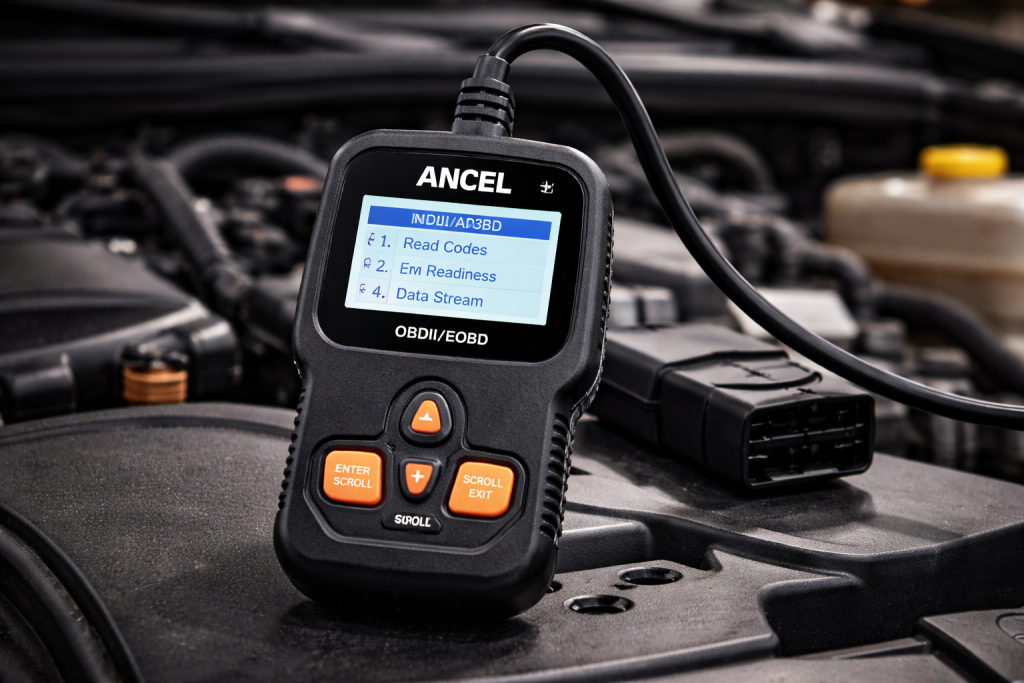
Perform an OBD diagnosis
A diagnostic scanner can quickly locate any errors stored by the ECU.

What to do now
If the engine temperature is normal:
- monitor fan behavior
- check the coolant level
- check the operation of the air conditioning
- perform an electronic diagnosis
If the temperature is high:
- reduce the load on the engine
- avoid heavy traffic
- schedule a checkup as soon as possible
What NOT to do
Do not disconnect the fan
Some drivers think they can solve the problem by unplugging the connector.
This is a bad idea.
You could end up with an overheating engine with no protection.
Don't ignore the problem for weeks
Even if the car appears to be operating normally, a fan that is always on could be hiding a more serious fault.
Don't replace components at random
Many start by changing the sensor, then the relay, and finally the fan.
A correct diagnosis costs much less.
Useful products to identify the problem
Bluetooth OBD2 Scanner
Digital multimeter

Coolant

When it is dangerous to continue driving
The fan always on is not dangerous in itself.
However, you should get checked if you also notice:
- high engine temperature
- abnormal battery consumption
- air conditioner that cools poorly
- engine lights on
- coolant leak
👉 If a warning light appears, also consult the guide on engine temperature light on.
How much does the repair cost?
Temperature sensor
From 30 to 120 euros.
Fan relay
From 15 to 60 euros.
Electronic diagnosis
From 30 to 80 euros.
Complete fan
From 150 to 700 euros.
Control unit
From 200 euros and up, depending on the model.
In most cases, the problem is with sensors or relays and does not require a complete fan replacement.
For this reason, it's always advisable to perform a diagnosis before purchasing replacement parts. Many drivers replace the fan without fixing the problem because the real cause was a faulty sensor or relay.
Attention
Never disconnect the radiator fan to temporarily eliminate the problem.
The fan is one of the components that protects the engine from overheating and turning it off can cause very expensive damage.

FAQ - Frequently Asked Questions
Can the radiator fan stay on after turning off the car?
Yes. After long journeys or high temperatures it can continue to work for a few minutes.
Does a constantly running fan drain the battery?
It may help to unload it if it continues to run for abnormal times.
Can the air conditioner turn on the fan?
Yes. On many cars this is normal behavior.
Can I drive with the fan always on?
Generally yes, but it is advisable to identify the cause as soon as possible.
Can a faulty control unit keep the fan running all the time?
Yes, although it is a less common cause than sensors and relays.
Why does the fan start as soon as I start the engine?
If the fan activates immediately even with a cold engine, the problem may be caused by a faulty temperature sensor, a stuck relay, or a fault in the control unit that activates the protection mode.
In some cases the problem can also be linked to a radiator fan not working properly, which causes the temperature management system to fail.
Does a radiator fan that's always on increase fuel consumption?
Yes, although to a limited extent. A continuously running fan increases the load on the electrical system and can slightly impact fuel consumption, especially on urban journeys.
Conclusion
A radiator fan that is always on does not necessarily mean that the engine is about to break down.
Most often the problem is a sensor, a relay, or a simple fault in the cooling system.
Identifying the cause quickly allows you to avoid unnecessary expenses and keep your engine in top condition.
You may also be interested in
If you're experiencing engine temperature, cooling, or air conditioning issues, these guides can help you quickly pinpoint the cause of the problem.
👉 Car radiator fan not working: symptoms, causes, and what to do immediately
👉 Car overheating: what to do immediately
👉 Low coolant: symptoms and risks
👉 Dirty car radiator: symptoms and solutions
👉 Car air conditioning not blowing cold air
Often a small check today can avoid a much more expensive repair tomorrow.


 Italian
  English