
Reading time: 9 minutes
Immediate response
If you suspect a faulty alternator, the most common symptoms are the battery warning light coming on while driving, weak or unstable lights, a frequently discharged battery, electrical anomalies, noises from the engine compartment or difficulty starting.
If the alternator stops charging properly, the car may continue to run temporarily on the energy remaining in the battery, but it may shut down when the battery runs out. There is therefore no certain number of kilometres to travel: The charging system should be checked as soon as possible.
What you will learn:
- What are the most common symptoms of a faulty alternator?.
- How to distinguish an alternator problem from a dead battery.
- What happens when the alternator does not charge.
- When it is risky to continue driving.
- What are the most common causes?.
- How to do a first check with the multimeter.
- When is it best to repair or replace the alternator?.
Index
A faulty alternator It can start with seemingly minor symptoms and only become apparent when the battery is no longer able to power the car properly. Recognizing the early signs helps distinguish a charging problem from a simple dead battery and avoid replacing components unnecessarily.
What is the alternator and what is it used for?
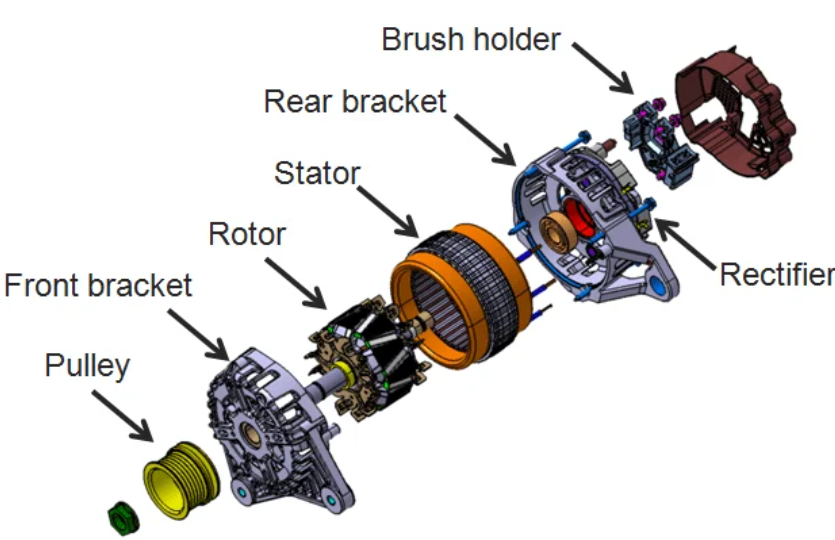
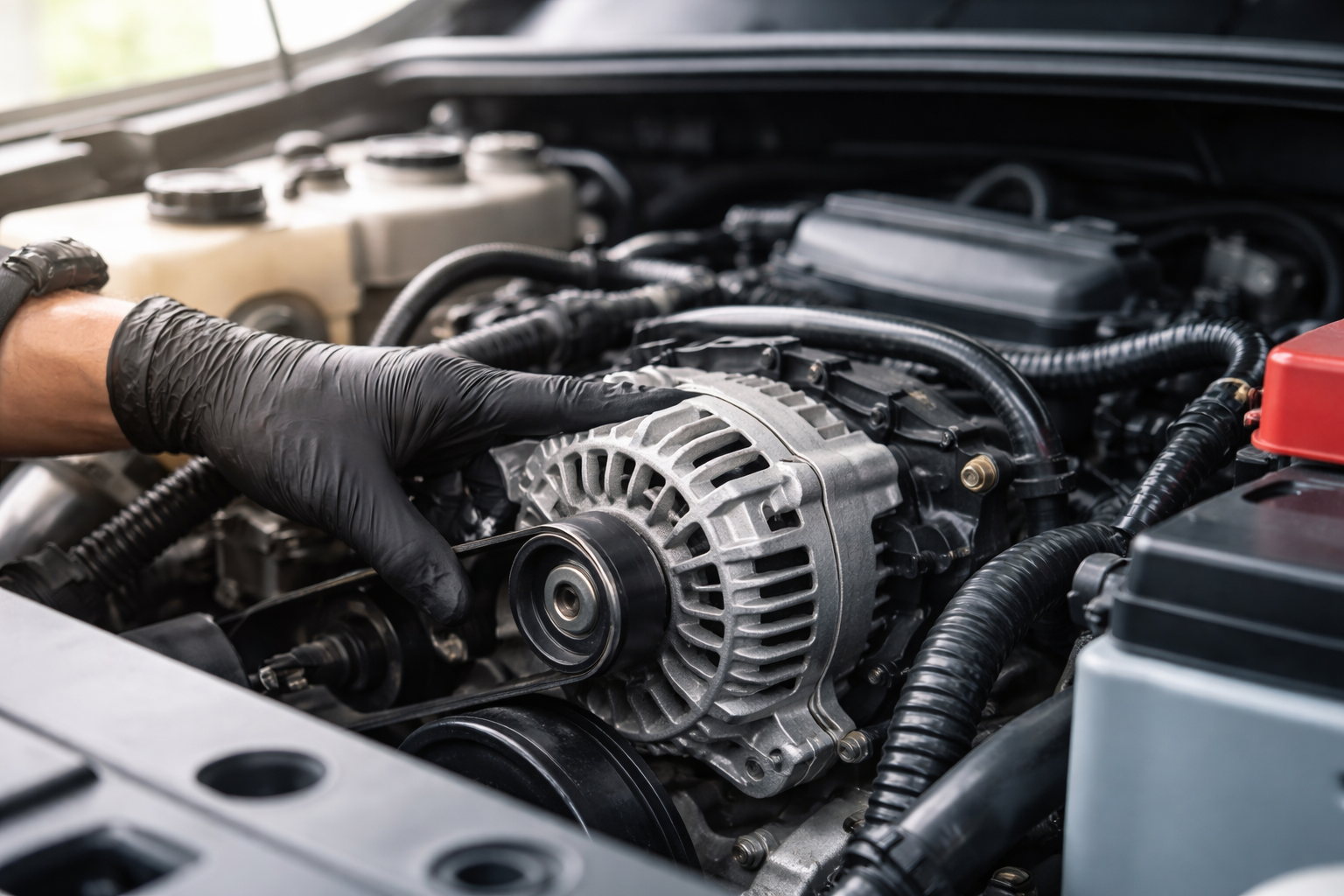
The alternator produces electrical energy while the engine is running and helps power the car's electrical systems and keep the battery charged.
It is powered by the engine, usually via the service belt. If the charging system malfunctions, the battery gradually loses charge, and electrical anomalies, warning lights, and starting difficulties may appear.
For this reason, an alternator problem does not only affect the battery, but can affect various systems in the vehicle.
Faulty alternator: most common symptoms
Here are the 7 most common symptoms of a faulty alternator that you shouldn't ignore:
1. Battery drains quickly
2. Weak or unstable lights
3. Battery light on
4. Difficulty starting the car
5. Metallic noises or whistling
6. Burning smell
7. Sudden electronic malfunctions
👉 Even just one of these signs can indicate a problem with the charging system.
Battery drains quickly
If your battery discharges frequently, the problem may not be the battery itself but an alternator that is not charging properly.
👉 If you recently changed your battery and it's discharging again, you should also check the alternator and charging system.
To understand how long a battery can last and what conditions can reduce its life, read also How long does a car battery last? Actual lifespan and signs.
Weak or unstable lights
When the alternator does not work well:
- the headlights become less bright
- the interior lights are dimmed
- the intensity varies as you drive
This happens because the current is no longer stable.
Battery indicator light on
The battery warning light on the dashboard indicates a problem with the charging system.
If it stays on with the engine running:
👉 If it stays on with the engine running, it generally indicates a problem in the charging system. The alternator is one possible cause, but the problem could also depend on the connections, belt, regulator, or other components.
If you want to understand all the meanings of the warning light and the checks to be carried out, consult the guide dedicated to the battery light on.
Difficulty starting the car
A faulty alternator does not recharge the battery, so over time:
- the engine struggles to start
- the car may not start at all
If the engine does not start and you are not sure if the problem is the alternator, read also Car won't start: all the most common causes.
Metallic noises or whistling
A faulty alternator can produce:
- whistles
- screeches
- metallic noises
This is often a sign of worn bearings.
Burning smell
In some cases, you may notice a burning smell coming from the engine compartment. This could indicate overheating or electrical problems within the alternator.
⚠️ The most dangerous signal
If, along with the charging system symptoms, the car begins to lose power or stalls while driving, the situation requires special attention. The battery may no longer have enough energy to properly power the vehicle's systems.
👉 In this situation, some electrical aids and electronic systems may stop working properly.
You must stop as soon as safely possible.
If the battery warning light also appears, check engine light, it is important to immediately understand the seriousness of the problem.
Faulty alternator: what to do immediately
If you suspect an alternator problem:
• reduce electricity consumption by turning off non-essential devices
• avoid long journeys
• check if the battery light stays on
• have your charging system checked as soon as possible
If your car shows multiple symptoms at the same time, it's best not to delay having it checked.
How to distinguish between a battery and an alternator
A dead battery and charging system problems can cause similar symptoms. Therefore, it's not a good idea to immediately replace the battery without checking the charging system first.
What happens if the alternator is broken?
If the alternator is no longer able to recharge, the car gradually uses the energy available in the battery. When the voltage becomes insufficient, electrical anomalies may appear and, eventually, the engine may stall.
It is not possible to predict precisely when this will happen: it depends on the battery charge, the vehicle and the active electrical consumption.
Here's what actually happens:
- the battery runs out while you're driving
- the lights are getting dimmer and dimmer
- electrical accessories stop working
- the engine may stall suddenly
👉 In modern cars, even power steering and electronic systems can fail, making driving dangerous.
When it is dangerous to continue driving
The situation becomes potentially dangerous when:
• the battery light stays on for several minutes
• the lights dim visibly
• power steering becomes harder
• multiple lights appear at the same time
• the engine starts to misfire
In these cases it is advisable to stop in a safe place as soon as possible.
If the engine warning light comes on in addition to the battery warning light, it's important to quickly determine whether it's a simple electronic error or a problem that could compromise the vehicle's safety. Learn more in the guide. Engine light on: when to really worry.
How long can you drive with a broken alternator?
There is no safe distance. If the alternator isn't charging, range depends on the remaining battery charge and the car's power consumption. The vehicle may stall before reaching its destination.
If the battery warning light appears along with dim lights, electronic malfunctions, or other signs of power loss, it is prudent to safely stop and have the vehicle inspected.
There is no specific time: the car can turn off at any time.
If you want to learn more about the meaning of the warning light and understand when it is necessary to stop, consult the complete guide on Battery light on: what it really means and what to do immediately.
Why the alternator breaks: most common causes
An alternator can fail gradually or suddenly manifest the problem.
In most cases it is the result of wear and tear over time.
A faulty alternator can cause problems with control units, sensors, and electronic systems, especially in modern cars. If the voltage is irregular, it can cause abnormal warning lights, malfunctioning instruments, and malfunctions in assistance systems. Therefore, it's important not to ignore the first signs.
The most common causes are these.
Bearing wear
Inside the alternator are bearings that are constantly turning.
Over time, bearings can wear out and produce whistling, buzzing, or rattling noises coming from the alternator area.
Service belt worn out
The alternator is driven by the engine via the service belt. If the belt is worn, loose, damaged, or slipping, the alternator may not rotate properly and its charging capacity may be reduced.
Squeaking noises from the engine compartment or a visibly damaged belt therefore warrant an inspection.
In some cases, the problem isn't the alternator itself, but the belt itself. For more information, see the guide. Alternator belt: when to change it, symptoms and maintenance.
Broken voltage regulator
The regulator keeps the voltage stable.
If it breaks down, it can happen that:
the battery will not charge
the tension becomes too high
This can also damage other electronic components.
Extreme temperatures can exacerbate the problems of an already weakened alternator. Intense cold increases the effort required of the electrical system to start the engine, while high heat accelerates wear on internal components and can cause overheating. In either case, a device that is not perfectly efficient can stop working just when it is needed most.
For this reason, many failures occur suddenly during seasonal changes, when the vehicle is subjected to more demanding conditions than normal.
How to test the alternator with a multimeter
To determine if the alternator is working properly, the simplest method is to measure the battery voltage with a multimeter.
It's a quick check that you can do yourself.
For this check, a simple digital multimeter is sufficient: it can be useful for checking the battery voltage before and after starting.
HELPFUL TIP

Digital multimeter for cars
Useful for checking battery voltage and carrying out simple checks on the electrical system.
See on Amazon →
With the engine off, the battery voltage provides an initial indication of its state of charge.
After starting, on many conventional vehicles, the voltage increases as the alternator recharges. Actual values, however, may vary depending on the vehicle, temperature, and charging management strategy.
If the voltage does not increase, is very low, excessively high, or unstable, the charging system should be checked. Measuring with a multimeter alone does not necessarily identify which component is faulty.
How much does it cost to change an alternator?
The cost depends largely on the car model, the accessibility of the component, the type of alternator, and whether you choose a new, remanufactured, or repaired part.
In some cases, it's possible to repair only components such as the regulator, bearings, or brushes; in others, it's more cost-effective to replace the entire alternator. Therefore, it's important to accurately identify the fault before purchasing a replacement part.
If you want to understand how long a battery can last and what conditions accelerate its wear, read also How long does a car battery last? Actual lifespan and signs.
In summary
- Battery warning light, unstable lights, and frequent discharges may indicate a problem with the charging system.
- A faulty alternator can cause the battery to gradually discharge while driving.
- There is no safe number of miles you can drive on an alternator that doesn't charge.
- The battery and alternator can produce similar symptoms: they need to be checked before replacing components.
- Noises, burning smells or electrical anomalies require special attention.
Common mistakes that make the problem worse
• continue driving for days with the battery light on
• replace the battery immediately without checking the alternator
• ignore noises coming from the service belt
• use the car with a burning smell from the engine compartment
• postpone the diagnosis until the car stops

Frequently Asked Questions
How long can you drive with a faulty alternator?
There's no safe distance. It depends on the battery charge and electricity consumption; if the alternator isn't charging, the car can stall when the available energy becomes insufficient.
Can the car shut down due to broken alternator?
Yes. If the charging system does not power the vehicle properly, the battery will gradually lose charge and the engine may eventually stall.
What are the symptoms of a bad alternator?
Common signs include an illuminated battery warning light, unstable lights, frequent discharges, electrical anomalies, noises from the engine compartment, and difficulty starting.
How to tell if it's the battery or the alternator?
Symptoms may overlap. If the battery continues to discharge or electrical problems arise while driving, it's important to also check the charging system.
Can a faulty alternator drain a new battery?
Yes. If the charging system isn't working properly, even a new battery can gradually lose its charge.
How long does an alternator typically last?
There's no specific lifespan for all cars. It depends on the component, the vehicle, the conditions of use, and the wear and tear of its internal components.


 Italian
  English