
Reading time: 9 minutes
Immediate response
If the 12V Ford Kuga PHEV battery It often discharges, on our 2021 Kuga we solved it by installing a 70 Ah Varta A7/E39 AGM.
On our 2021 Ford Kuga PHEV, the Varta A7/E39 AGM 70Ah battery fit in the original compartment. The Ford bracket already had a second mounting hole, the cables arrived unmodified, and the vent hose could be connected. After installation, we performed a BMS reset with FORScan and the Vgate vLinker adapter.
What you will learn:
In this guide you will see:
- because we replaced the original battery;
- why we chose a 70 Ah AGM;
- how we checked compatibility;
- how we mounted the battery, bracket and vent;
- how we did the BMS reset with FORScan;
- What checks to do before closing the compartment.
Index
If the 12V battery in your Ford Kuga PHEV is frequently discharging, you're not alone. We also encountered this problem on our 2021 Kuga 2.5 Plug-in Hybrid and resolved it by replacing the original battery with a 70 Ah AGM battery, personally checking compatibility, installation, and BMS reset with FORScan.
Why we replaced the 12V battery on the Ford Kuga PHEV
Our 2021 Ford Kuga PHEV is mostly used for short trips.
On some occasions, the car sat for a week, and more rarely, even longer. The original 12V battery would drain enough to require a booster.
The first battery had already been replaced under Ford warranty, but the problem recurred.
For this reason we decided to replace the original 45 Ah battery with a more capacious solution.
Even on a plug-in hybrid, the 12V battery remains essential. It powers control units, locks, electronic systems, and the procedures needed to put the car into READY mode.
When the voltage is too low, the Kuga may not start properly even if the traction battery is charged.

If the battery runs out often, also read the guide dedicated to Why does the 12V battery on the Ford Kuga PHEV run out?.
👉 Further information: If the battery continues to discharge, before replacing it, also read Why does the 12V battery on a Ford Kuga PHEV die? 7 things to check.
Which AGM battery did we choose for the Ford Kuga PHEV?
We have chosen one:
Varta A7, previously also referred to as E39, AGM 70 Ah and 760 A.
The original battery fitted to our Kuga was 45 Ah. The new Varta therefore offers significantly higher capacity.
The choice was not made by checking only the ampere-hours.
Before purchasing we checked:
- dimensions of the compartment;
- available height;
- position of the poles;
- cable length;
- fixing base;
- vent position;
- space needed to close the cover.
This check is important because on the Ford Kuga PHEV the 12V battery is not located in the engine compartment.
It is installed in the rear, under the trunk floor.
Why we preferred an AGM battery
We chose an AGM to have a greater energy reserve and a battery more suitable for withstanding frequent charge and discharge cycles.
In our case, the problem occurred mainly after periods of disuse or limited use of the car.
Going from 45 Ah to 70 Ah increases the available margin, but does not automatically eliminate all possible causes of discharge.
If there is an abnormal draw, a module that does not go into sleep mode, or a problem with the charging system, a separate diagnosis is required.


Varta A7/E39 AGM – 70 Ah, 760 A
Do you want to understand why we chose an AGM battery? Discover all the differences between AGM and EFB, when it is better to choose one or the other and what are the advantages and disadvantages of each technology.
Varta A7/E39 AGM – 70 Ah, 760 A
This is the model we actually installed on our 2021 Ford Kuga PHEV.
Why we chose this model for our Kuga:
- higher capacity than the original battery;
- AGM technology;
- dimensions compatible with the space being checked;
- pole position suitable for our assembly;
- side connection for the vent pipe.
Before purchasing, always check:
- measurements of the battery in your car;
- position of the poles;
- fixing bracket;
- cable length;
- compartment configuration.
Does the Varta A7 70 Ah fit in the original compartment?
On our 2021 Ford Kuga PHEV, yes.
The Varta A7/E39 fit into the bay without modifying the bodywork, cutting trim or extending cables.
The most important check concerned the fixing bracket.
The original Ford bracket already had a second hole
The Varta 70 Ah is longer than the original battery.
On the Ford bracket, however, we found a second fixing hole, positioned approximately 70 millimetres further forward than the one used for the smaller battery.
It was then possible to move the clamping block and secure the new battery correctly.
We didn't have to:
- drill the bracket;
- build handmade supports;
- cut metal parts;
- block the battery with improvised systems.
This detail made the assembly much cleaner and safer.

Do the original cables reach the terminals?
In our case, yes.
The positive and negative cables reached the poles without extensions and without being pulled.
Before tightening we checked that:
- the terminals entered completely onto the poles;
- the cables were not under tension;
- no connections touched metal edges;
- the sensor on the negative pole remained in its original position.
The sensor connected to the negative is part of the battery monitoring system and must not be moved or bypassed.
👉 Related guide: Before you buy a new battery, find out How to check the 12V battery of your Ford Kuga PHEV with FORScan to check if the problem really depends on the battery or the charging system.

How we replaced the 12V battery on the Ford Kuga PHEV
The procedure described is the one actually performed on our 2021 Ford Kuga PHEV.
Before starting, we turned off the car completely, removed the key and left the vehicle stationary for a few minutes.
The operation requires caution because you are working on a heavy battery, in a confined space and near electronic wiring.
1. Accessing the battery compartment
We lifted the trunk floor and removed the polystyrene elements covering the compartment.
The battery is not immediately visible like in a traditional car.
It is best to remove each item in order, remembering its position and orientation.

2. Disconnecting the original battery
We have disconnected:
- the negative terminal first;
- then the positive terminal.
We then removed:
- vent pipe;
- fixing block;
- original battery.
Even a 45 Ah battery is heavy. Its location in the trunk makes lifting it less convenient than in an open engine compartment.
3. Test the new battery in the compartment
Before the final assembly we inserted the Varta into the compartment without connecting it.
We have verified that:
- the base rested correctly;
- the poles were oriented in the right direction;
- the bracket reached the second hole;
- the cables arrived without tension;
- the vent connection remained accessible;
- the battery did not interfere with the coatings.
Only after this test did we proceed with the fixing.
4. Fixing with the original bracket
We moved the clamping block to the second hole in the Ford bracket.
After tightening we tried to move the battery manually.
The battery must not:
- to scroll;
- to lean;
- lift off from the base;
- move during braking or on rough roads.

5. Connecting the terminals
We have connected:
- positive pole first;
- then the negative pole.
The clamps were inserted fully and tightened without excessive force.
After connecting, some messages may temporarily appear on the instrument panel. The control units must be reactivated after the power failure.
How to connect the AGM battery breather hose
The battery is located under the trunk floor, so the vent connection should not be overlooked.
The Varta A7 has side openings for ventilation.
We connected the original Ford hose to the fitting on the correct side of the battery.
Before closing the compartment we checked that the tube was not:
- folded;
- crushed;
- too tense;
- partially disconnected.
It is best to connect the vent before final tightening, because with the battery clamped the working space is reduced.

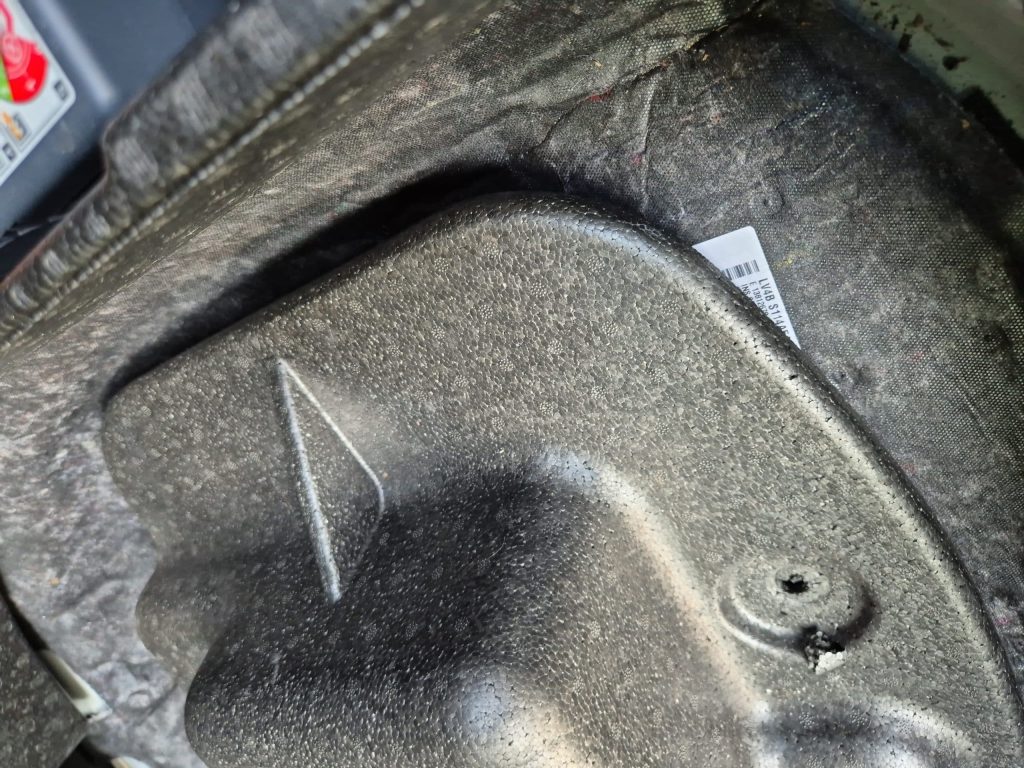
Does the compartment close with the 70Ah battery?
The battery fits into the compartment and the trunk floor can be refitted.
In our case, however, the polystyrene cover remained slightly raised in correspondence with the larger battery.
Before closing we checked that:
- no elements pressed on the terminals;
- the positive pole remained protected;
- the vent pipe was not crushed;
- the cables did not remain under pressure;
- the upper floor was stable.
This is an important detail.
A battery can fit in the compartment, but you also need to check what happens when the trunk cover and floor are reassembled.
Why we did the BMS reset
After the replacement we performed a reset of the Battery Monitoring System.
The BMS records the battery's health and behavior over time. If the battery is replaced without resetting this data, the system can continue to use parameters from the old unit.
The reset signals to the vehicle that a new battery has been installed.
For the procedure we used:
- Windows computer;
- FORScan 2.3.71;
- active FORScan license;
- Vgate vLinker OBD2 adapter;
- Ford Kuga diagnostic socket.
Resetting the BMS does not fix any current leaks and does not increase the power of the charging system.
However, it is used to reset the learning data relating to the previous battery.

Vgate vLinker MC+
OBD2 adapter used for BMS reset
Vgate vLinker compatible with FORScan
This is the adapter used during our diagnosis and reset of the Battery Monitoring System.
Why we used it:
- stable connection with FORScan;
- access to Ford forms;
- reading error codes;
- use of service procedures;
- compatibility with Windows computers.
To work with FORScan, it's important to choose a reliable adapter. Cheap, generic OBD2 devices can interrupt communication or fail to display all modules.
👉 Practical guide: Where is the OBD2 port on the Ford Kuga PHEV? Location and photos.
Where is the OBD2 socket located on the Ford Kuga PHEV?
The OBD2 socket is located under the dashboard, on the driver's side.
It is accessible from the bottom of the dashboard.
We connected the Vgate vLinker to the socket and then the computer to the adapter.

👉 Further information: If you've never used a diagnostic scanner, check out the complete guide Where is the OBD2 port on the Ford Kuga PHEV? Location and photos.
How we performed the BMS reset with FORScan
During the first tests we attempted to connect with the car in READY mode.
FORScan, however, did not complete the reading correctly.
With the ignition on and the car not in READY, the connection was successful.
Procedure actually performed
We have:
- connected the Vgate vLinker to the OBD2 socket;
- the ignition is turned on;
- FORScan started;
- connected the software to the vehicle;
- waiting for the forms to be read;
- opened the service procedures section;
- selected Battery Monitoring System reset;
- followed the instructions shown on the screen;
- waiting for completion message;
- Restarted the module when prompted.
The procedure was completed successfully.


Modules detected during diagnosis
During the connection FORScan detected several modules, including:
- PCM;
- PSCM;
- BdyCM;
- system linked to the DC-DC converter.
The list may vary depending on the car year, configuration, FORScan version, and the adapter used.
During the BMS reset it is best not to change other configurations unless you know their exact function.
👉 Read also: How to Check the 12V Battery on a Ford Kuga PHEV with FORScan, where you can find the connection details, the detected modules, the DC/DC converter and how to read the error codes.
Checks performed after replacement
Before completely closing the compartment we carried out some checks.
Stable battery
The battery did not move sideways and could not lift from the base.
Tightened clamps
The clamps did not rotate on the poles and the cables were not under tension.
Connected vent
The tube was inserted correctly and was not pinched.
Free cables
No cables were pressed by the Styrofoam covering.
Regular system startup
After connecting, the Kuga entered READY mode regularly.
We also used FORScan to check for any errors.
Some codes may appear simply because the battery has been disconnected. Before clearing them, it's best to read them and determine if they're related to the repair.
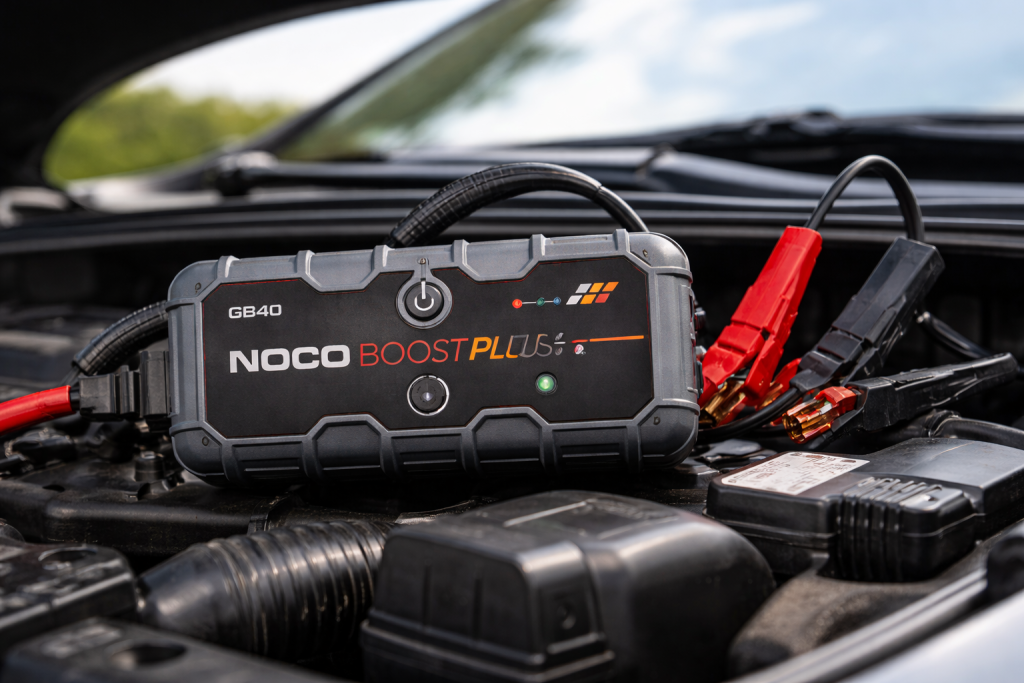
12V Battery Emergency Booster
A compact booster can be useful when the 12V battery is too low to activate the Ford Kuga PHEV's systems.
In our case, the booster was needed several times before the original battery had to be replaced.
Features to look for:
- reverse polarity protection;
- insulated pliers;
- charge status indicator;
- hard case;
- dimensions suitable for the trunk;
- compatibility with petrol engines.
The booster is an emergency tool: it does not replace the diagnosis of the cause of the battery discharge.
What has changed with the 70 Ah AGM battery
Our goal was not to increase the performance of the car.
We wanted to achieve greater energy reserves during periods of non-use and when used mainly for short journeys.
With 70 Ah the margin is greater than with the original 45 Ah battery.
This does not mean that the battery can no longer discharge.
Even a larger AGM can lose energy if:
- the car remains stationary for a very long time;
- there is abnormal absorption;
- a control unit does not go into suspension;
- DC-DC system not charging properly;
- the battery is never charged enough.
The main advantage is having a battery with a higher reserve and less close to its limit during daily use.
Long-term behavior will be evaluated based on actual use of the car.
👉 If your battery continues to run out in the future, also consult the guide: Why does the 12V battery on a Ford Kuga PHEV die? 7 things to check.
Mistakes to avoid
Check only capacity and inrush current
Ahs are not enough.
You also need to check the dimensions, poles, fixing, height, venting and length of the cables.
Place the battery without fixing it
A 70Ah battery is heavy and must remain completely locked.
Ignore the vent pipe
The battery is located in a closed compartment under the trunk. The connection must be properly reconnected.
Pull the cables to reach the poles
The cables must arrive without tension and without forcing terminals or sensors.
Close without checking the cover
The cover must not press on the clamps, cables or vent pipe.
Skip BMS reset
After replacement, it is advisable to register the new battery in the monitoring system.
Change other functions in FORScan
FORScan provides access to numerous parameters. It's best to limit this procedure to the necessary reset.
Is the Varta A7 compatible with all Ford Kuga PHEVs?
We can only confirm what we have verified on our 2021 Ford Kuga 2.5 Plug-in Hybrid.
On our car:
- the Varta A7/E39 70 Ah entered the compartment;
- the bracket had a second compatible hole;
- the original cables were long enough;
- the vent pipe could be connected;
- BMS reset completed with FORScan.
On another Kuga PHEV it is still necessary to check the compartment directly.
Ford may have used different batteries, brackets, or trims depending on year, market, and trim level.

FAQ - Frequently Asked Questions
Which battery did we install on the Ford Kuga PHEV?
We installed a Varta A7/E39 AGM 70Ah 760A battery in our 2021 Ford Kuga PHEV.
Does the 70Ah battery fit in the original compartment?
On our car, yes. We used the second hole already present on the Ford bracket.
Do I need to modify the cables?
Not in our case. The positive and negative cables reached the poles without extensions.
Does the vent hose need to be connected?
Yes. The battery is located under the trunk floor and the original hose must be restored.
Is a BMS reset necessary?
After replacing the battery, it's a good idea to notify the Battery Monitoring System that the battery is new. We performed the reset using FORScan.
Which OBD2 adapter did we use?
We used a Vgate vLinker connected to a Windows computer running FORScan.
Does FORScan connect with the Kuga in READY mode?
During our test, the connection didn't work properly in READY mode. However, with the ignition on, FORScan read the modules correctly.
Does an AGM battery permanently solve discharges?
No. A larger battery provides more reserve, but any abnormal power draw or charging problems must be diagnosed separately.
In summary
On our 2021 Ford Kuga PHEV we replaced the original 45 Ah battery with a 70 Ah 760 A Varta A7/E39 AGM.
The new battery fit into the original compartment without modifying the bodywork or wiring.
The Ford bracket already had a second mounting hole. The breather hose was connected, and after installation, we performed a BMS reset using FORScan and the Vgate vLinker adapter.
The most important detail is not just the increased capacity.
It is having actually checked compatibility, fixing, wiring, coverage and diagnostics on the car.
Conclusion
This guide documents a personal service performed on a 2021 Ford Kuga 2.5 Plug-in Hybrid. The compatibility checks, photographs, and screenshots are from the vehicle used for the test drive. Before working on another vehicle, it is necessary to directly check the configuration and installed components.
This guide shows how to replace the 12V Ford Kuga PHEV battery with a real case documented step by step.


 Italian
  English