

Reading time: 5 minutes
Immediate response
To understand if the problem is the battery or alternator, observe above all when the defect appears.
If your car struggles to start after a stop, the engine turns slowly, or you frequently need jump leads and boosters, the battery is one of the first things to check.
If the car starts but the battery warning light appears while driving, the lights become dim or electrical anomalies begin, the problem may be the alternator or charging system.
Confirmation comes by checking the battery and charging: Replacing a component based on symptoms alone may mean replacing the wrong part.
What you will learn:
- How to distinguish battery and alternator symptoms.
- What signs to check when starting.
- What to look for with the engine running.
- How to do a first check with the multimeter.
- Because a new battery can continue to discharge.
- What mistakes to avoid in diagnosis.
Index
Battery or alternator: how to understand where the problem lies
The battery and alternator work together, but have different tasks.
La battery It provides the energy needed primarily to start the engine and powers the electrical systems when the engine is off.
THE'’alternator, with the engine running, powers the electrical system and helps keep the battery charged.
And it is precisely this relationship that creates confusion.
A dead battery can make you think it's time to replace it, when in fact the real problem is that the alternator is not charging it properly.
Symptoms of a weak or bad battery
A battery problem often occurs when starting the car.
The most common signs are:
- slow starter motor;
- difficulty starting the engine;
- ticking when trying to start;
- dashboard lights dimming during start-up;
- frequent need to use cables or boosters;
- car that doesn't start after a stop.
If after a full charge the car works normally but, after a short time, the battery is discharged again, you need to understand why does it lose its charge.
This does not automatically mean that the battery needs to be replaced.
If you want to learn more about this case, read Dead car battery: causes and what to check before replacing it.
Symptoms of a failed alternator
An alternator problem tends to manifest itself instead even with the engine already running.
You may notice:
- battery light on while driving;
- headlights that change intensity;
- electrical system anomalies;
- battery that discharges again after being charged;
- electrical problems increasingly evident during the trip;
- engine that can shut down when the available energy runs out.
If the alternator stops charging, the car can temporarily continue to run using the energy remaining in the battery.
When this energy runs out, the vehicle can stop.
To learn more about the symptoms, read Faulty alternator: symptoms, causes, and how to tell if it's not charging..
Battery or alternator: the simplest check
Before even picking up the multimeter, when the problem appears can give a first clue.
| When the problem appears | First thing to check |
|---|---|
| Car struggles to start | Battery and connections |
| The scooter turns slowly | Battery and charge status |
| Battery warning light while driving | Charging system |
| Electrical anomalies with the engine running | Alternator and charging |
| Battery discharges repeatedly | Battery, charging and absorption |
This is just a preliminary indication. Similar symptoms can have different causes.

How to Check Your Battery and Alternator with a Multimeter
A multimeter allows you to carry out an initial check directly at the battery terminals.
Engine off check
After an adequate rest period, a well-charged lead-acid battery is generally found around 12.6 V.
A lower voltage may indicate a lower state of charge, but a single measurement is not enough to establish that the battery is faulty.
Temperature, recent car use and state of charge influence the value.
Check with engine running
Start the engine and measure the voltage again.
On many conventional vehicles the value increases compared to the measurement with the engine off and can be approximately in the area 13.5–14.8 V.
On modern cars with smart charging systems, however, the voltage can vary significantly depending on the conditions.
So the old rule:
“14 V = good alternator, less than 14 V = bad alternator”
It is not reliable in all cases.
The multimeter provides a first clue, not always a definitive diagnosis.
For an initial check of the battery and charging voltage, you don't need a complicated tool. A digital multimeter allows you to directly measure the voltage at the terminals and can also be useful for many other electrical checks on the car.
HELPFUL TIP
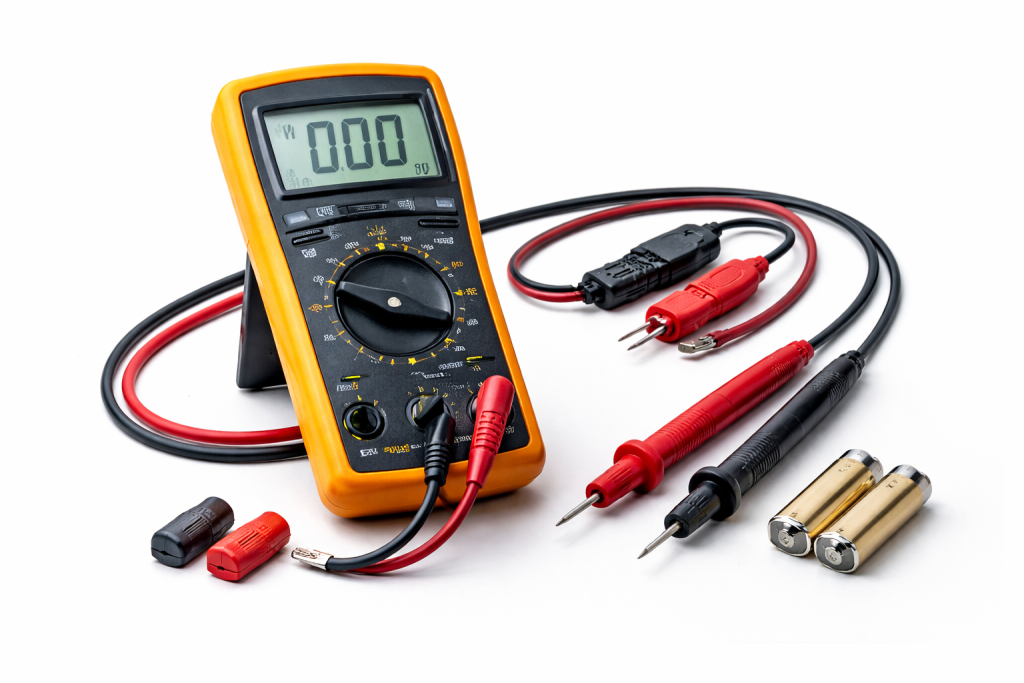
Digital multimeter for cars
Useful for checking battery voltage and carrying out simple checks on the electrical system.
See on Amazon →
New battery but car still dead: could it be the alternator?
Yes.
A new battery does not fix a charging system problem.
If the alternator does not properly replenish the energy used by the car, even a recently replaced battery can gradually discharge.
Continuing to recharge or replace the battery without checking the alternator means addressing the symptom rather than the cause.
If you suspect this problem, read Alternator not charging the battery: symptoms, causes, and checks to perform.
Good alternator but battery always flat: what to check?
The opposite case is also possible.
If the battery and charging system are working, frequent discharge may be due to:
- very short journeys;
- car left stationary for long periods;
- accessories that continue to draw current;
- control units that do not enter sleep mode correctly;
- faulty connections or grounds;
- abnormal absorption with the vehicle off.
So A dead battery does not automatically mean a bad battery.
Does the battery light indicate battery or alternator?
The symbol can be misleading.
La battery indicator light It doesn't simply mean "battery needs replacing." If it stays on with the engine running, it generally indicates a problem with the charging system.
The cause may be related to the alternator, voltage regulator, belt, wiring, or electrical connections.
For this reason, immediately replacing the battery after seeing that light can be a mistake.
Can you test the alternator by disconnecting the battery?
No. Don't do this on modern cars.
The old method of disconnecting a battery terminal with the engine running is not a recommended test.
The battery helps stabilize the electrical system and disconnecting it during operation can cause voltage variations that are potentially harmful to the vehicle's electronics.
For a first check, use a multimeter; for a complete diagnosis, properly check the charging system.
When the battery and alternator give similar symptoms
This is where the diagnosis can become tricky.
An alternator that charges poorly can cause a still-functioning battery to gradually discharge.
At the same time, a deteriorated battery can create voltage problems that suggest a fault in the charging system.
To avoid unnecessary substitutions, follow this sequence:
battery → terminals and grounds → charging system → alternator → any abnormal absorption.
Mistakes to avoid
- Change the battery immediately because the car won't start.
- Change the alternator just because the battery warning light appears.
- Consider a single voltage measurement as the definitive diagnosis.
- Disconnect the battery with the engine running.
- Ignore terminals, grounds and wiring.
- Forget that the battery can also discharge due to abnormal absorption.
In summary
To distinguish battery or alternator, first look at when the problem appears.
If the car is having trouble starting, first check the battery and connections. If problems appear while driving, the battery light stays on, or the battery isn't charging, the charging system needs to be checked.
A multimeter can provide useful information, but in modern cars, a single voltage isn't always enough to declare a component faulty.
Check first, then replace.

FAQ - Frequently Asked Questions
How to quickly tell if it's the battery or the alternator?
If the problem occurs primarily when starting, the battery is one of the first items to check. If the car starts but develops electrical problems while driving or the battery warning light stays on, the charging system should be checked.
If the alternator is faulty, will the car start?
It can start if the battery still has enough power. However, if the alternator isn't charging, the battery will continue to discharge while the car is running.
Can a new battery be drained by the alternator?
Yes. If the charging system isn't working properly, even a new battery can discharge.
If the battery measures 12 V is it good?
Not necessarily. The quiescent voltage provides an indication of the state of charge, but by itself it doesn't determine the battery's health.
Can I check the alternator with a multimeter?
Yes, a multimeter can be used to initially check the charging voltage. However, on cars with intelligent charging management, the values may vary and must be interpreted correctly.
Conclusion
The battery and alternator can produce similar symptoms, and replacing components on a trial-and-error basis can become costly.
Before buying a new battery or alternator, check when the problem occurs, the charging status, the connections and the operation of the charging system.
In many cases these checks already allow us to understand where to start the diagnosis.


 Italian
  English