

Reading time: 5 minutes
Immediate response
Where is the Ford Kuga PHEV battery located? The 12V battery is not installed under the hood, but under the trunk floor. To access it, you need to remove the carpet, the polystyrene cover, and the roof panel.
What you will learn:
- Where is the battery located?.
- How to get there.
- How to recognize the original battery.
- What is the BMS sensor and breather tube for?.
- What to check before closing the compartment.
Index
Where is the Ford Kuga PHEV battery located?
Many owners look for the battery under the hood, but on the Ford Kuga PHEV the location is different.
The Ford Kuga PHEV's 12V battery is located under the trunk floor. To access it, simply remove the carpet, the polystyrene cover, and the top panel protecting the battery compartment.

✔ Quick information
| Given | Value |
|---|---|
| Position | Trunk |
| Under the hood | ❌ No |
| Time needed | 5–10 minutes |
| Tools | 10mm and 13mm wrench |
| Difficulty | ⭐⭐☆☆☆ |
How to access the battery compartment
- Open the tailgate.
- Lift the trunk carpet.
- Remove the Styrofoam covering.
- Unscrew the protective panel.
- Lift the lid.

The original Ford battery
My 2021 Ford Kuga PHEV still had the original factory battery.
The main characteristics can be clearly read from the label:
- 12 Volts
- 45 Ah
- 390 A (SAE/EN)
This data is useful for identifying the installed battery and checking the compatibility of a possible replacement or a future upgrade to a higher capacity AGM battery.
If you are considering a battery upgrade, we recommend you also read AGM vs. EFB Batteries: Differences, Advantages, and Which to Choose, so you can choose the technology that best suits your Ford Kuga PHEV.
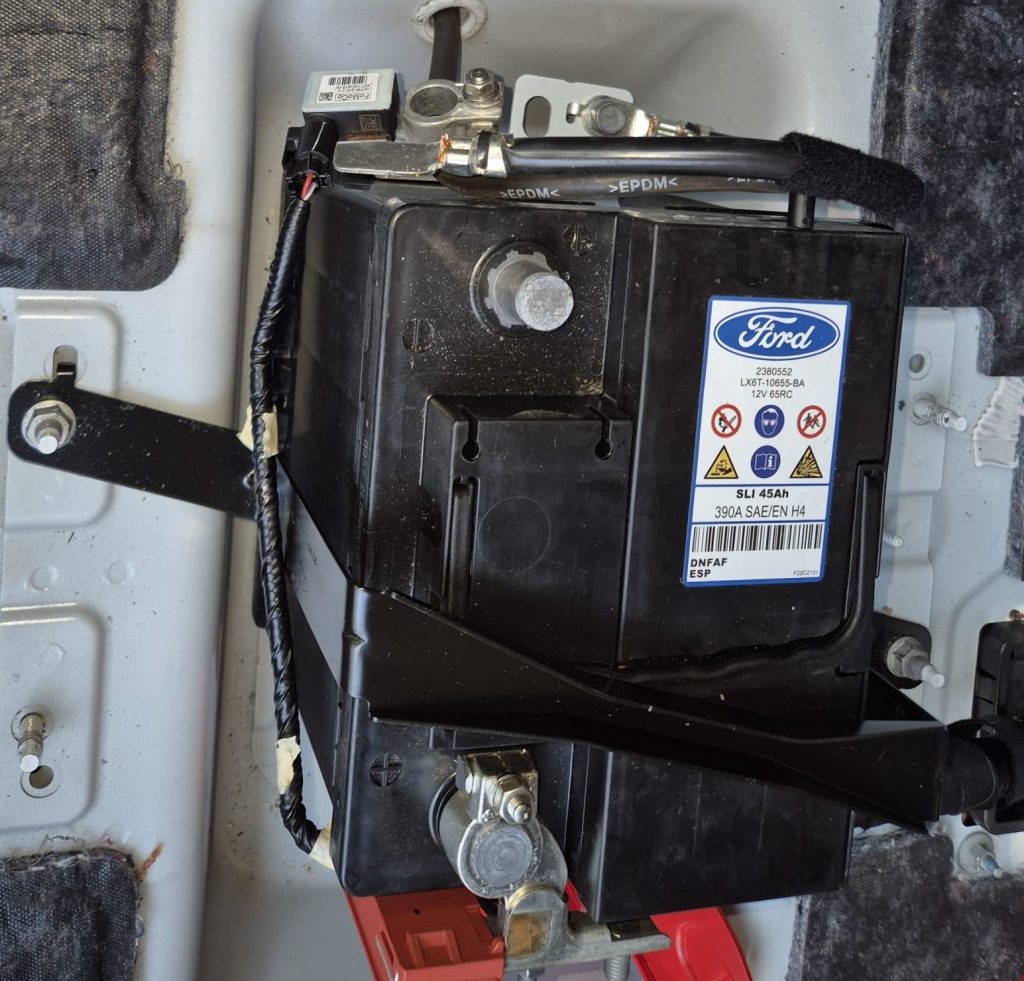
The components in the battery compartment
When the battery compartment is open, you can see some components that are essential for the correct functioning of the Ford Kuga PHEV's electrical system.
Knowing them is useful both during a simple check and before a future battery replacement.
BMS (Battery Management System) sensor
The sensor BMS (Battery Management System) It is installed on the negative terminal of the battery and constantly monitors parameters such as voltage, current, and state of charge. This information is sent to the vehicle's control units, which efficiently manage the electrical system.
During any work on the battery it is important to avoid impacts or damage to this component.
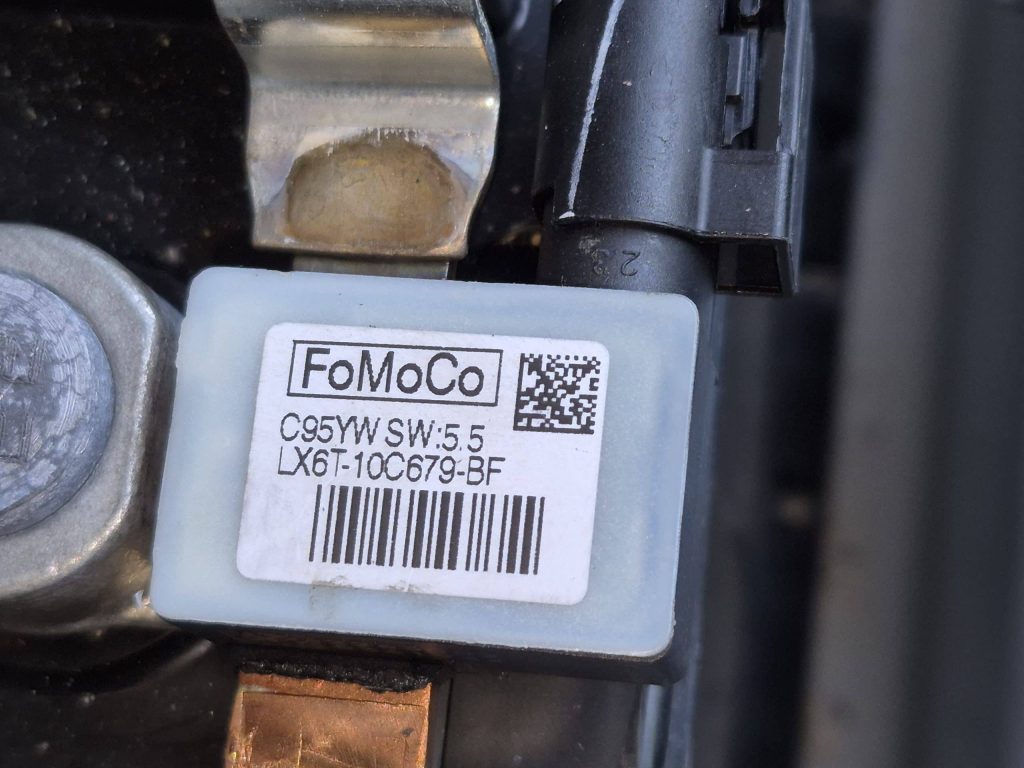
To check the battery status and monitor the BMS parameters you can follow our guide on How to check your Ford Kuga PHEV battery with FORScan
HELPFUL TIP

Vgate vLinker MC+ OBD2 Scanner
FORScan compatible OBD2 scanner, useful for reading battery parameters, checking the BMS and accessing the modules of the Ford Kuga PHEV.
Why it can be useful to you
- Compatible with FORScan
- Reading the Ford Kuga PHEV modules
- Checking battery and BMS parameters
See on Amazon →
Vent pipe
The battery uses a vent tube that vents any gases produced during operation.
When checking or replacing the battery it is important to make sure the hose is connected correctly.
Mistake to avoid
Always check that the vent pipe is inserted correctly and that any opposite hole is closed with the cap provided by the manufacturer.

Fixing bracket
The bracket holds the battery securely in place and prevents movement while driving.
If you install a battery with a different size in the future, always check the compatibility of the fastening system.

Main fuse
Next to the battery is the main electrical system fuse.
During a simple visual inspection it is not necessary to remove or manipulate it.
If you don't know where to connect the diagnostic scanner, please consult the dedicated guide. Ford Kuga PHEV OBD2 socket: where it is located and how to use it

Why is the battery in the trunk?
Ford chose this location for several reasons:
- better weight distribution;
- less exposure to engine heat;
- optimisation of the space available in the engine compartment.
This solution is common on many hybrid and plug-in hybrid vehicles, where the engine compartment houses numerous components of the propulsion system.
What to check when the compartment is open
Take advantage of the access to the compartment to check:
- terminal status;
- presence of any oxidation;
- correct battery attachment;
- vent pipe connection;
- integrity of the wiring.
If this is your first time using a diagnostic tool, you may also find it helpful to read OBD2 for cars: what it is, how it works, and how to read errors.
Check the battery properly
Before considering replacing the battery, it's worth checking whether it really needs replacing. A simple tester allows you to check the voltage and charge level in just a few minutes, avoiding unnecessary replacements.
HELPFUL TIP

12V Car Battery Tester
Checking your battery periodically can help you identify a drop in performance before your vehicle breaks down.
Useful features
- Checking the battery voltage
- Checking the state of charge
- Easy to use even for those with no experience
See on Amazon →
Useful tools for working on the drums
To access the Ford Kuga PHEV battery, all you need is a standard socket wrench set. Using the right tools makes removal easier and reduces the risk of damaging screws and terminals.
HELPFUL TIP

Ratchet socket wrench set
Ideal for removing battery clamps and fastening system during maintenance work.
Useful features
- Sizes suitable for the main fixings
- Greater convenience during disassembly
- Also useful for other maintenance work on the car
See on Amazon →
Article verified on real vehicle
Documented vehicle
- Ford Kuga 2.5 Plug-in Hybrid
- Year 2021
This guide is based on an actual job performed on the vehicle listed. The photographs used are original and document the battery compartment and its components, offering practical and verifiable information.
Note: The operations described in this guide were documented during a real intervention on a 2021 Ford Kuga 2.5 Plug-in Hybrid. Before working on the vehicle, always consult the owner's manual and follow the manufacturer's instructions.

FAQ - Frequently Asked Questions
Where is the battery in the Ford Kuga PHEV located?
The battery from 12V Ford Kuga PHEV It's located under the trunk floor. To access it, simply lift the carpet, remove the polystyrene cover, and remove the protective panel.
Is the battery of the Ford Kuga PHEV under the hood?
No. Unlike many conventional cars, the Ford Kuga PHEV's 12V battery is located in the trunk. The engine compartment is primarily occupied by the hybrid system components.
How long does it take to access the battery?
Under normal conditions, approximately 5-10 minutes. There is no need to dismantle any body parts: simply remove the covers in the trunk.
Can I check the battery without disconnecting it?
Yes. You can visually inspect the terminals for rust and measure the voltage with a tester without disconnecting the battery.
What is the BMS sensor used for?
The Battery Management System (BMS) Check the battery health by monitoring voltage, current, and charge level. If the battery is replaced, it is recommended to reset the BMS with a compatible diagnostic tool, such as FORScan.
Can I install an AGM battery instead of the original one?
Yes, as long as it's compatible with the available space and the vehicle's mounting system. After replacement, it's advisable to reset the BMS so the control unit can properly manage the new battery.
In summary
The Ford Kuga PHEV's 12V battery is located under the trunk floor and can be easily accessed in just a few minutes. Knowing its location and the components in the compartment allows you to perform safe checks and prepare for any maintenance.
Conclusion
Knowledge Where is the Ford Kuga PHEV battery located? It allows you to carry out checks and maintenance more easily and safely. As you've seen in this guide, the 12V battery is installed under the trunk floor and, once the covers are removed, you can easily check the condition of the battery, BMS sensor, breather hose, and other components in the compartment.
This guide is based on an actual intervention performed on a 2021 Ford Kuga 2.5 Plug-in Hybrid and uses original photographs to show you each step without resorting to generic images. If you want to learn more about the maintenance of your vehicle, on Consutil you can also find guides dedicated to Battery check with FORScan, to the BMS reset, at the Ford Kuga PHEV OBD2 socket and to the 12V battery replacement.


 Italian
  English