
Updated September 2026
Reading time: 5 minutes
Immediate response
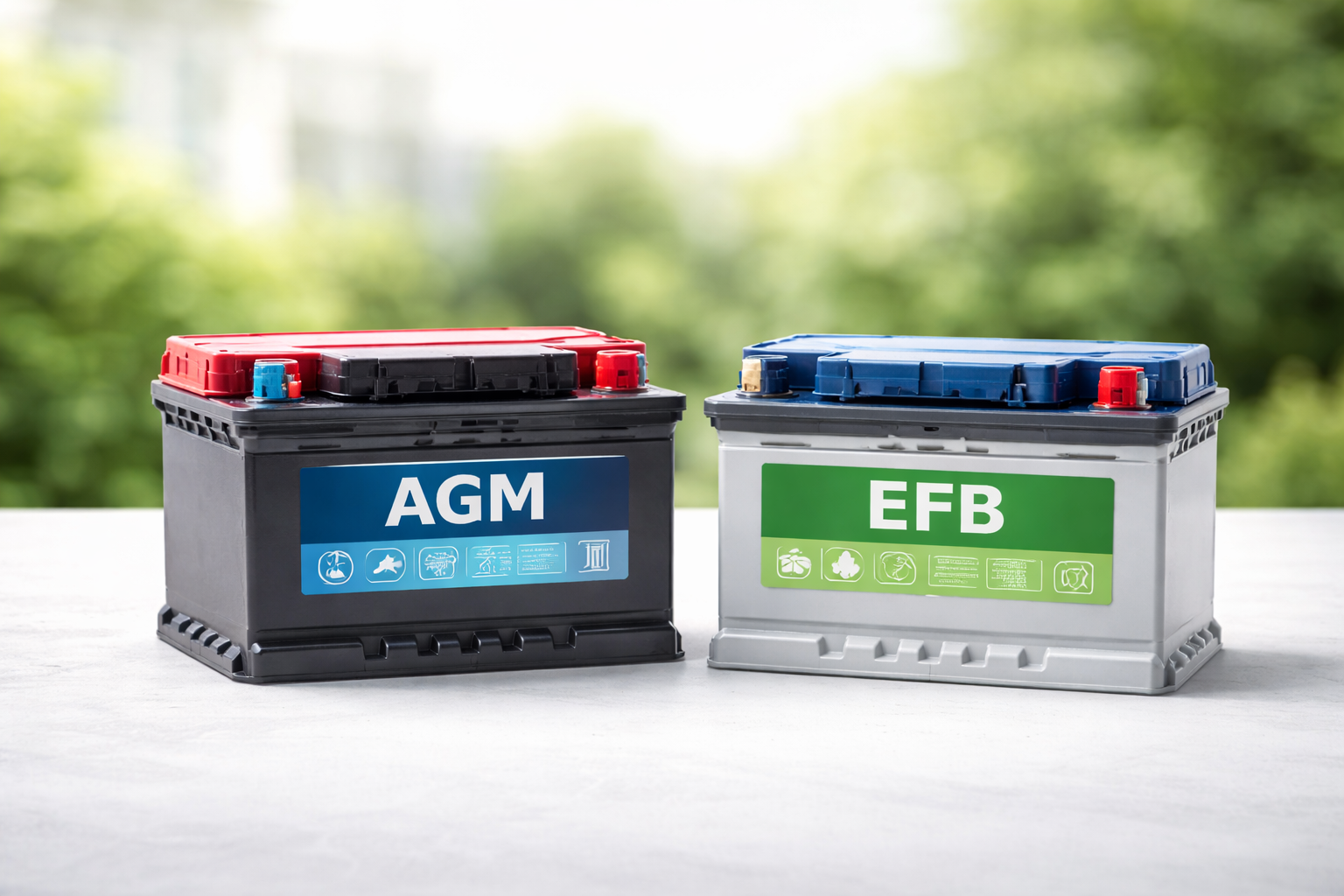
AGM vs. EFB Batteries? The first rule is to respect the technology provided for your car.
If the vehicle is equipped with a AGM, it is normally not worth replacing it with an EFB. If you have a EFB, switching to an AGM may be possible, but only if it is compatible with the charging system and the manufacturer's specifications.
In short: don't choose AGM just because it performs better or EFB because it costs less. Check what your car requires first.
What you will learn:
- What is the difference between AGM and EFB batteries?.
- When to choose AGM and when EFB.
- If it is possible to switch from EFB to AGM.
- What mistakes to avoid when replacing.
- When may it be necessary to register your new battery?.
Index
AGM and EFB: Why They're Not the Same Thing
Modern cars require much more energy than in the past.
In addition to starting the engine, the battery must power control units, sensors, infotainment systems, safety systems, and numerous electronic devices. On vehicles with Start&Stop, it must also withstand continuous shutdown and restart cycles.
For this reason, more resistant technologies are used than traditional lead batteries, especially EFB and AGM.
Both can be used on Start&Stop vehicles, but are not automatically interchangeable.
What is an EFB battery
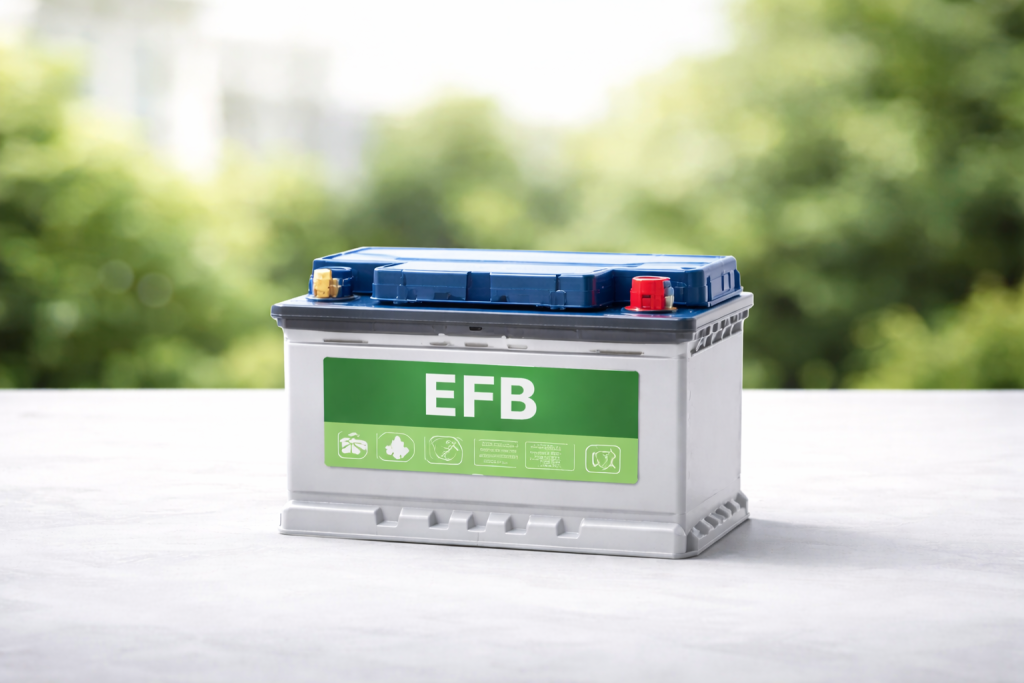
EFB means. Enhanced Flooded Battery.
It is an evolution of the traditional liquid electrolyte battery, designed to withstand a greater number of charge and discharge cycles.
EFB batteries are mainly used in cars with less demanding Start&Stop systems and with a not particularly high energy requirement.
Main advantages of EFB
- it generally costs less than an AGM;
- it withstands cycles better than a traditional battery;
- it is suitable for many Start&Stop systems;
- offers a good compromise between price and performance.
If your car originally came with an EFB, replacing it with another EFB of the correct specification is usually the simplest solution.
What is an AGM battery
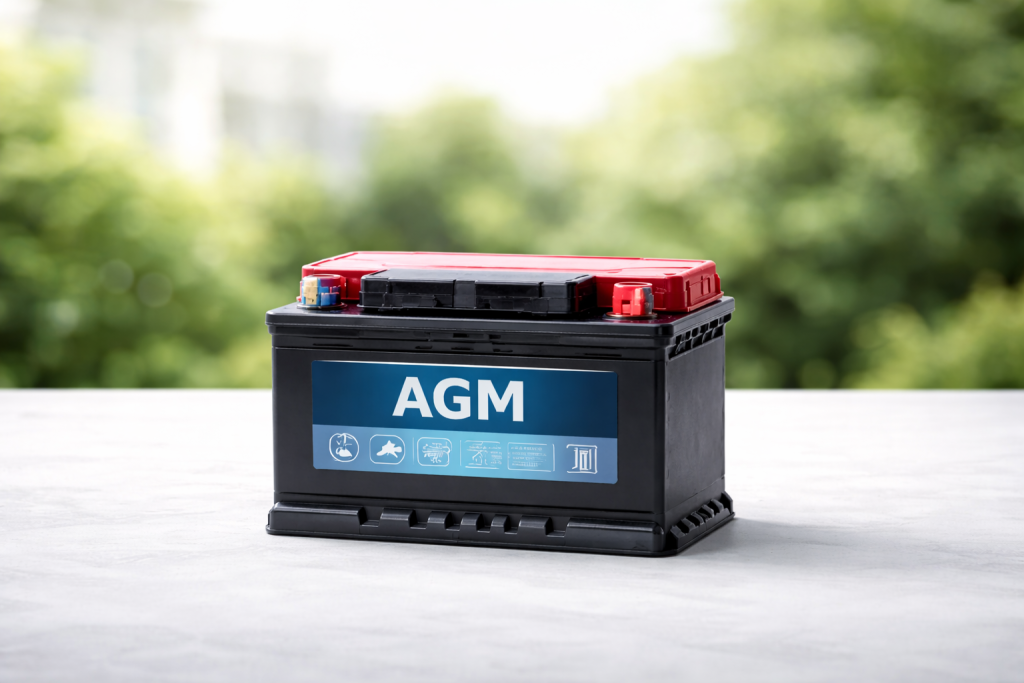
AGM means Absorbent Glass Mat.
In these batteries, the electrolyte is absorbed in special glass fiber separators instead of remaining free inside the battery.
This structure allows the AGM to better withstand frequent charge and discharge cycles and high energy demands.
AGMs are often used on vehicles with advanced Start&Stop, brake energy recovery, and numerous electrical devices.
Main advantages of AGM
- high resistance to charge and discharge cycles;
- good ability to supply high currents;
- suitable for more demanding electrical systems;
- increased resistance to vibrations;
- good voltage stability.
The advantage, however, comes at a cost: an AGM is normally more expensive than an equivalent EFB.
AGM or EFB battery: main differences
| Feature | EFB | AGM |
|---|---|---|
| Technology | Improved liquid electrolyte | Electrolyte absorbed in glass fiber |
| Cycle resistance | Good | Higher |
| Start&Stop | Yes | Yes, even more demanding systems |
| Energy demand | Average | High |
| Price | Generally lower | Generally superior |
| Replacement | According to car specifications | According to car specifications |
The most important difference is not which battery is the “best” overall.
The correct question is: Which battery is recommended for my car?
AGM or EFB: Which One to Choose?
Before buying a new battery, check:
- currently installed battery technology;
- capacity expressed in Ah;
- inrush current;
- size and polarity;
- manufacturer's instructions;
- any need for registration or coding of the new battery.
Don't choose an AGM just because it offers superior performance.
Likewise, don't install an EFB instead of an AGM just to save money.
A battery must work properly with the management and charging system provided by the vehicle.
Can you switch from EFB to AGM?
In some vehicles, yes.
Switching from EFB to AGM can be an upgrade, especially when the car is subjected to numerous charge and discharge cycles.
Before doing so, you need to check that:
- the charging system is compatible;
- capacity and dimensions are correct;
- the new technology is permitted by the manufacturer;
- the BMS, if any, can be configured correctly.
The opposite passage, that is from AGM to EFB, however, is generally to be avoided when the vehicle has been designed to use an AGM.
Do I need to register my new battery?
It depends on the car.
Many modern vehicles use a BMS (Battery Management System) which monitors the battery status and adapts the charging strategy.
On some models, after replacement, it is necessary to perform a reset or register the new battery via diagnostics.
This becomes even more important when capabilities or technology change.
If you want to learn more about electronic battery control, you can also read Car battery check with FORScan, where we show how to check some parameters via diagnosis.
Mistakes to Avoid When Changing a Start&Stop Battery
One of the most common mistakes is to buy a battery by looking only at its price and capacity in Ah.
Above all, avoid:
- fitting an EFB in place of an AGM without checking compatibility;
- choosing the wrong size or polarity;
- increase capacity without checking the charging system;
- ignore the BMS;
- forget about any registration/reset procedure;
- consider AGM and EFB automatically interchangeable.
A more expensive or more powerful battery is not necessarily the right one for your vehicle.
How long does an AGM or EFB battery last?
There is no guaranteed lifespan that applies to all cars.
Battery life depends on temperature, frequency of use, short journeys, state of the charging system and number of charge and discharge cycles.
An AGM battery, thanks to its greater cycle resistance, can offer longer life under demanding conditions. However, even an AGM can deteriorate rapidly if it is frequently discharged or used in a vehicle with charging problems.
To learn more about this aspect you can read How long does a car battery last?, where we analyze the factors that really affect its duration.
When to check or replace the battery
Some signs may indicate that it is time to check it:
- slower than usual start;
- Start&Stop stops working;
- battery voltage too low;
- frequent discharges;
- difficulty starting after a few days of inactivity.
If instead the battery light on while engine is running, the problem may not be the battery itself.
In that case it is worth reading Battery light on: what it means and what to do.
If you suspect a problem with the charging system, you can also find Faulty alternator: symptoms, causes, and what to do e Broken alternator: what happens and how much you can drive.
In summary
AGM and EFB are not two batteries to choose simply based on price.
The EFB is a suitable solution for many Start&Stop systems, while the AGM can withstand more intense energy demands and cycles.
The most important rule, however, remains one:
Always start from the technology and specifications provided for your car.
If your vehicle has an AGM battery, avoid switching to an EFB battery without specific technical guidance. If your vehicle has an EFB battery, an upgrade to an AGM battery may be possible, but it must be compatible with the charging system and BMS.
Recommended AGM and EFB batteries

FAQ - Frequently Asked Questions
Is AGM better than EFB?
In terms of cycle resistance and performance, an AGM battery can offer superior features. However, this doesn't mean it's automatically the best choice: you need to use a battery compatible with your vehicle.
Can I replace an EFB with an AGM?
Yes, in some vehicles. Before upgrading, you need to check compatibility, charging system, dimensions, capacity, and BMS management.
Can I fit an EFB instead of an AGM?
It is generally not recommended when the car is designed for an AGM. The EFB may not adequately handle the vehicle's expected power demands.
How do I know if my battery is AGM or EFB?
Check the label on your installed battery. AGM or EFB technology is usually clearly indicated. You can also check your vehicle's owner's manual or the manufacturer's specifications.
Is coding required after changing the battery?
It depends on the vehicle. On some cars with a BMS, it's necessary to register or reset the new battery via diagnostics.
Does an AGM battery last longer than an EFB battery?
It may last longer due to increased cycle resistance, but actual life depends on usage, temperature, state of charge, and proper functioning of the charging system.
Are you unsure about your car battery?
Checking for the correct technology before purchasing can avoid costly mistakes and electronic problems. Always consult your vehicle's manual and compare capacity, dimensions, and compatibility before replacing.
Conclusion
When it comes time to replace your battery, avoid starting with the question “how much do I want to spend?”.
Check first What technology does your car require?.
AGM and EFB have different characteristics and using the correct one helps protect the Start&Stop, charging system and vehicle electronics.
A quick check before purchasing can help avoid having to replace the wrong battery and having to wait a short time beforehand.


 Italian
  English