

Reading time: 12 minutes
Immediate response
OBD2 is the diagnostic system found on almost all modern cars. By connecting a scanner to the diagnostic port, you can read the ECU's error codes, monitor numerous parameters in real time, and determine whether a warning light indicates a minor problem or a situation requiring immediate intervention.
What you will learn:
What is the OBD2 system really?.
✔ Where is the diagnostic socket located?.
✔ How to read error codes correctly.
✔ How to avoid misdiagnosis.
✔ Which scanner to choose.
✔ When a scanner can save you hundreds of euros.
✔ When it is necessary to contact a mechanic.
Index
This guide is intended for:
✅ who just saw an engine light come on;
✅ those who want to buy their first OBD2 scanner;
✅ those who want to better understand error codes;
✅ Ford owners who want to use FORScan;
✅ those who want to avoid unnecessary diagnoses and replacements.
Did you start your car and a light came on?
It's a situation that happens to almost all drivers sooner or later.
You start the engine, look at the instrument panel and notice a yellow light that wasn't there the day before.
The car appears to be running normally.
You don't hear any strange noises.
You don't feel any vibrations.
Yet that little light on the dashboard is enough to make you immediately think the worst.
“Can I keep driving?”
“Am I at risk of breaking the engine?”
“How much will this repair cost me?”
The first reaction is almost always the same: look up the meaning of the warning light on the Internet.
The problem is that you often find dozens of different answers.
Who tells you to stop immediately.
Who says you can ignore it.
Who recommends replacing a component directly.
The truth is that none of these answers can be corrected without a diagnosis.
And this is where OBD2 comes into play.
With a diagnostic scanner, you can communicate with your car's control unit and understand what the electronic system has recorded.
Be careful, though.
A scanner is not a magic wand.
Reading an error code doesn't mean you know for sure which component to replace.
Its true value is another:
It allows you to start from real data rather than hypotheses.

What is OBD2?
OBD is the acronym for On-Board Diagnostics, that is, on-board diagnostics.
The number II identifies the second generation of the international standard used by car manufacturers.
Basically, it's the language your car uses to communicate any anomalies.
Every time you start the engine, dozens of control units begin continuously monitoring the operation of the vehicle's main systems.
Among these we find:
- motor;
- diet;
- anti-pollution system;
- sensors;
- automatic transmission (when present);
- ABS;
- ESP;
- electric steering;
- air conditioning.
When one of these systems detects a value outside the expected parameters, it records a diagnostic code.
If the problem is serious, a warning light also appears on the instrument panel.
OBD2 allows you to read all this information.
Why was it introduced?
In the 1990s, each manufacturer used proprietary protocols, making diagnosis complex and expensive.
With the arrival of OBD2, a common standard was introduced that made it much easier to read car diagnostic data.
Today, almost all petrol vehicles registered since 2001 and diesel vehicles since 2004 are equipped with the standard OBD2 socket.

How the OBD2 system works
Imagine your car as a network of small computers.
Each control unit has a specific task.
One checks the engine.
Another monitors the ABS.
Another one manages the airbag, the air conditioning or the battery.
All these control units communicate with each other via a data network.
When a sensor detects an anomaly, the control unit records a DTC (Diagnostic Trouble Code).
The OBD2 scanner connects to the diagnostic socket and reads this information.
But not only that.
It can also display numerous real-time data, such as:
- coolant temperature;
- engine revs;
- battery voltage;
- manifold pressure;
- intake air mass;
- air temperature;
- accelerator position;
- state of many sensors.
This data helps to understand whether the problem is occasional or requires immediate intervention.
If you want to start spending little…
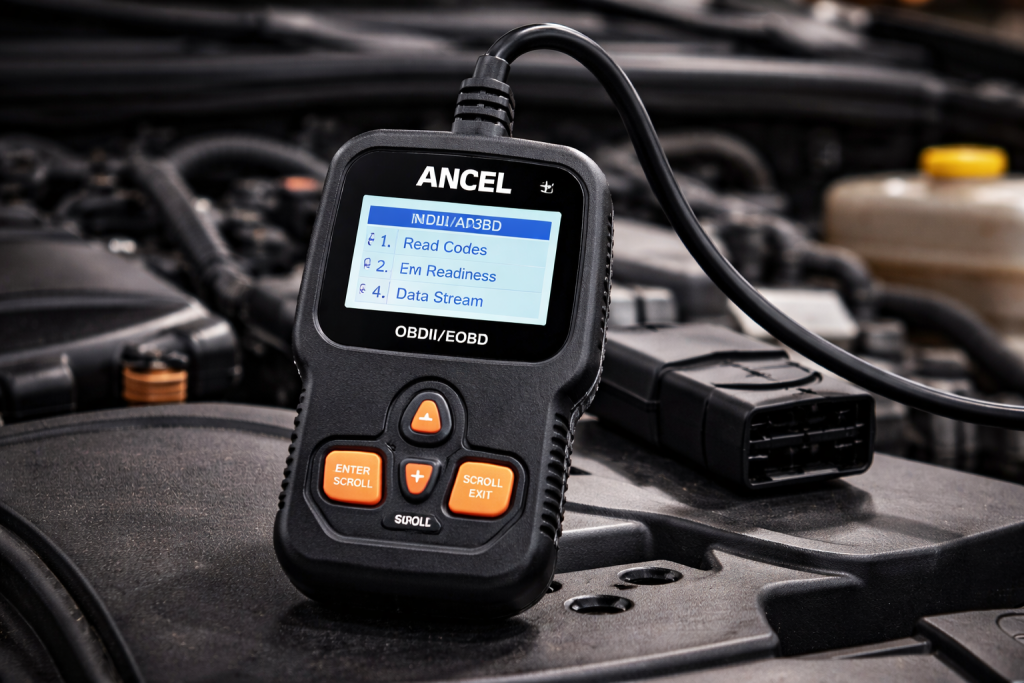
ANCEL AD310
If you want to understand why a warning light is on without immediately having to go to the shop for a diagnosis, a basic scanner like the ANCEL AD310 is a simple and reliable solution. It's easy to use, reads engine codes quickly, and is ideal for those new to OBD2 diagnostics.
If the problem is related to a warning light you are not familiar with, also read our complete guide to car dashboard lights, where you can find the meaning of the main warnings and how to behave safely.
How to Connect an OBD2 Scanner in Under 2 Minutes
Many drivers think they need mechanic skills to use an OBD2 scanner. In reality, in most cases, it only takes a few minutes.
- Park your car safely and turn off the engine.
- Locate the OBD2 socket under the steering wheel or near the fuse box.
- Gently connect the scanner without forcing the connector.
- Turn on the ignition (without starting the engine, unless the scanner instructs otherwise).
- Launch the app or software and wait for it to connect.
- Read and save error codes before clearing them.
- If available, also check real-time data and Freeze Frame.
Real-world case: OBD2 diagnosis with FORScan on a Ford Kuga Plug-in Hybrid
While preparing this guide, we performed a full diagnostic on a 2021 Ford Kuga Plug-in Hybrid using a FORScan-compatible Vgate USB adapter.
This intervention allowed us to verify in the field how an OBD2 scanner, used together with FORScan, not only serves to read error codes, but also to monitor vehicle parameters and complete some maintenance procedures required by the manufacturer.
The procedure was performed while replacing the original battery with a new Varta AGM A7 70 Ah battery. If you'd like to understand the differences between the main technologies, read our guide. AGM or EFB Battery: Which One to Choose?.
At the end of the installation, we also reset the Battery Monitoring System (BMS), documenting each step with real photographs that you can find throughout the article.


🔧 Consutil practical case study
While making this guide we performed a real diagnosis on a 2021 Ford Kuga Plug-in Hybrid using FORScan and an interface OBD2 Vgate vLinker FS USB.
After replacing the original battery with a Varta AGM A7 70 Ah we have checked that the converter is working correctly DC/DC and successfully completed the reset of the Battery Monitoring System (BMS).
This test confirms that a compatible OBD2 scanner is not only useful for reading error codes, but can also become a valuable tool for monitoring vehicle parameters and performing some maintenance procedures required by the manufacturer.
How to Read an OBD2 Code Without Making Mistakes
When you connect an OBD2 scanner, the first temptation is to read the error code and Google it.
It's a good starting point, but it's not enough.
The same code can have different causes depending on the car model, engine and the conditions in which the problem occurred.
For this reason, a correct diagnosis is not based only on the code, but also on the data that accompanies it.
Freeze Frame: the “photograph” of the failure
When the control unit records an anomaly, it also saves a series of vehicle parameters at the exact moment the problem occurred.
This function is called Freeze Frame.
This may include information such as:
- engine revs;
- vehicle speed;
- coolant temperature;
- engine load;
- battery voltage;
- accelerator position.
This data is very useful because it allows us to understand under what conditions did the fault appear?.
Practical advice: Before erasing any errors, always save the freeze frame or take a snapshot of the scanner screen. This may be helpful if the problem recurs.
Types of diagnostic codes
Not all codes have the same meaning.
Active codes
These are the errors that are currently present and can cause the engine light to come on.
Pending Codes
They indicate a one-time detected anomaly. If the problem recurs, the code will become permanent.
Stored Codes
These are errors recorded in the past that remain in the control unit's memory.
Permanent Codes
They can only be eliminated when the system verifies that the fault has actually been resolved.

The most common OBD2 codes
Diagnostic codes always begin with a letter.
That letter indicates the affected system.
P – Powertrain
It concerns the engine, fuel, automatic transmission and emissions.
This is the most common category.
B – Body
Includes climate control, airbags, doors, power seats and other body systems.
C – Chassis
Includes ABS, ESP, electric steering and suspension.
U – Network
Reports communication problems between the electronic control units.
| Code | Meaning | First check recommended |
|---|---|---|
| P0101 | Mass air sensor | Flow meter and air filter |
| P0118 | Liquid temperature sensor | ECT sensor and wiring |
| P0171 | Mix too lean | Intake, MAF, fuel pump |
| P0300 | Misfires | Spark plugs, coils, injectors |
| P0420 | Catalyst efficiency | Lambda probe and catalytic converter |
| P0442 | EVAP system leak | Fuel tank cap and pipes |
| P0500 | Speed sensor | ABS sensor and wiring |
Important: The code does not automatically indicate the component to be replaced. It only indicates the area in which the control unit detected an anomaly.
Live Data
One of the most interesting advantages of an OBD2 scanner is the ability to read engine parameters while the car is running.
Among the most useful data we find:
- coolant temperature;
- battery voltage;
- engine speed (RPM);
- manifold pressure;
- mass air intake (MAF);
- intake air temperature;
- fuel pressure;
- accelerator pedal position;
- instantaneous consumption (on some vehicles).
These values help to understand whether a sensor is working correctly or not.

How to interpret data without making mistakes
Many drivers see a different reading than expected and immediately think of a fault.
In reality, you always have to consider the context.
For example:
- a high engine temperature may be normal after a long trip;
- a battery voltage changes between engine off and engine on;
- Some sensors continuously change their values while driving.
For this reason, it is important to compare multiple parameters and not stop at the first piece of data that seems unusual.

Vgate vLinker MC+
If you prefer to check your car directly from your phone, a Bluetooth scanner compatible with Android and iPhone allows you to easily read error codes and real-time data without using a computer.
If during the diagnosis you notice abnormal values of the charging voltage, also read our guide dedicated to the’broken car alternator, where we explain symptoms, checkups, and when to intervene.
Which OBD2 scanner should you choose?
After understanding how OBD2 works, comes the question that almost everyone asks:
“Which scanner should I buy?”
The answer depends on what you intend to use it for.
If you simply want to understand why a check engine light came on, a basic scanner may be sufficient.
If, however, you want to monitor vehicle parameters, perform more in-depth diagnoses, or you own a Ford and want to use FORScan, it is worth looking at a more advanced tool.
Bluetooth Scanner
They are the most popular models among motorists.
They connect to the OBD2 socket and communicate with the smartphone via Bluetooth.
Ideal for
- reading error codes;
- error deletion;
- real-time data;
- occasional use.
Advantages
✔ Compact.
✔ Easy to use.
✔ Always available in the car.
Disadvantages
✘ Some budget models are unreliable.
✘ Not everyone reads all control units.
USB Scanner
They connect directly to the computer.
They are particularly suitable for diagnostic software such as FORScan.
Advantages
✔ Stable connection.
✔ Faster speed.
✔ Ideal for in-depth diagnoses.
Disadvantages
✘ You need a PC.
✘ Less practical for everyday use.
Professional scanners
They are designed for workshops and expert users.
They allow you to:
- read all control units;
- conduct active tests;
- perform maintenance resets;
- encode some modules;
- monitor numerous vehicle systems.
They cost more, but offer much more advanced features.
| Scanner | Ideal for | Level | Compatibility |
|---|---|---|---|
| ANCEL AD310 | Reading engine codes | Beginner | Universal |
| Vgate vLinker MC+ | Smartphone | Intermediate | Android / iPhone |
| Vgate vLinker FS USB | FORScan | Advanced | Ford |
| OBDLink EX | Ford Complete Diagnosis | Expert | Ford |
Recommended scanners
Beginner
ANCEL AD310
To quickly read engine codes without complications.
Use with smartphones
Vgate vLinker MC+
To control your car directly from Android or iPhone.
Ford + FORScan

Vgate vLinker FS USB
One of the most popular adapters among FORScan users.
Advanced diagnosis

OBDLink EX
Ideal for those who want access to as many Ford control units as possible.
ELM327: original or clone?
Many cheap adapters have the abbreviation ELM327.
However, few people know that there are many clones on the market.
A cheap clone can:
- do not read some control units;
- interrupt the connection;
- show incomplete data;
- be incompatible with some applications.
For this reason, it is preferable to purchase products from well-known brands, even if they are slightly more expensive.
The difference in reliability is often notable.
FORScan: Why is it so popular among Ford owners?
If you own a Ford, FORScan is one of the most interesting software available.
Unlike generic applications, it was developed specifically for Ford vehicles.
This allows it to access many control units that are not normally visible with common OBD2 readers.
Among these:
- PCM;
- BCM;
- ABS;
- PSCM;
- IPC;
- BMS;
- RFA;
- SCCM.
For those who really want to know the status of their Ford vehicle, FORScan offers much more possibilities than a simple code reader.
In this guide, we'll simply explain why FORScan is so popular. A dedicated article will show you how to install, configure, and use it safely.

How to Use FORScan on Your Ford
Does OBD2 also work on hybrid cars?
Yes.
OBD2 is also present on many cars:
- Mild Hybrid;
- Full Hybrid;
- Plug-in Hybrid.
It allows you to read numerous parameters of the internal combustion engine and of many electronic control units.
However, some hybrid system-specific information can only be accessed via manufacturer-compatible software, such as FORScan in the case of Ford.
Is it really worth buying a scanner?
It depends on what you will use it for.
| Situation | My advice |
|---|---|
| A light comes on every now and then | ✅ Yes |
| Do you want to buy a used car? | ✅ Yes |
| Do you have more cars in the family? | ✅ Yes |
| You like to do maintenance | ✅ Yes |
| You will never check your car | ❌ Probably not |
Before buying an OBD2 scanner
Before choosing a model, stop for a moment and answer these questions:
- 🔹 Do you just want to read engine error codes?
- 🔹 Or do you also want to check ABS, Airbag and other control units?
- 🔹 Do you have a Ford and want to use FORScan?
- 🔹 Do you prefer using your smartphone or a computer?
- 🔹 Do you need a scanner for occasional use or do you plan to use it in the future?
The answers will help you choose the most suitable device, avoiding spending money on features you won't use or, conversely, purchasing a scanner that is too limited for your needs.
How much can you save?
A diagnosis in the workshop can cost approximately between 30 and 80 euros, depending on the type of control and structure.
A good quality OBD2 scanner is often similar in cost and can be reused whenever a warning light appears or you want to check the vehicle's operation.
Of course, it doesn't replace the work of a mechanic, but it can help you arrive at the shop with more precise information, avoiding diagnoses based only on assumptions.
Mistakes to Avoid When Using an OBD2 Scanner
An OBD2 scanner is a very useful tool, but only if used correctly.
Here are the most common mistakes that can lead to misdiagnosis or unnecessary expenses.
Clear the error code immediately
This is probably the most common mistake.
Before deleting any code:
- write it down;
- photograph the screen;
- save the Freeze Frame;
- Check if there are any other related errors.
If you delete everything immediately, you could lose valuable information to help you pinpoint the cause of the problem.
Replace the component immediately
An error code does not automatically identify the faulty part.
For example:
The code P0171 indicates a mixture that is too lean.
The cause could be:
- dirty flow meter;
- air infiltration;
- fuel pump;
- fuel filter;
- injectors;
- lambda probe.
Replacing the first component you find on the Internet is often the quickest way to waste money.
Ignoring an important warning light
Not all spies have the same gravity.
A fixed engine light often allows you to drive to the garage with caution.
A flashing engine light, on the other hand, can indicate a serious problem and requires more attention.
The same applies to warning lights relating to engine temperature, oil pressure or braking system.
When is it best to contact a mechanic?
The OBD2 scanner is a great diagnostic tool, but it cannot replace the experience of a professional.
It is advisable to contact a workshop when:
- the error code reappears after clearing;
- the engine loses power;
- the car goes into emergency mode;
- multiple codes are present at the same time;
- safety warning lights come on (ABS, Airbag, ESP);
- you notice any unusual noises, vibrations, or a burning smell.
OBD2 Glossary
DTC
Diagnostic Trouble Code.
It is the error code recorded by the control unit.
Freeze Frame
Photograph of the main engine parameters at the time the fault is detected.
PID
Parameter ID.
These are the parameters that you can read in real time via the scanner.
PCM
Powertrain Control Module.
It is the control unit that manages the engine and, in many vehicles, also the automatic transmission.
CAN Bus
Communication network used by vehicle electronic control units to exchange information.

FAQ - Frequently Asked Questions
Can I use an OBD2 scanner on any car?
In most cases, yes. Petrol cars registered since 2001 and diesel cars since 2004 use the OBD2 standard. Some older models may have different diagnostic systems.
Can I damage the ECU by connecting a scanner?
No, if you're using a reliable device and simply reading data. Advanced features, such as encoding and configuration, require more experience.
After clearing an error code, is the problem solved?
No. You just cleared the warning. If the cause of the fault is still present, the code will return after a few driving cycles.
Do all scanners read all ECUs?
No. Many inexpensive scanners primarily read the engine control unit. To access modules like ABS, airbags, BMS, or electric steering, you need manufacturer-compatible devices and software.
Does OBD2 also work on hybrid and plug-in hybrid cars?
Yes. The OBD2 standard is also present on many hybrid and plug-in hybrid cars. However, some hybrid system-specific information may require dedicated software, such as FORScan for Ford vehicles.
What is the difference between OBD2 and EOBD?
OBD2 is the international standard for on-board diagnostics. EOBD (European On-Board Diagnostics) is the version adopted for the European market. In practice, for the end user, the operational differences are minimal.
Conclusion
OBD2 isn't just for when a warning light comes on.
It can become a valuable tool for getting to know your car better, preventing breakdowns, and approaching any diagnosis with greater awareness.
Used correctly, it can save you time, money, and a lot of worry.
Understanding how OBD2 works doesn't mean you have to replace your mechanic, but rather, it gives you the tools to better understand what's happening to your car and tackle any diagnosis with greater peace of mind.
To enrich this guide, we've documented a diagnostic test performed on a 2021 Ford Kuga Plug-in Hybrid with real photographs. The images show connecting the OBD2 interface, performing diagnostics with FORScan, monitoring parameters in real time, replacing the battery, and resetting the Battery Monitoring System (BMS). The actual photographs were taken during the tests described in the article. The images of the recommended products are used for illustrative purposes only.
 Italian
  English