

Reading time: 5 minutes
Immediate response
A faulty starter motor It can prevent the car from starting even when the battery is charged. The most common symptoms are a clicking sound without starting, rattling noises, intermittent operation, or the starter motor turning over without cranking the engine.
Before replacing it, check the battery, terminals and electrical connections. The same symptoms can be caused by a power supply problem or a control circuit problem.
What you will learn:
What are the symptoms of a bad starter motor.
How to distinguish a scooter problem from a dead battery.
What noises indicate a possible fault.
How to check the starting system.
Because the problem can get worse in the cold.
How much does it cost to repair or replace the scooter?.
Index
How does the starter motor work?
The starter motor is an electrical component that allows the internal combustion engine to start turning.
When you turn the key or press Start, the control system activates the starter motor. The pinion engages the flywheel ring gear and sets the engine in motion.
When the engine starts, the starter motor disengages.
In modern cars, the control can be managed by the control unit. Some start-stop and hybrid systems use different solutions.
Faulty starter motor: 6 symptoms to recognize
1. You hear a clicking sound but the motor doesn't turn.
You turn the key, you hear a click coming from the engine compartment, but nothing else happens.
The problem could be with the solenoid, the internal contacts, or the power supply.
Attention: A clicking sound doesn't mean the starter motor is faulty. A dead battery can also cause this symptom.
If you want to know all the possible causes, also read the guide Car won't start: causes and what to check immediately.
2. The motor turns slowly
The engine is hard to pull, especially when starting for the first time.
Before suspecting the starter motor, check the battery and connections. Insufficient voltage can cause the same problem.
3. You hear metallic noises during start-up
A grinding noise may indicate problems with the pinion gear, the clutch mechanism, or the flywheel ring gear.
If the noise is loud, avoid further attempts.
4. The motor is idling
You hear an electrical noise, but the combustion engine is not being driven.
One possible cause is the pinion not engaging.
5. The car only starts sometimes
One day it works, the next day it doesn't start.
The fault could be due to worn contacts, solenoid, relay, wiring or control circuit.
6. The starter motor remains on after starting
It is a less common situation, but it can cause damage.
If you feel the starter motor continuing to run after the engine is started, stop safely and turn off the vehicle, if possible.
Do not continue to use it until verified.

Battery or starter motor? How to tell the difference
Some symptoms may appear identical.
| Symptom | Possible causes |
|---|---|
| Repeated clicking, dim lights | Battery or connections |
| One click, no rotation | Battery, solenoid, motor or cables |
| The scooter turns slowly | Battery, connections or motor |
| The scooter is spinning idly | Engagement mechanism |
| No noise | Power supply, control or motor |
| Intermittent start | Contacts, relays, wiring or motor |
The most important difference is this: If the battery, connections and control are efficient, the suspicion of an internal fault in the motor increases.
To learn more about power supply issues, also see Battery or alternator? How to figure it out for yourself.
Why can the starter motor have problems in the cold?
As temperatures drop, engine oil can become more viscous, requiring more effort for the engine to crank.
At the same time, the lead-acid battery generally supplies less current.
A scooter that is already worn out can therefore more easily experience difficulties during the winter.
This does not mean that the cold necessarily damaged the component.
If the problem appears only on cold mornings, read also Car battery discharge in the cold: why it goes flat and what to do about it.
How to check the starter motor without disassembling it
Before replacing the starter motor, you can carry out some preliminary checks.
1. Check the battery
A well-charged 12V battery may show about 12.6–12.8V at rest.
But a seemingly normal voltage does not guarantee that it will be able to supply the necessary current during starting.
For a reliable verification, a battery test is needed.
A specific car battery tester can help assess the battery's condition and starting ability, avoiding immediately attributing the problem to the starter motor.
HELPFUL TIP

12V Car Battery Tester
See on Amazon →
2. Check the terminals and cables
With the vehicle off, visually inspect for obvious oxidation, damaged wiring, or loose connections.
Do not touch the motor's power terminals and do not attempt any improvised connections.
3. Listen to the behavior during start-up
A single click, repeated clicks, or a spinning motor can provide helpful clues.
Avoid long or repeated attempts.
4. Check the instrument panel
There is no universal starter motor warning light.
However, on some cars, messages relating to the ignition system, immobilizer or electronics may appear.
The battery warning light on when the engine is running mainly concerns the charging system.
5. Have the starter circuit checked
If initial checks do not identify the cause, a technician may measure:
the tension during the starting attempt;
the voltage drops on the positive and ground cables;
the solenoid control signal;
the current draw of the motor.
These checks help distinguish an internal fault from an external electrical problem.

Can a multimeter be helpful?
Yes. It allows you to check the battery voltage and, with the necessary skills, perform some electrical measurements.
However, a single reading is not enough to diagnose the starter motor.
A digital multimeter can be useful for basic battery and electrical system checks.
HELPFUL TIP
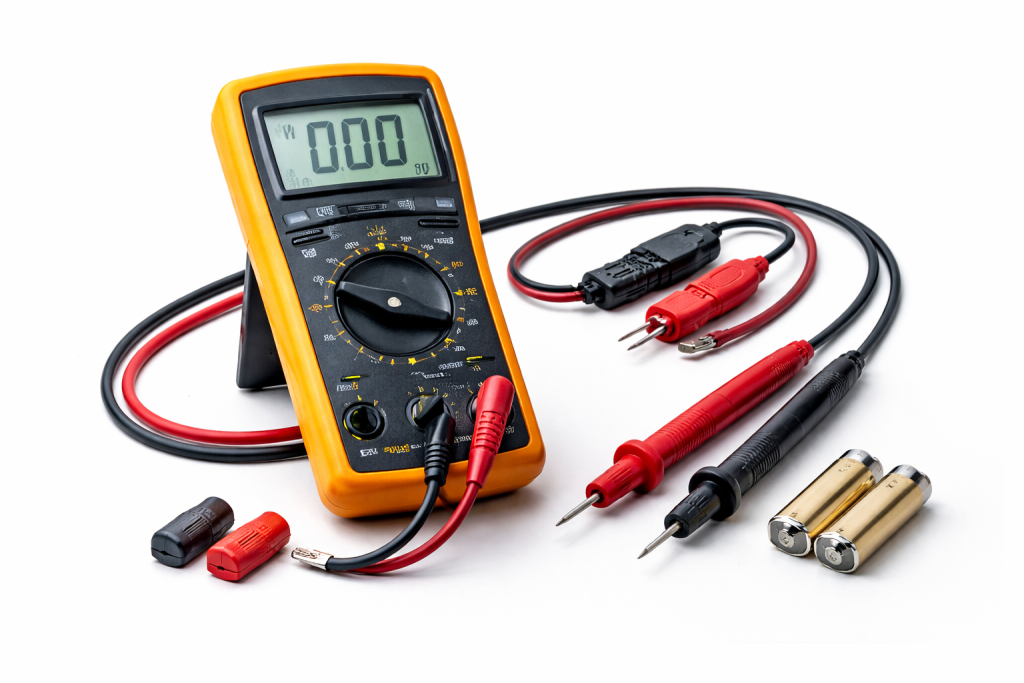
Digital multimeter for cars
Useful for checking battery voltage and carrying out simple checks on the electrical system.
See on Amazon →
The most common causes of a faulty starter motor
Worn brushes and contacts
Over time, internal components can wear out, causing difficult or intermittent starting.
Faulty solenoid
The solenoid allows the pinion to engage and, in traditional systems, closes the electrical power circuit.
A failure of this can prevent starting.
Damaged pinion or clutch mechanism
It can cause metallic noises or the motor turning without cranking the engine.
Faulty electrical connections
High resistance wires, clamps, and ground connections can prevent the starter motor from receiving the necessary current.
Relay or control circuit
In some cases the starter motor is fully functional, but does not receive the start command.
Starter motor: repair or replacement?
It is not always necessary to replace the entire component.
On some models it is possible to overhaul the motor, replace the brushes or repair the solenoid.
The choice depends on the availability of spare parts, the cost of labor and the condition of the component.
How much does it cost to replace the starter motor?
For many common cars, the overall cost can be approximately 200–600 euros, between spare parts and labor.
This is just a guideline, not an estimate: the cost may vary significantly on some vehicles.
Before authorizing the replacement, ask for a diagnosis that excludes problems with the battery, connections and control circuit.
How to prevent starter motor problems
There is no universal maintenance interval, but some precautions can help:
Keep your battery efficient.
Check for any oxidized connections.
Avoid taking too long to start.
Don't ignore metallic noises.
Have intermittent problems checked promptly.
Electrical Contact Spray: When is it useful?
A specific spray for electrical contacts can help in the maintenance of some compatible connectors, when the intervention is required by the manufacturer's procedures.
Does not repair worn brushes, faulty solenoids or damaged gears.
Do not spray it indiscriminately on the motor or electronic components.
For maintaining accessible and compatible connectors, an electrical contact cleaner can be useful, as long as it is used according to the product instructions.
HELPFUL TIP

Electrical contact spray
See on Amazon →

Mistakes to avoid
Replace the motor immediately: First check the battery and power supply.
Persist with the start: you can overheat the motor.
Hit the engine to get it going again: It's not a reliable repair.
Using starter spray: It doesn't fix a motor that doesn't turn.
Jumper relays or terminals: may cause short circuits and unexpected vehicle movements.
In summary
A faulty starter motor can cause clicking, rattling, failure to crank, or intermittent operation.
However, the same symptoms can also depend on the battery, the connections or the control circuit.
Before replacing the starter motor, a correct diagnosis is required.

FAQ - Frequently Asked Questions
How to tell if the starter motor is broken?
The most common symptoms are clicking without starting, unusual noises, intermittent operation, or a motor that spins freely. Electrical checks are necessary to confirm the fault.
If the starter motor is broken, can the car be pushed to start?
On some traditional manual cars, it may be technically possible, but it's not a generally recommended solution. Many modern vehicles don't support this procedure, and it can be risky.
Does the starter motor have a dedicated light?
Generally, no. Some vehicles display messages related to the ignition system, but there is no specific universal light.
Can a faulty starter motor drain the battery?
Under certain conditions, yes, for example, if it's powered when it shouldn't be. A non-working starter motor, however, doesn't automatically mean it's draining the battery.
How long does a starter motor last?
It can last for many years. The lifespan depends on the number of starts, the conditions of use, and the quality of the component.
Conclusion
If you hear a clicking sound and the car doesn't start, don't immediately blame the starter motor.
First, check the battery and connections. If they're OK, a starter circuit diagnosis can pinpoint the culprit.
Have you had any starter problems? Tell us in the comments what symptoms you noticed and how you solved them.


 Italian
  English