

Reading time: 4 minutes
Immediate response
THE'’Car ABS This is the anti-lock braking system. During heavy braking, it monitors the speed of the wheels and, when it detects that one is about to lock up, rapidly modulates the brake pressure.
Its main purpose is prevent wheel lockup and help the driver maintain directional control of the car during braking.
What you will learn:
- What is car ABS?.
- How it works during braking.
- What are the sensors, control unit and hydraulic unit for?.
- What do you feel when ABS kicks in?.
- What does it mean when the ABS light stays on?.
Index
ABS almost always works without being noticed. It becomes especially noticeable when braking is severe enough to bring one or more wheels close to locking up.
And that's exactly when it can make the difference in keeping the car controllable.
What is car ABS?
ABS means Anti-lock Braking System, that is, anti-lock braking system.
The principle is simple: when braking, the wheels must continue to maintain a certain rotation to maintain grip and directional stability.
If a wheel tends to lock up, the ABS intervenes by applying brake pressure to that wheel.
In practice, the system helps to:
- avoid wheel lockup;
- maintain greater steering ability;
- improve stability during heavy braking;
- control the vehicle better on surfaces with little grip.
How the ABS system works
The operation of ABS is mainly based on three elements.
Wheel speed sensors
They control the rotation speed of the wheels.
If during braking a wheel slows down to the point where it risks locking, the system can detect this.
ABS control unit
It receives information from the sensors and determines when intervention is necessary.
Hydraulic group
Modulates the pressure of the braking circuit on the affected wheel.
The process happens very quickly:
- the sensor detects that a wheel is about to lock up;
- the control unit processes the signal;
- the system modulates the brake pressure;
- the wheel recovers rotation;
- the pressure is readjusted if necessary.
This cycle can repeat itself rapidly during the same braking.

What is ABS for?
The main purpose of ABS it's not just shortening the braking.
Its main function is to prevent the wheels from locking during heavy braking.
With locked wheels, it becomes much more difficult to change the car's trajectory. ABS instead tries to keep the wheels in a position that allows for greater directional control.
This can be especially useful during sudden braking where you also need to avoid an obstacle.
When the ABS kicks in
The ABS does not intervene during every braking.
It comes into operation when the system detects that one or more wheels are at risk of locking up.
It can happen, for example:
- during very intense braking;
- on wet asphalt;
- on ice or snow;
- on surfaces with little grip;
- when the wheels have different grip between one side of the car and the other.
It therefore does not intervene exclusively in "emergencies": it depends above all on the braking and the available grip.
What does it feel like when the ABS kicks in?
When the ABS intervenes you may feel:
- pulsations on the brake pedal;
- vibrations;
- noises coming from the braking system.
During ABS intervention this can be normal behavior.
If you are performing an emergency braking in a car equipped with ABS, Don't interpret pedal pulsations as a fault and don't release the brake just because you feel them..
ABS and braking distance: does it really brake sooner?
Not necessarily.
The distance needed to stop the car depends on several factors:
- speed;
- tires;
- asphalt conditions;
- available grip;
- braking system conditions;
- surface characteristics.
On many surfaces, ABS allows for effective braking while maintaining greater directional control, but does not guarantee a shorter stopping distance in every situation.
On some soft surfaces, such as gravel or loose snow, the behavior may be different than on asphalt.
What happens without ABS
If braking hard enough, a car without ABS can lock its wheels.
When it happens:
- decreases the ability to control the trajectory;
- steering can become much less effective;
- increases the risk of losing stability.
However, the behavior depends on speed, road surface, tires and vehicle characteristics.

With ABS and without ABS: main difference
| Without ABS | With ABS |
|---|---|
| The wheels can lock up | The system counteracts blocking |
| Reduced directional control with locked wheels | Greater chance of maintaining direction |
| The driver must directly manage the braking | The system automatically modulates the pressure when necessary |
ABS indicator light on: what it means
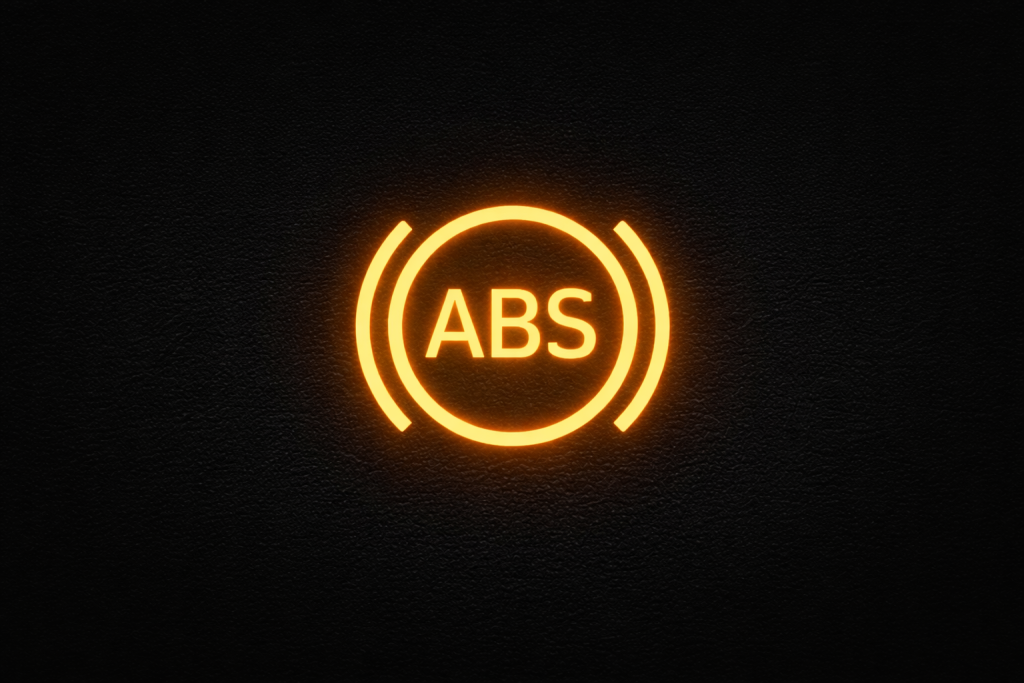
When you start your car, the ABS light normally comes on for a few moments while the system is being checked and then goes off.
If stays on or appears while driving, may indicate a fault in the ABS system.
In many cases, conventional braking remains available, but the anti-lock function may not intervene correctly.
If other brake system warning lights appear together with the ABS warning light, the situation should be assessed more carefully, also following the instructions in the car manual.
Read also: ABS light on: what it means and what to do immediately
ABS symbol: how to recognize it
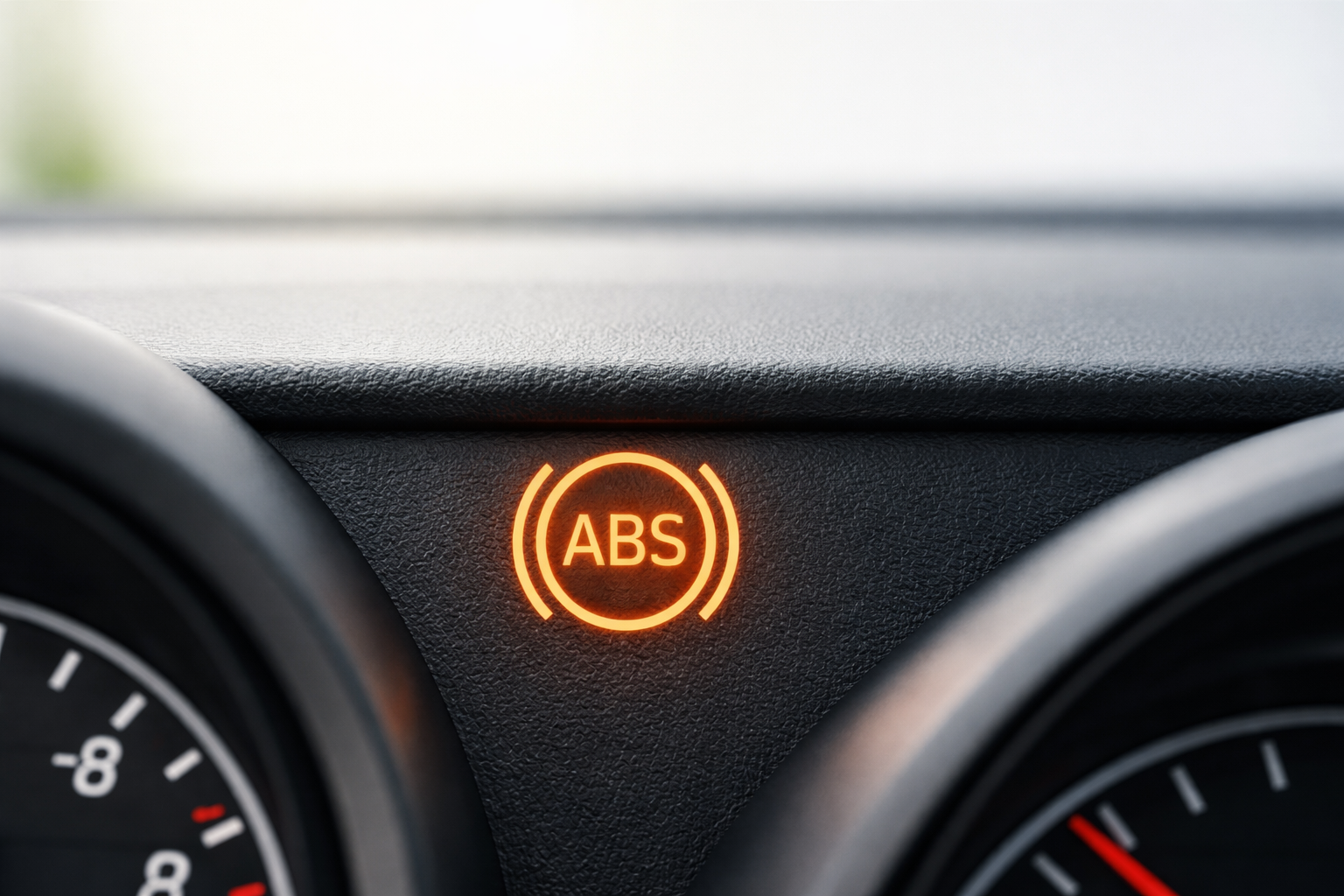
The ABS warning light is generally recognisable by the writing ABS inside a circular symbol.
Normally:
- it turns on when you start the car;
- remains visible for a few moments during the system check;
- It switches off if no anomalies are detected.
If it stays on, however, it's a good idea to understand why.
In summary
The car ABS:
- prevents the wheels from locking during heavy braking;
- uses wheel sensors, a control unit and a hydraulic system;
- quickly modulates brake pressure;
- helps maintain greater directional control;
- may cause normal pulsations on the pedal when it intervenes;
- does not always guarantee a shorter braking distance.
If the ABS indicator light stays on, the system must be checked because the anti-lock function may not be available.

FAQ
What is ABS in a nutshell?
This is the anti-lock braking system. It intervenes when one or more wheels are about to lock up during braking, modulating the brake pressure.
Does ABS always reduce braking distance?
No. Stopping distance depends on the surface, tires, speed, and other conditions. The primary benefit of ABS is to prevent wheel lockup and help maintain directional control.
Why does the pedal vibrate when the ABS kicks in?
Pulsations can be caused by rapid changes in brake pressure controlled by the ABS system. During normal operation, they do not necessarily indicate a fault.
Can you drive with the ABS light on?
If it stays on, it may mean that the anti-lock braking function is not available, although conventional braking may still function. If other brake lights or braking anomalies are present, it is necessary to stop safely and investigate the problem.
Does ABS work on snow and ice?
Yes. The system can intervene when it detects the risk of wheel lockup, even on low-grip surfaces. However, this does not eliminate the tires' grip limitations and does not guarantee a shorter stopping distance.
Conclusion
THE'’Car ABS It is one of the systems that help the driver maintain control of the vehicle during heavy braking.
Its main task is not to work miracles on stopping distance, but avoid wheel lockup and maintain greater directional ability.
During normal driving, you barely notice its presence. When it does kick in, however, the pulsations on the pedal can be completely normal.
If the ABS light stays on after starting, the next step is to understand what fault the system has detected.
Read also: ABS light on: what it means and what to do immediately
 Italian
 English