
Reading time: 5 minutes
Immediate response
Tire pressure warning light on? Slow down, avoid sudden maneuvers, and check your tires as soon as it's safe to do so. If a tire is visibly underinflated, the car vibrates, pulls to one side, or becomes unstable., stop and don't continue driving.
If the tires appear normal, measure the pressure with a pressure gauge and compare it to the values specified by the car manufacturer. Don't rely solely on the tire's appearance.
What you will learn:
- What does the tire pressure warning light mean?.
- What to do as soon as it turns on.
- When you can reach a safe point and when you have to stop.
- Because the warning light can come on in cold weather.
- How to check your blood pressure correctly.
- Why can the light stay on after inflation?.
- How direct and indirect TPMS work.
Index
Tire pressure warning light on: what does it mean?
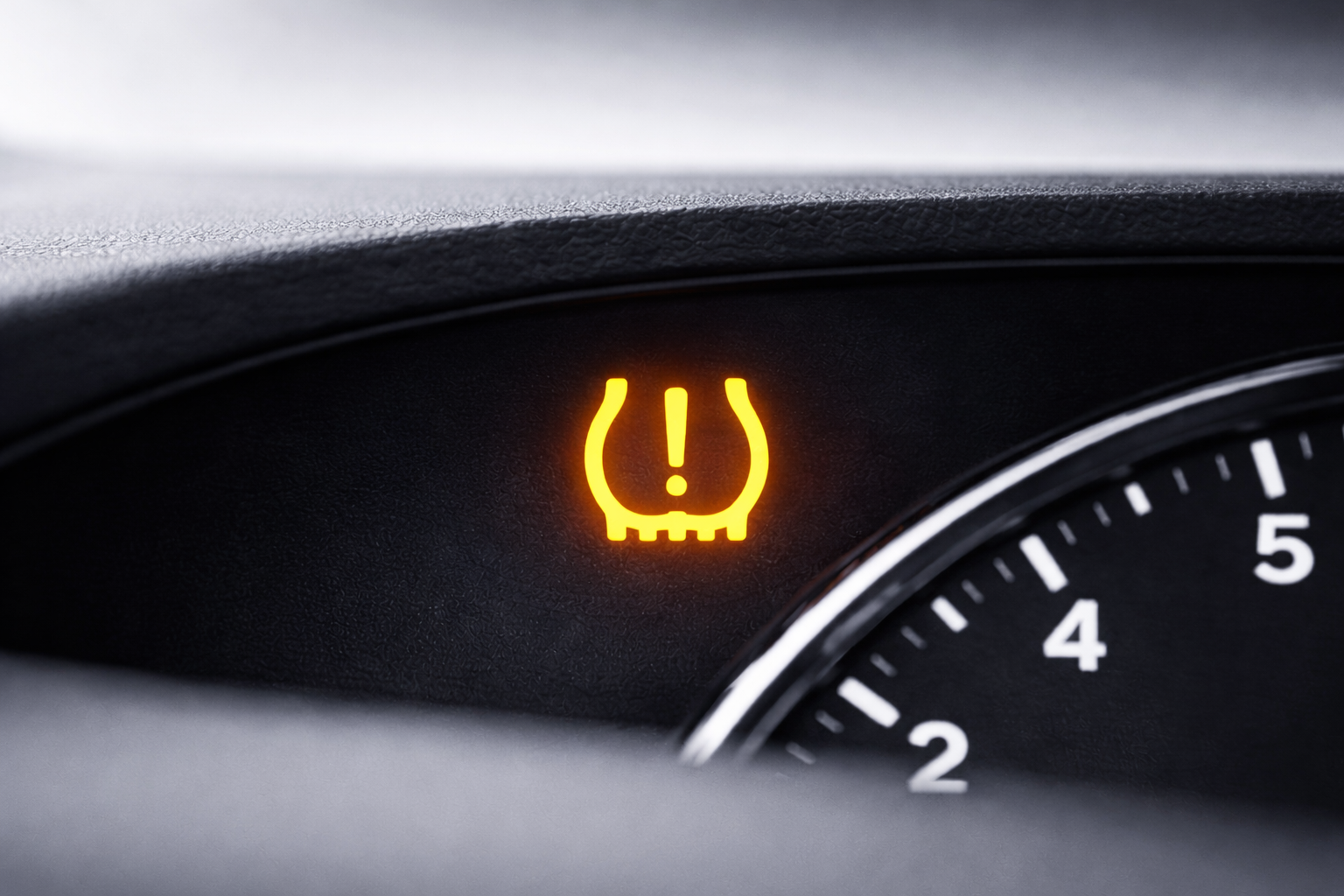
La tire pressure light is associated with the TPMS system (Tire Pressure Monitoring System), used to report a possible anomaly in tire pressure.
The most common symbol looks like a cross-section of a tire with a exclamation point in the center.
When the light stays on, one or more tires may have a different pressure than expected or the system may need to be checked.
The important thing is not to immediately assume that it is a puncture: First you need to check the tires and measure the pressure.
To find out about other instrument panel warnings, read Car warning lights on: what they mean and what to do.
What to do immediately if the tire pressure warning light comes on
If the light comes on while you are driving:
- slow down without braking sharply;
- avoid sudden turns and maneuvers;
- pay attention to vibrations or changes in steering;
- get to a safe spot to check your tires;
- Check the pressure with a pressure gauge.
If a tire is clearly very under-inflated or the car is unstable, do not continue the journey.
If you don't notice any obvious anomalies, check your tire pressure as soon as possible.
Can I drive with the tire pressure light on?
It depends on the actual condition of the tires.
If the car remains stable and no tires appear severely deflated, you can move away with caution. only as much as necessary to get to a safe place to check your blood pressure.
However, there is no universal distance such as 1, 2, 5 or 10 kilometers that can be considered safe.
Stop if:
- one tire is visibly very flat;
- the car vibrates;
- the vehicle pulls sharply to one side;
- you hear unusual noises coming from a wheel;
- the stability of the car suddenly changes.
Why does the tire pressure light come on
The most common causes are a drop in pressure, an air leak or a fault in the TPMS system.
Pressure too low
A tire can gradually lose pressure even without an obvious puncture.
If the pressure drops enough to activate the system, the warning light appears.
So don't wait until the tire feels "flat": a pressure difference may not be easily recognizable by eye.
Change in temperature
Air pressure varies with temperature.
For this reason, the warning light may appear after a particularly cold night or during a sharp change in seasons, especially if a tire was already close to the warning threshold.
This does not mean, however, that the warning light can be ignored.
Measure your blood pressure anyway.
Puncture or slow leak
A nail, screw, faulty valve, or other small leak can cause the pressure to slowly drop.
A typical sign is this:
inflate the tire → after a few days the pressure drops again.
In this case it is advisable to have the tyre checked.
TPMS system problem
If the pressure is correct but the warning continues, the problem may be with the monitoring system.
Depending on the vehicle, sensors, internal sensor batteries, learning procedures or other faults may be involved.
Direct TPMS
It uses sensors installed in the wheels that can directly measure the pressure.
On some vehicles, the display also allows you to view the pressure of individual tires.
Indirect TPMS
It does not necessarily measure the pressure with a sensor inside each wheel.
The system uses information from wheel speed sensors and other parameters to identify variations consistent with abnormal pressure.
For this reason, the procedure to follow after inflation is also It depends on the type of system and the vehicle.
How to understand which tire has lost pressure
If your car displays individual tire pressures on the display, identifying the affected tire can be easy.
Otherwise the most reliable method is to check all tires with a pressure gauge. A moderate leak may be difficult to detect by simply pressing the tire.
Where to find the correct tire pressure
The correct pressure is not the same for all cars and should not be chosen "by eye".
Check the values provided by the manufacturer, which can normally be reported:
- in the car manual;
- on a label in the door compartment;
- near the fuel door;
- in another position indicated by the manufacturer.
The location of the label varies depending on the vehicle.
Do not use the maximum pressure on the tire as a reference
The value shown on the side of the tire This is not automatically the recommended pressure for your car..
When inflating, you must use the values prescribed by the vehicle manufacturer, also taking into account any load-related information.
How to check your blood pressure correctly
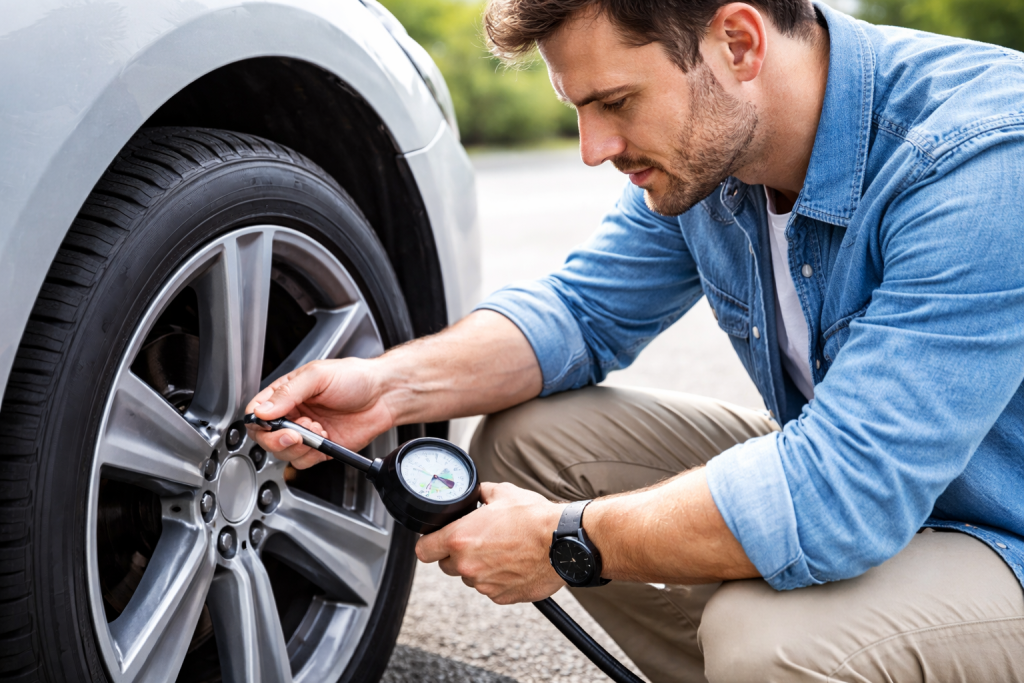
Whenever possible, check the pressure when the tires are cold and use a reliable gauge.
The procedure is simple:
- find the prescribed pressure for your car;
- remove the valve cap;
- connect the pressure gauge;
- fit all tires;
- adjust the pressure if necessary;
- replace the valve caps correctly.
If a tire continues to lose pressure after being inflated, have it checked.
Does the pressure change with load?
On many vehicles the manufacturer may indicate different pressures based on load, number of passengers or conditions of use.
Use the specific values provided by the manufacturer for that vehicle and that load condition.
Tire pressure warning light on in cold weather
It's a fairly common situation.
As the outside temperature drops, the tire's air pressure also decreases. If the pressure was already close to the system's threshold, a cold night may be enough to trigger the warning.
The solution is not to automatically wait for it to get warmer.
Check the cold pressure and bring it back to the prescribed values, if necessary.
Tire pressure warning light after tire change
After a tire or wheel change, some vehicles may require a reset, learning, or recalibration procedure.
Other systems can automatically recognize values while driving.
Because of this I would no longer write that you always have to "reset the TPMS"“.
The correct procedure depends on the vehicle: follow the instructions in the manual or on-board computer.
What to do if the tire pressure light does not go out
Before thinking about a faulty sensor, check that all tires actually have the correct pressure.
If the values are correct but the light remains on, check the procedure required by your car.
If the reporting continues or returns frequently, there may be:
- a slow loss;
- a faulty valve;
- a direct TPMS sensor problem;
- an initialization or calibration problem;
- another system anomaly.
In these cases it is advisable to have the tires and TPMS checked.
Can the tire pressure warning light turn off by itself?
Yes, on some vehicles this can happen after conditions return to normal or after the system updates its information.
But light off does not automatically mean problem solved.
If the warning has appeared, checking the pressure remains the simplest check.
When to go to the tire shop
Have your tire checked if the pressure drops again after inflating, if you find a foreign object in the tread, or if you suspect a leak.
An inspection is also advisable when the car exhibits vibrations or other abnormal behavior.
A slow leak may be subtle at first and become more noticeable over time.
Useful tools for checking blood pressure at home
Keeping a small compressor with a pressure gauge in your car or garage can be convenient for checking and restoring pressure without having to search for a gas station every time. Before purchasing, check the power supply, maximum pressure, and compatibility with your intended use.
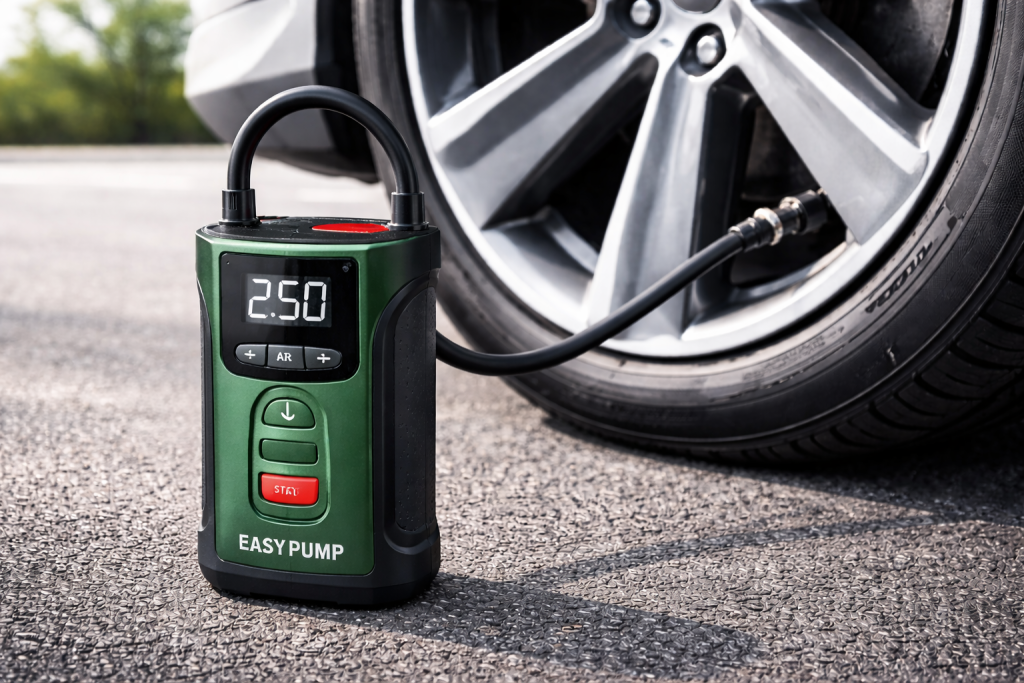
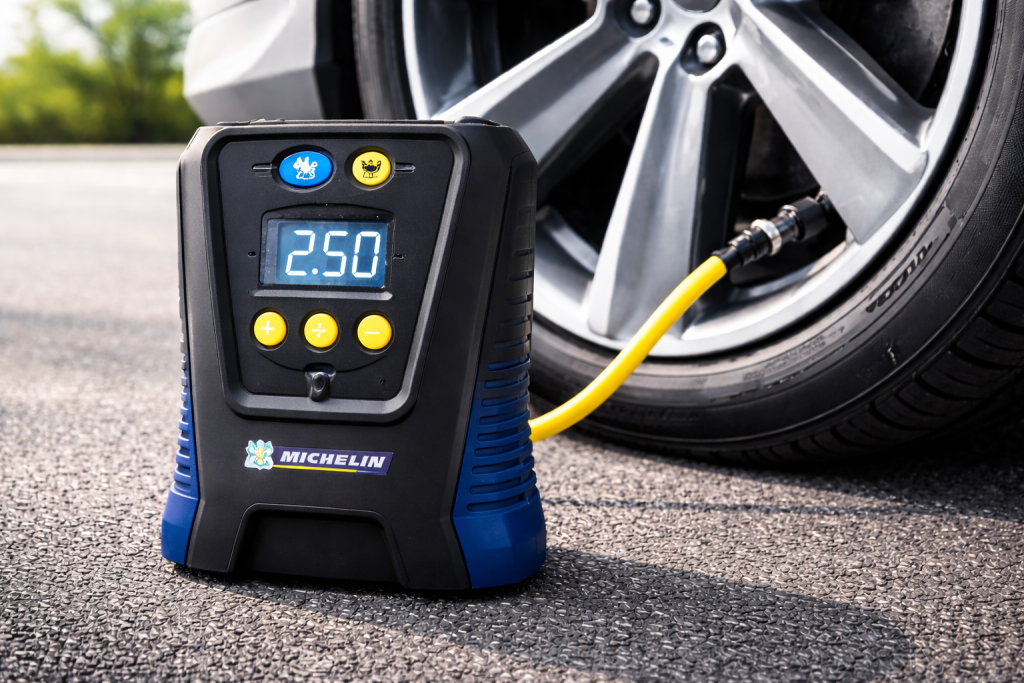
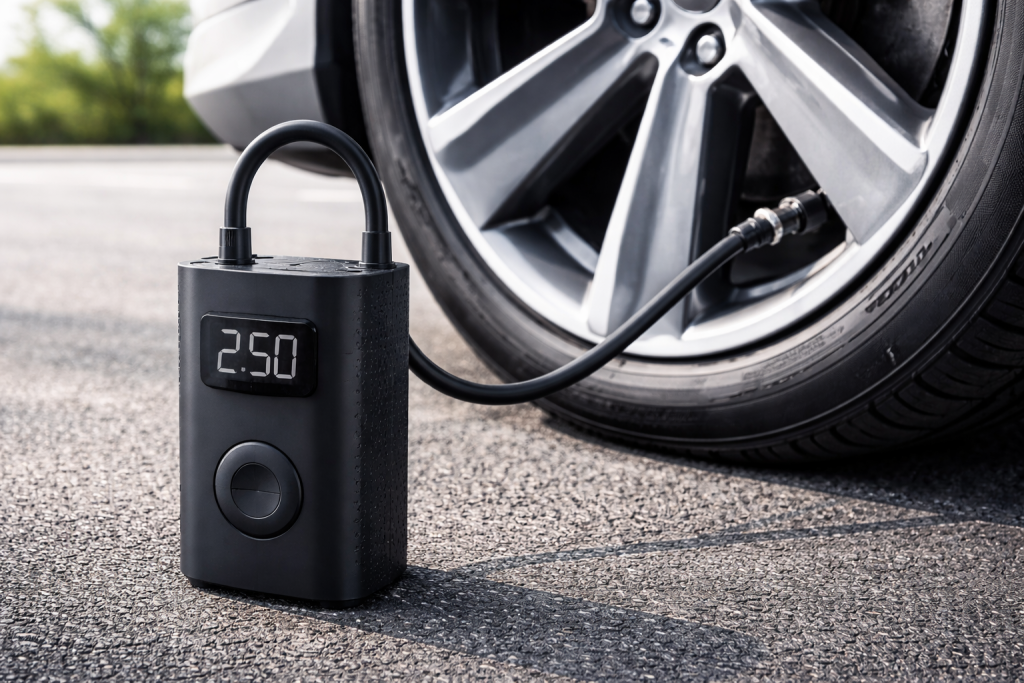
Xiaomi Portable Air Compressor
digital portable compressor
automatic shutdown
rechargeable
Mistakes to avoid
- Ignore the warning light because the tire appears normal.
- Check the pressure simply by looking at or pressing the tire.
- Inflate using a generic value instead of the one intended for the vehicle.
- Consider it normal for a tire to need to be topped up continuously.
- Thinking that the warning light on in the cold can always be ignored.
- Performing a TPMS reset without checking the pressure first.
- Continue driving if a tire is severely underinflated or the car is unstable.
How to prevent new reports
Check the pressure periodically, preferably when the tyres are cold, and before long journeys.
Take advantage of the check-up to also observe the condition of the tires: uneven wear, cuts, deformations or foreign bodies can indicate problems that measuring the pressure alone does not reveal.
If a tire loses pressure repeatedly, do not simply continue to inflate it: look for the cause of the loss.
In summary
If the appears tire pressure warning light on, does not automatically mean that you have a flat tire, but it still requires a check.
Slow down → check your tires → measure all pressures → compare them with the manufacturer's values.
If a tire is significantly underinflated or the car becomes unstable, stop. If the pressure is correct but the light remains on, check your car's TPMS procedure or have the system checked.
To find out the meaning of other warnings, see Car warning lights on: what they mean and what to do.

FAQ - Frequently Asked Questions
What does the yellow tire pressure light mean?
Indicates that the TPMS has detected a tire pressure condition that needs to be checked or, depending on the vehicle and the behavior of the light, a possible system problem.
Can I drive with the tire pressure light on?
If the car is stable and no tires appear significantly underinflated, carefully drive to a safe location to check the pressure. If a tire is significantly underinflated, the car vibrates, or becomes unstable, stop.
Can the tire pressure light come on in cold weather?
Yes. A drop in outside temperature can reduce tire pressure and cause the warning to appear, especially if the pressure was already close to the expected threshold.
What is the correct tire pressure?
It depends on the vehicle, the approved tires, and the manufacturer's specifications. Use the values indicated for your car, not a generic value.
Why does the light stay on after inflating the tires?
A reset or recalibration procedure may be necessary, or the TPMS system may be leaking or malfunctioning. The procedure varies from car to car.
Can the warning light come on without a puncture?
Yes. It could be due to temperature changes, gradual loss of pressure, valve, wheel replacement, or a faulty TPMS system.
Do I need to reset the TPMS after inflating my tires?
Not necessarily. Some systems require a specific procedure, others update the information automatically. Always follow the instructions provided for your vehicle.
Conclusion
La tire pressure warning light on It shouldn't be ignored, but it doesn't automatically mean a tire is flat.
The first check is simple: visually check the tires and measure the pressure of all four comparing it with the values expected by the manufacturer.
If you find a tire significantly underinflated or the car's handling changes, do not continue driving. If the pressures are correct but the light remains on, the next step is to check the car's TPMS procedure or have the system checked.


 Italian
  English