

Organizing your daily life in a simple way is possible, even if you have little time and a thousand commitments.
In this practical guide you will discover:
- how to organize your day effectively
- how to reduce stress and mental confusion
- how to have more free time without doing more
👉 No theory: just immediately applicable strategies.
Organizing your daily life in a simple way is the most effective way to reduce stress and have more free time.
How to organize your daily life (in short)
Here's what to do, in practice, to organize your daily life without stress:
- define 3 priorities per day
- use blocks of time to work better
- create small automatic routines
- reduce distractions
- plan your free time too
👉 It only takes 10–15 minutes a day to get started.
This is the easiest way to organize your daily life without stress.
There is one thing almost no one says when it comes to organization: the problem is not lack of time, but lack of structure.
The days today are full. Not necessarily of important things, but of micro-commitments, distractions, notifications, constant decisions. And every decision consumes energy.
You get to the evening and you're tired, even though you haven't done anything really meaningful.
It is not your fault.
According to studies by the’American Psychological Association, decision-making overload and lack of perceived control over time are among the main causes of daily stress.
Organizing daily life does not mean becoming rigid or perfect.
It means reducing invisible chaos.
This guide will not teach you how to do everything. It will teach you how to do better.
And we start where it all originates: the home and the mindset.
How to organize your daily life when you're short on time
If you're short on time, simplify everything:
- choose only 3 priorities
- work in 30–60 minute blocks
- eliminate at least one distraction a day
👉 Even 10 minutes well spent make a difference
Signs that your daily life is disorganized
- You start many things but finish few.
- you always feel late
- you're tired even for no reason
- the house is often in disarray
👉 If you recognize yourself, it's not a lack of time: it's a lack of structure.
How to Organize Your Home Without Stress (The 15-Minute Method)
Organizing your home is the first step to organizing your daily life.

Many people try to organize work, time, productivity--but they ignore the context in which they live.
The home is not just a space. It is a system.
If the system is chaotic, your mind also becomes chaotic.
Why home affects more than you think
Every misplaced object is:
- a pending decision
- a visual distraction
- a constant micro-stress
You don't notice it right away, but you accumulate it.
And over time it weighs.
The myth of “I'll fix it when I have time”
This is the most common thought.
And that's what stops everything.
Why?
Because the brain perceives “fixing up the whole house” as a huge task → so it avoids it.
👉 The solution is not more time. It is to reduce the size of the task.
The 15-minute rule (realistic approach)
This is one of the most effective methods because it works in real life.
It doesn't need motivation. It needs continuity.
Devote 15 minutes a day to one area.
Concrete example:
- Monday → kitchen (countertop, sink)
- Tuesday → bathroom (sink, mirror)
- Wednesday → room (bedside table, clothes out of place)
- Thursday → stay
- Friday → general rearrangement
This structure:
✔ eliminates accumulation
✔ reduces stress
✔ creates continuous order
After 10 days you will notice the difference.
After 30 days it becomes automatic.

Adjustable drawer organizers
Helps maintain order over time
reduces visual chaos
perfect for getting started right away
Decluttering: eliminate before organizing
Classic mistake:
👉 buy organizer without eliminating the superfluous
Result:
more objects → more organized chaos
The real change comes when you take away.
Practical exercise (immediately applicable)
Open a drawer and ask yourself:
👉 “Do I really use it in the next few weeks?”
If the answer is no → you probably don't need it.
It is not extreme minimalism. It is clarity.
According to several behavioral studies, reducing the number of objects reduces the number of daily decisions → less stress.
Invisible routines (the key that changes everything)
Organized people don't do things anymore.
They make fewer decisions.
Because they have routines.
Real-world examples:
- making the bed as soon as you wake up
- fix the kitchen before sleeping
- Emptying bags and pockets every night
These actions:
last a few minutes
avoid accumulation
create automatic order
According to Duke University, about 40% of daily actions are automatic habits.
The more you automate, the less effort you make.
Real Case
Chiara, 35, works full-time.
First:
- messy house
- cleaning concentrated on the weekend
- constant stress
After:
- 10-15 minutes a day
- fixed evening routine
Result:
✔ home always manageable
✔ free weekends
✔ less mental stress
Read also:
👉 Home and kitchen: comprehensive guide to organizing, furnishing and better living spaces
Mentality: organization ≠ perfection
This is where the real change happens.
Many people fail not because of lack of method but because of wrong expectations.
Mistake No. 1: wanting to do everything right away
When you start:
- you want to fix up your house
- improve work
- create perfect routine
Result:
burnout after a few days
Organization works only if it is progressive.
Mistake No. 2: looking for the perfect method
No way.
It exists:
the method you can maintain even on tired days
Mistake No. 3: underestimating energy
Not all hours are equal.
You have moments:
- of high concentration
- of low energy
Organizing means respecting them.
Practical mini-framework (immediately usable)
If you want to start today:
- choose ONE area of the house
- devotes 10-15 minutes
- eliminates 5 unnecessary objects
- creates a micro-routine
Don't do anything else.
This is enough to really get started.
Don't just read
👉 Pick one thing and do it today
Also small.
How to organize your work and your day (real productivity)
Because organizing time is not enough

Organizing your day effectively means managing energy, focus, and priorities.
When it comes to organization, most of the advice is about time:
- list-making
- use agenda
- plan
But there is a problem.
The time is fixed.
Energy does not.
Two hours of true concentration is worth more than eight distracted hours.
Yet, most people organize time by completely ignoring how their mental energy works.
The result?
Full but unproductive days.
The real goal: work better, not more
Organizing does not mean filling every free space.
Meaning:
reduce dispersion
increase concentration
complete what matters
The problem of endless lists
Writing a list of 15-20 activities may seem productive.
It actually creates:
- anxiety
- sense of failure
- decision block
The brain perceives too many options as a threat.
👉 More choice = less action.
The rule of 3 priorities (essential method)
This is one of the simplest but most powerful systems.
Every day you choose only 3 important things.
No more.
How to choose the 3 priorities
Ask yourself this question:
👉 If you could only do three things today, which three would really make a difference?
Real-world example:
- finish a presentation
- work out
- responding to an important client
Everything else is secondary.
This method:
reduces stress
increases clarity
creates a sense of completion
Real Case
David, consultant:
First:
- 20-task list
- half incomplete
- constant stress
After:
3 priorities per day
Result:
more productivity
less anxiety
more control
GTD (Getting Things Done) Method.
The method created by David Allen is one of the most robust because it addresses a fundamental problem:
👉 the mind is not made to retain information
Every time you try to remember something:
- energy consumption
- you lose concentration
- stress increases
The 5 steps of GTD
- Collect → write everything down (ideas, tasks, thoughts)
- Clarify → what does it mean? is it actionable?
- Organize → insert into categories
- Review → update system
- Take action → run
This system works because:
frees the mind
reduces mental chaos
creates clarity
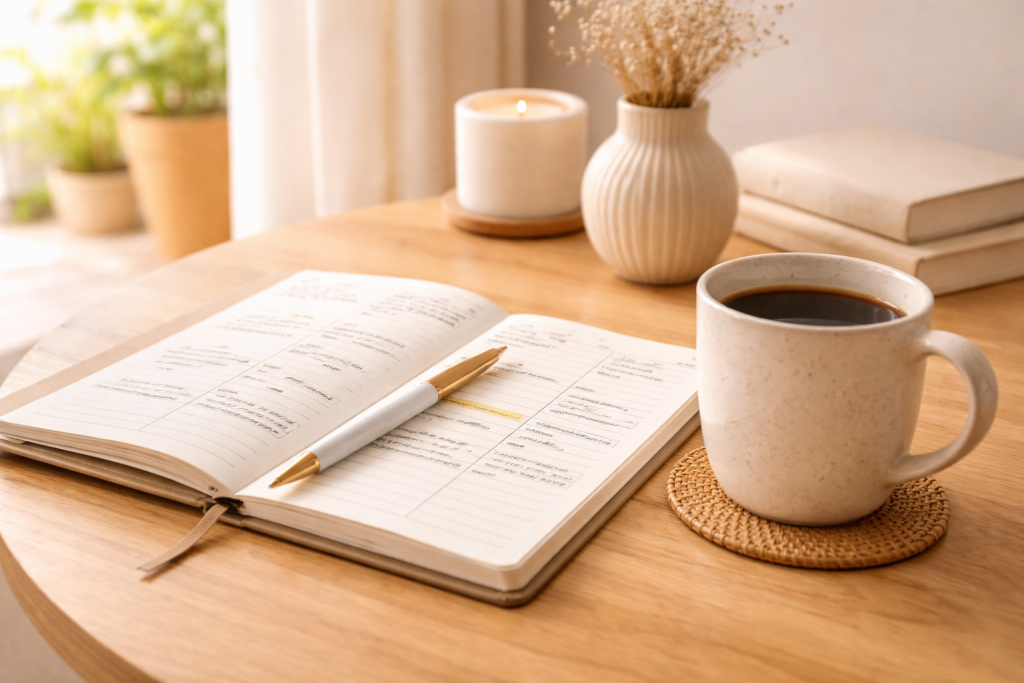
Daily productivity planner
Perfect for GTD
helps to dump everything on paper
improves mental clarity
Time blocking (structuring the day)

One of the main causes of inefficiency is working “haphazardly.”.
Jumping from one activity to another without structure.
Time blocking solves this problem.
How it works
Divide the day into dedicated blocks.
Practical example:
- 9:00-11:00 → deep work
- 11:30-12:30 → email
- 14:00-15:00 → meetings
- 16:00-17:00 → light activities
You don't decide what to do each time. You have already decided it.
👉 This reduces decision fatigue.
Why it really works
According to cognitive studies:
- multitasking reduces productivity up to 40%
- each interruption takes minutes to recover focus
Time blocking:
protects concentration
eliminates dispersion
increases quality of work
Organizing your daily life in a simple way is the most effective way to reduce stress and have more free time.

Digital Pomodoro Timer
helps maintain focus
creates rhythm of work
ideal for blocks of time
Pomodoro Method (short but intense focus)
The Pomodoro method is simple:
- 25 minutes work
- 5 minutes break
Repeat 4 times → longer pause.
This system works because:
reduces mental stamina
increases concentration
makes the work lighter
It is especially useful when:
- you are tired
- you have to start something
- you feel stuck
Managing distractions (the real enemy)

Distractions today are not random.
They are designed.
Notifications, social, email-everything is built to capture attention.
The real problem
It is not the lack of time.
It is the fragmentation of attention.
Any interruption:
- breaks the focus
- increases stress
- reduces quality of work
Practical strategies (immediately applicable)
✔ airplane mode during deep work
✔ notifications turned off
✔ phone out of sight
✔ closed windows on the computer
A simple rule:
👉 if it is not urgent, it should not interrupt you.
Francesca:
- Before → checked phone every 5 minutes
- after → 2 hours without notifications
Result:
✔ work completed faster
✔ less stress
✔ more leisure time
Second Brain (second digital brain)
This is one of the most powerful concepts in recent years.
👉 you don't have to remember everything
👉 you need to know where to find it
The Second Brain is an external system where archives:
- ideas
- notes
- projects
- information
Why it is critical
Whenever you keep something in mind:
- occupy mental space
- reduce ability to concentrate
With an external system:
✔ free the mind
✔ increases clarity
✔ you work better
Practical example
Simple system:
- notes app (Google Keep, Notion, etc.).
- organized folders
- separate lists
No need for complexity.
Consistency is needed.
Practical example of an organized day
Morning:
- 3 priority
- important work
Afternoon:
- light activities
Evening:
- quick tidy up
- planned relaxation
👉 This scheme works because it is simple and sustainable.
Managing moments of low energy
Not all hours are equal.
And this is normal.
Common mistake
Treat all hours the same.
Correct strategy
Adjusting work to energy.
Example:
- high energy → important work
- low energy → simple tasks
👉 This completely changes productivity.
Common mistakes in organizing daily life
- wanting to do everything right away
- create lists that are too long
- don't consider mental energy
- ignore distractions
👉 Avoiding these mistakes is half the battle.
Practical mini-scheme
Morning:
important activities
Afternoon:
light activities
Evening:
relaxation or organization
Tomorrow morning try this:
- write 3 priorities
- create 1 block of work
- eliminates 1 distraction
That's all you need to get started
Leisure, displacement and real balance
Leisure and relaxation: the most underrated part

There is a silent mistake that almost everyone makes: to consider free time as something that “advances.”.
If there is time left, I relax.
If I finish everything, I stop.
👉 This approach does not work.
Because work and commitments tend to expand until they take up all available space.
The result is that leisure time:
- is reduced
- fragments
- becomes unregenerative
And in the long run it leads to chronic fatigue.
According to the’World Health Organization, mental recovery is essential to maintain psychological balance and prevent burnout.
Leisure time is not optional. It is functional.
The first mindset change: relaxation must be planned
It may sound strange, but it is fundamental.
If you don't plan for free time, it doesn't exist.
Concrete example
- Friday night → movie or outing
- Saturday morning → personal activity
- Sunday → slow time
It is not rigidity. It is protection.
Protect your time as you would protect a work commitment.

Book Atomic Habits - James Clear
Helps build healthy habits
Improves daily management
Perfect for creating sustainable routines
Active relaxation vs. passive relaxation
Not all rest is equal.
Passive relaxation
- social
- TV
- continuous scroll
It gives you immediate relief, but often leaves you:
- tired
- inattentive
- dissatisfied
Active relaxation
- walk
- read
- sports
- hobby
It requires a little initial effort, but it gives back:
energy
mental clarity
real welfare
Why the brain prefers the passive
The brain seeks the easy way out.
Scrolling is easy. Moving is not.
But in the long run, passive relaxation:
👉 doesn't really regenerate
Real Case
Alexander:
- first → 2 hours social every night
- after → 30 min walk
Result:
best sleep
less stress
more energy
Read also:
Digital disconnection (critical today)

We live in a state of continuous connection.
The problem is not using technology.
It is to never turn it off.
Effects of continuous connection
- always active mind
- difficulty in relaxing
- drop in concentration
Simple but powerful rule
1 hour a day without a phone
Or:
- no phone before sleeping
- screen-less breaks
These small actions:
improve sleep
reduce stress
increase mental presence
Work-life balance (real, not theoretical)
Balance is not dividing time perfectly.
It is to prevent one part from invading the whole.
Imbalance signal
If:
- you think about work even when you are free
- email checks continuously
- you can't get off
means a boundary is missing.
Strategy: create “closing rituals”
Example:
- always turn off PC at the same time
- fix desk
- writing tasks for the next day
This signals to the brain:
the day is over
Efficient displacements (hidden time)

Shifts are often ignored, but they can take up hours each week.
And become a source of stress.
Main problem
- traffic
- delays
- improvisation
Solution: simple planning
Check first:
- route
- traffic
- alternatives
Reduces stress immediately.
Transforming dead time
Commuting can become useful.
Examples:
- podcast
- audiobooks
- training content
turns wasted time into useful time

Magnetic car smartphone holder
Useful for navigation
increases security
enhances daily experience
Reduce travel (when possible)
Key question:
👉 Is this shift necessary?
Solutions:
- smart working
- online services
- early organization
Evening preparation (underrated but powerful)
The night before:
- choose clothes
- prepare bag
- check agenda
This reduces:
morning stress
decisions
delays
Building a sustainable system
At this point you have all the elements.
But the question is:
How to bring everything together?
The simple system
- Home
→ 10-15 minutes per day - Job
→ 3 priorities + blocks - Leisure time
→ planned - Moving
→ optimized
Mistake to avoid
Try to change everything together.
👉 It does not work.
Correct method
It begins like this:
- choose 1 habit
- apply it for 7 days
- then add the second
This creates continuity.
Today:
- choose 1 thing to improve
- eliminates 1 distraction
- create 1 small routine
Don't wait for the perfect moment.
It will not come.
Real change comes from small but steady actions.
How to organize your day (practical step-by-step guide)
If I had to summarize the whole article in a practical method, it would be this.
A simple structure that you can use every day.
5-step method
1. Download everything from the head
Write down everything you need to do.
Do not filter.
👉 This frees the mind.
2. Choose 3 priorities
Of all the activities, select only three important things.
These define your day.
3. Organize into blocks
Split time:
- morning → important work
- afternoon → light activities
- evening → management and relaxation
4. Eliminate 1 distraction
Every day reduce at least one source of distraction.
Example:
- notifications
- social
- email continue
5. Close the day
Before finishing:
- space system
- write activities for tomorrow
👉 This reduces mental stress.
Why most people fail (even with the right methods)

Having reached this point, you might think:
👉 “Okay, I understand what to do. But why can't I maintain it?”
This is a fundamental question.
The truth is that the problem is not the method.
It is the application in real life.
Mistake No. 1: Wanting to change everything at once
This is the most common.
Start motivated and decide:
- new routine
- perfect house
- training
- time management
After a few days:
👉 total collapse
Why?
Because any change requires mental energy.
Too many changes together = overload.
Mistake No. 2: underestimating fatigue
Many systems work only when you are motivated.
But real life is made up of:
- heavy days
- low energy
- contingencies
👉 A system only works if it holds up even on bad days
Mistake #3: looking for motivation instead of structure
Motivation is unstable.
Structure no.
👉 You don't have to have want. You have to have a simple system.
Key strategy: the principle of least effort

If you want to maintain a habit, it has to be easy.
Not perfect. Easy.
Concrete example
❌ Wrong:
“I clean the whole house on Saturday.”
✔ Correct:
“10 minutes a day”
Rule of thumb
👉 If a routine is too demanding, it will not last
Reduce it until it becomes unavoidable.
“Front door” method (powerful psychological trick)
When something is difficult to start, reduce the input.
Examples:
- not “train 1 hour” → but “start 5 minutes”
- not “work 3 hours” → but “start 10 minutes”
👉 Once started, continuing is easier
This exploits a well-known psychological principle:
action reduces resistance.

No need for a perfect routine.
A repeatable routine is needed.
Example realistic day
Morning
- make bed
- 3 priority
- 1 block important work
Afternoon
- light activities
- practice management
Evening
- quick tidy up
- next day preparation
- leisure
👉 This pattern works because:
is simple
is flexible
is sustainable
Organized day schedule
| Moment | Activity |
|---|---|
| Morning | important activities |
| Afternoon | light activities |
| Evening | relaxation and organization |
Practical weekly plan (ready to use)
This is one of the strongest points for SEO and real utility.
Typical week
Monday
- priority setting
- work organization
Tuesday-Thursday
- focused work
- home routine
Friday
- business closure
- planning
Saturday
- personal business
- light house
Sunday
- recovery
- soft planning
👉 It is not rigid. It is a guide.
Advanced time optimization (next level)
When you already have a base, you can still improve.
Batching (grouping activities)
Doing similar activities together.
Example:
- all emails in one block
- all calls together
✔ reduces context change
✔ increases speed
Rule 2 minutes
If something takes less than 2 minutes:
👉 do it now
This avoids accumulation.
Strategic elimination
Key question:
👉 Is this activity really necessary?
Often the problem is not organizing better.
It is doing less.
How to maintain everything over time
This is the real point.
Don't start. But continue.
Simple maintenance system
- minimal routine (10-15 min)
- 3 priorities per day
- weekly review
Weekly review (fundamental)
Once a week:
- check activity
- eliminates unnecessary
- plan
👉 This keeps the system alive.

Weekly erasable planner board
clear vision of the week
helps to plan better
reduces mental chaos
Signal that you are improving
It is not doing everything.
È:
✔ less stress
✔ more clarity
✔ more leisure time
Checklist for organizing daily life
✔ 3 priorities per day
✔ 1 deep work block
✔ 10–15 minutes for the house
✔ 1 distraction eliminated
✔ free time planning
👉 If you follow this, you're already organized.

FAQ - Frequently Asked Questions
How to organize your daily life easily?
Organize your daily life by focusing on 3 priorities a day, creating small routines and reducing distractions.
What is the best method of organizing?
The most effective method is simple and sustainable: a few priorities, blocks of time, and daily routines.
How to find more free time?
Planning for relaxation and reducing unnecessary activities such as overuse of social media.
How to reduce daily stress?
By creating structure, eliminating the superfluous and limiting digital distractions.
How long does it take to create a routine?
On average, it takes just a few weeks, but the point isn't speed: it's continuity.
Why can't I organize my daily life?
Because it lacks a simple structure: too many decisions, too many activities, and too many distractions.
Conclusion
Organizing your daily life in a simple way is the most effective way to reduce stress and have more free time.
There's no need to change everything today.
Choose just one thing:
- a routine
- a priority
- a distraction to be eliminated
Organizing daily life effectively does not mean doing more, but eliminating the superfluous.
👉 And start from there.
This is how you build an organized life, one step at a time.


 Italian
  English