

Reading time: 7 minutes
Immediate response
The starter solenoid is an electromagnetic device that operates the pinion engagement mechanism and closes the electrical contacts needed to power the starter motor.
When it fails, the car may not start, make a single clicking sound, or have intermittent problems.
However, the same symptoms can depend on the battery, the power cables or the control circuit.
Before replacing the solenoid, check the battery and electrical connections: a simple power problem can look like a faulty motor.
What you will learn:
How the starter solenoid works.
Symptoms that may indicate a malfunction.
How to distinguish a faulty solenoid from a weak battery.
What checks to perform with a multimeter.
When to replace the solenoid alone or the entire motor.
When you need to go to a garage.
Index
What is the starter solenoid?
The solenoid is an electromagnetic component mounted, in most traditional systems, directly on the starter motor assembly.
It is also called a clutch electromagnet.
It performs two fundamental functions:
It moves the mechanism that brings the motor pinion into mesh with the flywheel crown.
Closes the power contacts that power the electric starter motor.
If any of these operations are not performed correctly, the internal combustion engine may not turn.
The solenoid should not be confused with the starter relay.
The relay belongs to the control circuit; the solenoid operates the clutch group and the power contacts of the motor.

How the solenoid works during starting
When you turn the key or press the Start button, the electrical system authorizes starting if the conditions required by the vehicle are met.
The solenoid receives the command and generates a magnetic field.
This moves a movable core, connected to the pinion engagement mechanism.
During movement, the contacts that allow the battery current to power the electric motor are also closed.
The starter motor can thus drive the internal combustion engine.
When the command ends, the mechanism must return to its rest position.
If the contacts are worn or the moving core becomes stuck, the system may stop working properly.
The Five Symptoms of a Bad Starter Solenoid
1. You hear a click, but the engine doesn't turn
It is one of the most common symptoms.
You turn the key and hear a click coming from the starter motor area, but the engine doesn't crank.
The noise may indicate that the solenoid is trying to actuate.
However, it does not necessarily mean that the component is faulty.
Possible causes include:
Battery with insufficient starting capacity.
Oxidized electrical connections.
Faulty ground cable.
Worn internal solenoid contacts.
Damaged electric motor.
A single, sharp click is different from a series of rapid clicks. The latter can occur when the voltage drops too low during the starting attempt.
If you hear a clicking sound but the motor remains stationary, please also consult our guide Car clicks but doesn't start.
2. No click is heard
In some cases you press Start, but the motor does not turn and you do not hear any noise.
This can happen when the solenoid does not receive the command or when it has an internal defect.
It is therefore necessary to check:
Starter control circuit.
Relays and fuses provided by the vehicle.
Any electronic authorizations.
Solenoid power supply.
Continuity and operation of the component.
The absence of a click alone does not allow us to establish which element is responsible.
3. The car starts only after several attempts
The defect may appear intermittently.
One time the motor works normally, but on the next attempt it remains stuck.
Possible causes include worn contacts, loose connections, and internal mechanism problems.
To help with diagnosis, see if the problem appears:
With a cold engine.
After a long break.
When the engine is already warm.
On particularly humid days.
This information can help the repair shop reproduce the defect.
4. The motor turns slowly
Slow cranking is not a solenoid-specific symptom.
First of all you need to check the battery and main connections.
High resistance in the electrical contacts can help reduce the voltage available to the motor.
But a worn electric motor can also cause the same behavior.
This is why it is important to measure the voltage during start-up, not just with the engine off.
5. The starter motor remains on after starting
It is a less frequent, but more serious problem.
When the command ends, the starter group should disengage properly.
If it remains inserted, loud abnormal noises and damage to components may occur.
The causes may concern the solenoid mechanism, the electrical contacts or a command that remains active.
If you hear persistent mechanical noises after starting, stop safely, turn off the engine, and do not persist with further attempts.
Faulty solenoid or dead battery? How to tell the difference
When the car won't start, it's easy to immediately focus on the engine.
But a weak battery can produce very similar symptoms.
A battery may show a seemingly normal voltage at rest and still fail to supply the necessary current during starting.
For this reason, the value measured with the engine off is not sufficient to establish whether it is efficient.
Symptom | Possible cause |
|---|---|
Rapid and repeated clicks | Weak battery or insufficient power |
A firm click, without rotation | Solenoid, motor or power circuit |
No click | Control circuit or solenoid |
Motor turning slowly | Battery, connections or motor |
Intermittent problem | Connections, contacts or control circuit |
These symptoms are only initial indications.

If the lights work but the engine remains stationary, also read the guide in more detail. Car won't start but the lights come on.
How to Check the Starter Solenoid
The diagnosis should follow a precise order.
1. Measure the battery voltage
On a common 12V automotive system, a well-charged lead-acid battery may show about 12.6–12.8V at rest.
A value close to 12.4 V generally indicates a lower state of charge.
These values are indicative and must be interpreted taking into account the type of battery and the measurement conditions.
Caution: Even at 12.6 V the battery may not be able to supply enough current.
For this reason, a load test can be more significant.
To perform an initial voltage check, a digital multimeter can also be useful for other electrical checks on the car.
HELPFUL TIP
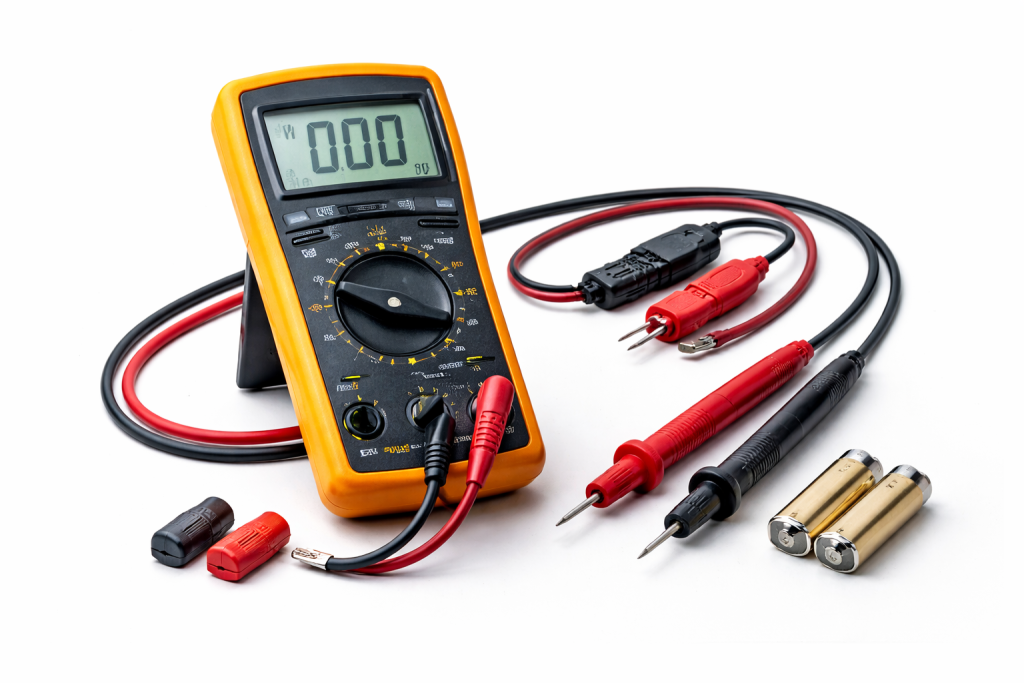
Digital multimeter for cars
Useful for checking battery voltage and carrying out simple checks on the electrical system.
See on Amazon →
2. Check terminals and cables
Visually check that the terminals are securely fastened and that there is no obvious oxidation.
Also note the accessible ground connections.
A connection with high resistance can prevent the motor from receiving enough current.
Do not bring metal tools close to the exposed terminals of the motor: the main positive connection can be powered even with the ignition off.
3. Measure the voltage drop
The voltage drop allows you to identify abnormal resistances along electrical connections.
The check is carried out during the starting attempt, comparing the voltages at the points foreseen by the diagnostic procedure.
Excessive hair loss may be caused by:
Oxidized clamps.
Damaged cables.
Faulty ground connections.
Deteriorated electrical contacts.

This is a particularly useful check because it prevents power supply problems from being attributed to the solenoid.
4. Check the solenoid control
If the battery and connections are good, the next step is to check the electrical control of the solenoid.
The position of the terminals and the operating logic change depending on the vehicle.
For this, the correct wiring diagram and an appropriate measuring instrument are required.
This check must be entrusted to competent personnel.
Do not attempt to connect the starter terminals directly to bypass the control: you may cause short circuits, sparks or unexpected vehicle movement.
The main causes of solenoid failure
Worn internal contacts
During each start, the solenoid closes contacts that must handle high currents.
Over time they can deteriorate, increasing the electrical resistance.
Overheating
Repeated and prolonged starting attempts can stress the starter motor and solenoid.
If the engine doesn't start, avoid trying too hard.
Faulty connections
Oxidized wires or loose connections can reduce the available voltage.
In this case the solenoid may be perfectly functional.
Humidity and corrosion
Exposure to moisture can contribute to the deterioration of connections and some electrical components.
Mechanical problems
A stuck clutch core or damaged clutch mechanism can prevent proper movement.
Can you continue to use the car with a faulty solenoid?
A faulty solenoid can prevent starting entirely.
If the problem is intermittent, the car may start normally and leave you stranded after the next stop.
For this reason, it is best not to postpone the diagnosis, especially before a trip.
If the motor remains engaged or makes loud noises after starting, stop use and have the system checked.
Should I repair the solenoid or replace the entire motor?
It depends on the type of scooter and the general conditions of the group.
On some models the solenoid is available separately.
On others it may be more convenient to replace or overhaul the entire motor.
The choice must consider:
Spare part availability.
Electric motor condition.
Pinion and clutch condition.
Cost of labor.
Reliability of repair.
If the motor already has significant wear, replacing just the solenoid may not be the best solution.
To learn about other possible defects of the group, consult our guide on faulty starter motor.
When to go to the mechanic
It is advisable to contact a workshop when:
The battery is good but the motor doesn't turn.
A single click is heard without starting.
The problem appears intermittently.
Visible connections are in good condition.
Abnormal noises occur from the starter unit.
A correct diagnosis must distinguish between insufficient power supply, a control circuit problem, and an internal motor fault.
In summary
The starter solenoid controls the clutch mechanism and the electrical contacts that power the starter motor.
When it doesn't work, the car may stall or have intermittent starts.
However, a clicking sound or failure to start does not automatically mean that the solenoid is faulty.
Before replacing the component, always check the battery, connections and control circuit.

FAQ - Frequently Asked Questions
Does the faulty solenoid always click?
No. It may make a clicking sound, work intermittently, or not make any noise at all. The behavior depends on the type of fault and the power supply.
If I hear a clicking sound, do I need to replace the solenoid?
No. A clicking sound could also be caused by the battery, the connections, or the electric motor. A diagnosis is required before replacing the battery.
Are starter solenoid and starter relay the same thing?
No. The relay belongs to the control circuit, while the solenoid operates the clutch mechanism and the power contacts of the motor.
Can cold weather cause solenoid problems?
Low temperatures can make existing defects more obvious, especially when the battery is weak. However, cold temperatures do not necessarily indicate a faulty solenoid.
Can just the solenoid be replaced?
Yes, on some scooters. The cost effectiveness depends on the availability of the spare part and the condition of the entire assembly.
Conclusion
The solenoid is a critical component for the functioning of the starter motor.
A failure of this can prevent the car from starting, but the same symptoms can be caused by external electrical problems.
For this reason, it is advisable to proceed with orderly checks, starting with the battery and only then arriving at the solenoid check.
An accurate diagnosis allows you to avoid unnecessary replacements and choose the most convenient repair.
Have you ever heard a clicking sound when trying to start your car, but the engine wouldn't turn over?
Tell us about the model and what checks you performed in the comments.
For other practical guides on electrical faults, visit the category Cars and Motorcycles by Consutil.


 Italian
 English