
Reading time: 5 minutes
Immediate response
La engine light on indicates that the control unit has detected an anomaly in the engine, combustion management or emissions system.
If the light remains fixed and the car is operating normally, you can usually safely drive to a safe location or repair shop, avoiding ignoring the warning.
If instead the spy flashes, the car loses power, jerks, vibrates a lot or noises or other abnormal signals appear, reduce your speed and stop as soon as it is safe to do so.
What you will learn:
- What does the check engine light mean?.
- The difference between a solid and flashing light.
- What are the most common causes?.
- When you can continue and when it is better to stop.
- How an OBD2 diagnosis can help you.
Index
Engine light on: what does it mean?
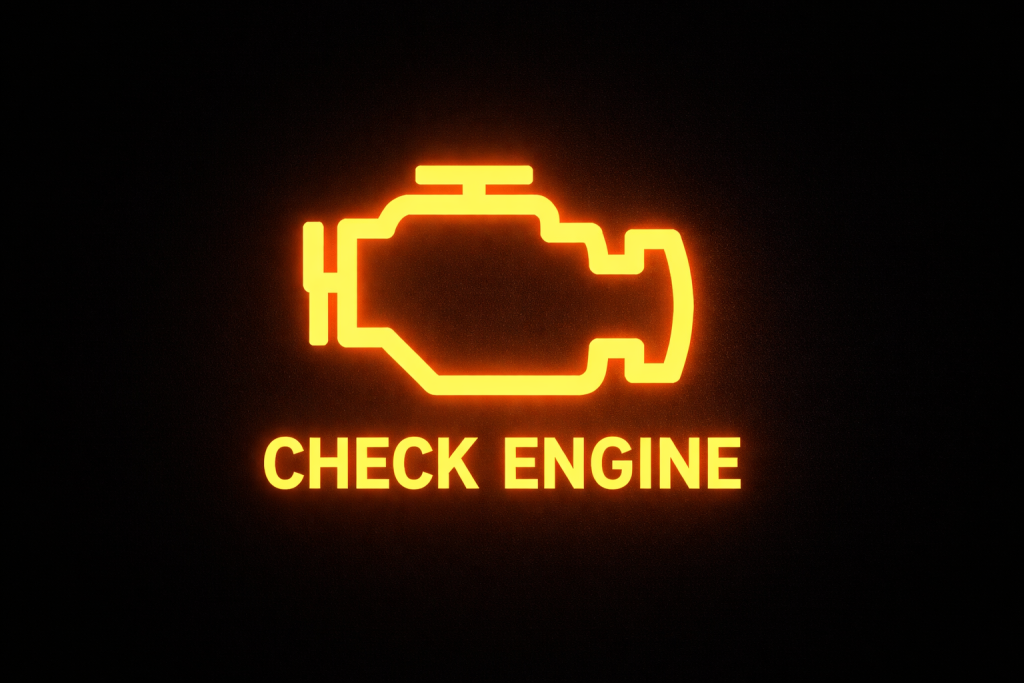
The engine light, also called check engine or engine failure warning light, indicates that the electronic control unit has detected an abnormal value in one of the monitored systems.
This may concern, for example:
- combustion;
- injection;
- air intake;
- sensors;
- exhaust system;
- anti-pollution devices.
This does not automatically mean that the engine is seriously damaged.
The problem is that the spy alone does not identify the precise cause. To understand which anomaly has been recorded, you need to read the error code stored by the control unit.
If you want an overview of the other dashboard warnings, check out our guide on car lights on to understand which warnings require more attention.
Engine light on or flashing: what's the difference?
It's one of the first checks to do.
Engine light on continuously
A fixed light indicates that the control unit has registered an anomaly.
If the car continues to operate normally, with no noticeable loss of power, vibrations, unusual noises, or other warning lights, you can generally proceed with caution and have the problem checked out as soon as possible.
However, this does not mean that the warning light can be ignored.
Engine light flashing
A flashing check engine light requires more attention.
It may be associated with a combustion anomaly capable of causing further damage, for example to the catalytic converter.
Therefore, reduce your speed and avoid sudden acceleration. If the flashing continues or the engine also jerks, vibrates strongly, or loses power, stop safely and evaluate assistance.
Most common causes of check engine light on
The same light can appear for very different problems. Without reading the error code, it's impossible to definitively determine the cause.
Among the most frequent ones we find:
Lambda sensor
The lambda probe measures the amount of oxygen present in the exhaust gases and contributes to the correct management of the air-fuel mixture.
When it malfunctions, higher fuel consumption, irregular idling, or other combustion problems may occur.
To learn more, read our guide on symptoms of a faulty lambda probe and increased fuel consumption.
EGR valve
Especially on diesel engines, deposits and residues can impair the functioning of the EGR valve.
Possible symptoms include loss of power, erratic operation, or abnormal smoke.
Flow meter
The air flow meter measures the air drawn in by the engine.
An incorrect value can alter the mixture management and cause irregular operation, a drop in performance or increased fuel consumption.
Spark plugs or coils
In gasoline engines, problems with the spark plugs or coils can cause misfires.
The engine may vibrate, jerk, or have difficulty accelerating.
Injectors
A dirty or malfunctioning injector can alter the quantity and quality of fuel delivered to the engine.
If you want to recognize the first signs, also consult our guide on dirty injectors and increased fuel consumption.
Catalytic converter and exhaust system
Combustion anomalies or problems ignored over time can also affect the catalytic converter and other components of the exhaust system.
This is precisely why a persistent check engine light should not be simply cleared without first understanding why it came on.
What to do immediately when it comes on
When the check engine light appears, avoid panicking immediately but don't ignore it.
Do these checks:
- Check whether the light is steady or flashing.
- Observe how the car behaves.
- Check if there are any other lights present.
- Avoid strong acceleration and high loads until you know the cause.
- Have the error code read as soon as possible.
If you have just refueled and the vehicle uses a system that monitors the tightness of the fuel vapor circuit, you can also check that the cap has been closed correctly, when required by the vehicle.
Can I continue driving with the check engine light on?
It depends mainly on the car's behavior and the type of signal.
You can generally proceed with caution to have your car checked if:
- the light is fixed;
- the engine runs normally;
- you don't feel strong vibrations;
- there are no abnormal noises;
- no other critical indicators appear.
It is better to stop safely if:
- the light flashes continuously;
- the engine jerks or vibrates a lot;
- there is a strong loss of power;
- unusual noises appear;
- you smell something burning or notice smoke;
- other warning lights come on at the same time, requiring you to stop.
The engine light is generic: the car's behavior and other signals present are essential to decide how to behave.
Diagnosing the engine light with OBD2
The control unit stores one or more diagnostic codes that can help identify the system in which the fault was detected.
A reader OBD2 allows you to read many of these codes by connecting to the car's diagnostic socket.
It can be helpful to arrive at the check with some more information, but there is an important distinction:
Reading the error code does not automatically mean you have found the component to replace.
The same code can have multiple causes and must be interpreted correctly.
To better understand how it works, read our complete guide on OBD2 diagnosis and car error codes.
If you want to have a small diagnostic tool at your disposal, a reader compatible with your vehicle can also be useful for an initial check.
HELPFUL TIP
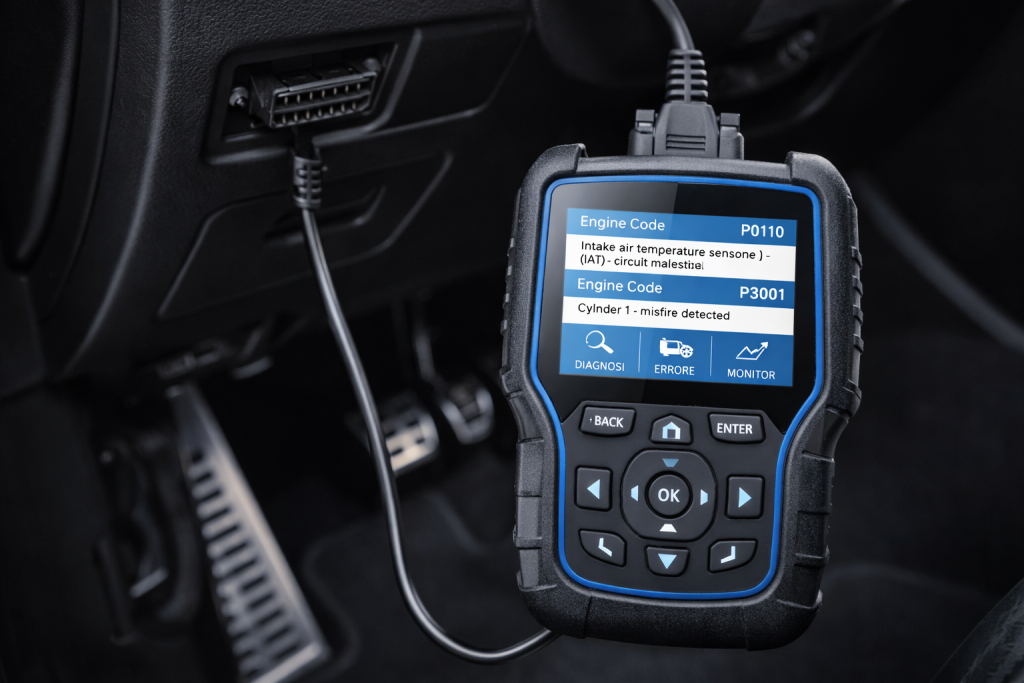
Bluetooth OBD2 Reader
It allows you to read many diagnostic codes available on the car's ECU via your smartphone. Before purchasing, check compatibility with your vehicle and the app you're using.
See on Amazon →
After the OBD2 reader, if you want to prepare the trunk for other small unforeseen events, you can find boosters, compressors and emergency kits in our guide to Essential car accessories to always keep in your car.
Mistakes to avoid
The first mistake is ignore the warning light because the car seems to be running normally. An anomaly may be present even without obvious symptoms.
The second is to replace components based only on the OBD2 code name.
Another common mistake is to clear the code and consider the problem solved. If the cause is still present, the light may come back on.
Finally, avoid continuing to drive normally when severe vibrations, loss of power, smoke, or other significant signs appear along with the warning light.
In summary
La engine light on does not automatically indicate a faulty engine.
If it stays put and the car operates normally, you can generally proceed with caution and have the problem checked as soon as possible.
If it flashes and there is a jerking, strong vibration or loss of power, stop as soon as it is safe to do so.
To know the cause it is necessary to read and interpret the correctly error code stored by the control unit.

FAQ - Frequently Asked Questions
Can the check engine light go out by itself?
Yes. If the fault is no longer detected, on some vehicles the warning light may go off after certain driving cycles. However, the fault code may remain stored and the problem may recur.
Can I drive with the engine light on?
If the car is operating normally and there are no other symptoms or warning lights, you can generally proceed with caution and have the vehicle checked. However, it's not a good idea to delay the diagnosis.
What does it mean when the check engine light flashes?
It could indicate a more serious problem, such as irregular combustion that risks damaging other components. Reduce your speed, and if the flashing persists or the car exhibits other symptoms, stop safely.
Can I clear the light with an OBD2 reader?
Some tools allow you to clear the codes, but doing so doesn't eliminate the cause of the problem. It's important to first understand why the code was recorded.
How much does it cost to fix a lit engine light?
It depends entirely on the cause. It could be a relatively simple problem or a more expensive component. Reading and correctly interpreting error codes is essential to avoid trial-and-error replacements.
Conclusion
La engine light on It's a warning from the control unit, not a diagnosis.
First check whether it is solid or flashing and pay attention to the car's behavior.
If the engine is running normally, have it diagnosed as soon as possible. If persistent flashing, strong vibrations, loss of power, or other significant signs appear, stop as soon as it is safe to do so.


 Italian
  English