
Reading time: 5 minutes
Immediate response
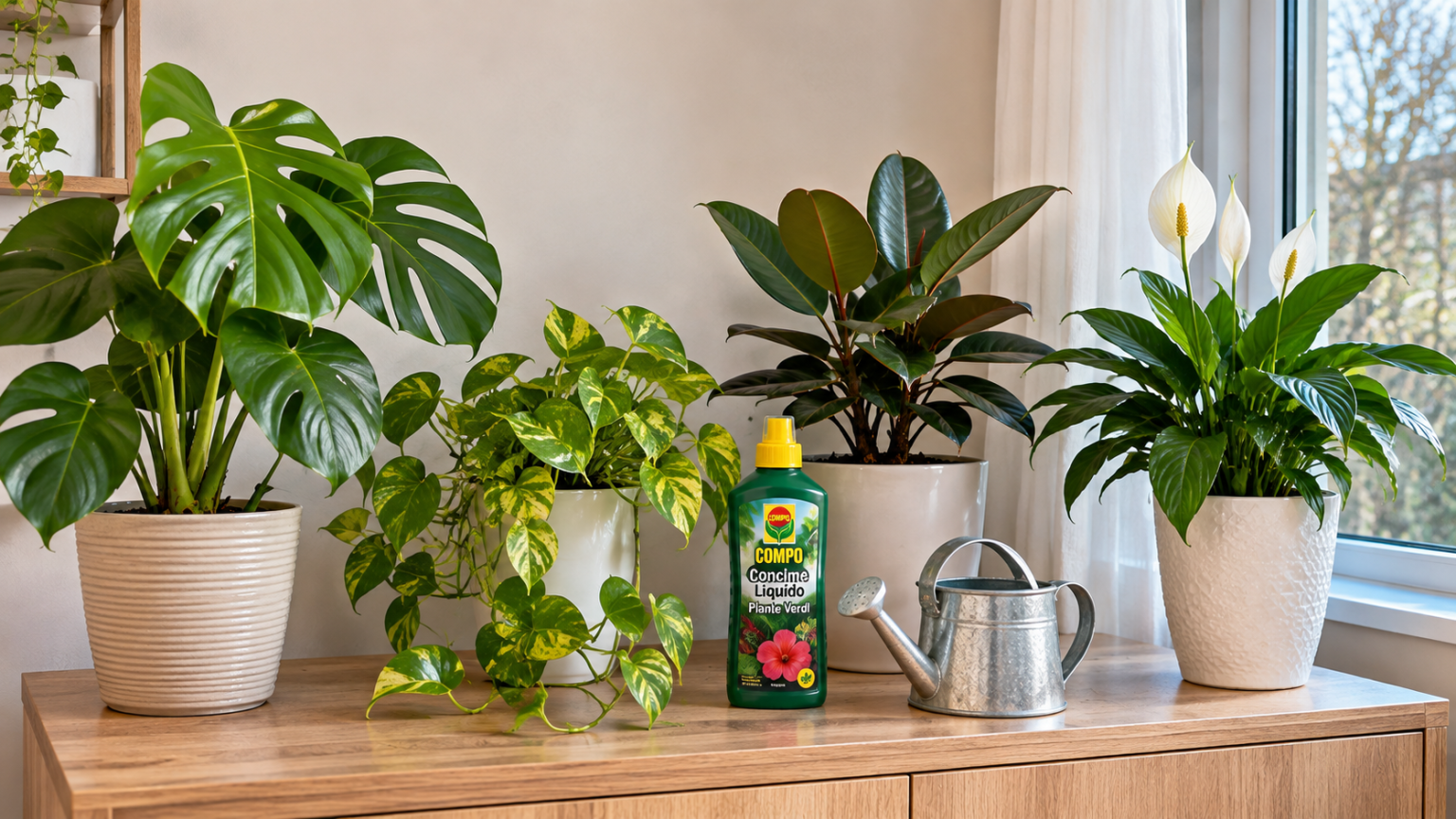
To choose the fertilizer for indoor plants, Start with the species you're growing. Pothos, monstera, and ficus can benefit from fertilizers designed for green plants, while a specific product is preferable for Phalaenopsis orchids. Cacti and succulents generally require less fertilization.
There is no need to fertilize all year round. For many plants, the main growing season is spring to summer. Before adding fertilizer, check the plant's condition and always follow the dosage indicated on the package.
What you will learn:
Which fertilizer to choose for six common houseplants.
When and how often to fertilize.
How to read NPK indications and dose a fertilizer.
What mistakes to avoid to avoid damaging the roots.
Index
Which fertilizer to choose for each plant
Not all houseplants have the same nutritional needs.
Some are grown primarily for their foliage, others for their flowers. Their growth rate and the amount of fertilizer they require also vary.
Here is a practical table based on the indications of the Royal Horticultural Society (RHS) and on the guides dedicated to individual species.
| Plant | Type of fertilizer | Indicative frequency |
|---|---|---|
| Pothos | Balanced liquid for green plants | Monthly, from April to October |
| Monstera deliciosa | Balanced liquid | Monthly during growth |
| Ficus elastica | For green plants, with good nitrogen supply | During growth, according to the product |
| Spathiphyllum | Balanced liquid | Every few weeks, from April to October |
| Phalaenopsis Orchid | Specific for orchids | Light and regular during growth |
| Cactus and succulents | Specific for cactus or suitable product | About once a month, generally from April to September |
Attention: The table indicates indicative frequencies, not universal quantities. The actual dose depends on the product concentration and the plant's condition..
Fertilizer for pothos and monstera
Pothos: a balanced liquid fertilizer
The pothos (Epipremnum aureum) is a houseplant appreciated for its ease of cultivation and decorative leaves.
During growth it can benefit from a balanced liquid fertilizer, suitable for green plants.
La RHS, in the Epipremnum growing guide, indicates monthly fertilization from April to October.
How to proceed:
Choose a fertilizer for green plants.
Use during active growth.
Follow the dilution indicated on the package.
Reduce or stop fertilizing when growth slows.
If your pothos produces small leaves or grows slowly, also check the light and root system. Adding fertilizer doesn't automatically solve these problems.
Monstera deliciosa: regular but moderate fertilization
Monstera is a tropical plant known for its large, incised leaves.
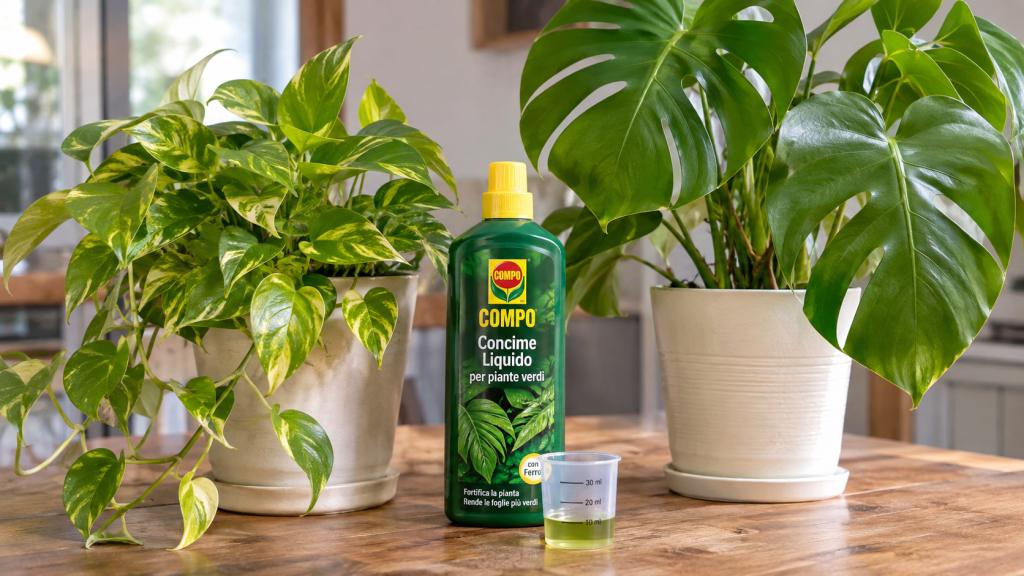
For the Monstera deliciosa a balanced liquid fertilizer can be used.
La RHS, in the Monstera Guide, recommends fertilizing during the growing period.
As a practical guideline, monthly fertilization with a suitable product may be sufficient, while still following the manufacturer's instructions.
There is no need to increase doses to encourage leaf development: light, temperature and substrate conditions remain fundamental.
HELPFUL TIP
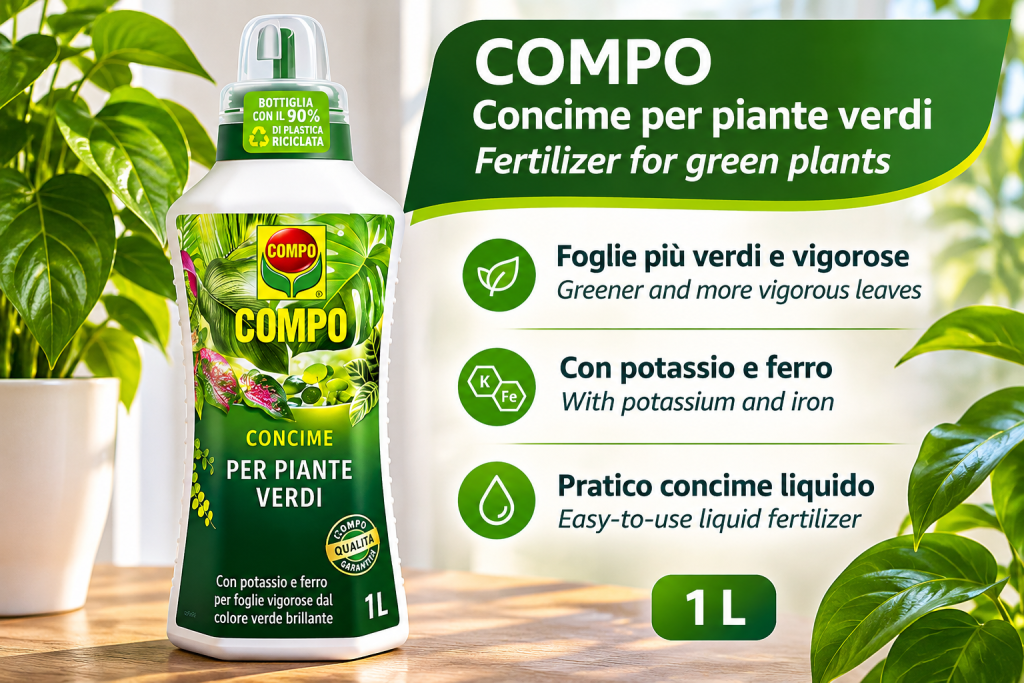
Compo Liquid Fertilizer for Green Plants
For indoor green plants. Check the label for compatibility, dosage, and frequency.
See on Amazon →
Fertilizer for ficus and peace lily
Ficus elastica: fertilizer to promote leaf growth
Ficus elastica is grown mainly for its large, glossy leaves.
During the growing season it can benefit from a fertilizer with a good nitrogen content.
According to the RHS, in the guide to ornamental ficus, A nitrogen-rich fertilizer can promote foliage development from spring to late summer.
To regulate yourself:
Choose a fertilizer suitable for green plants.
Fertilize during active growth.
Follow the doses and frequency indicated by the manufacturer.
Reduce or discontinue when the plant slows growth.
A practical tip: If the ficus loses leaves after being moved, don't add fertilizer immediately. Check exposure, temperature, and watering first.
Peace lily: be careful not to overdo it
The peace lily (Spathiphyllum) produces green leaves and characteristic white inflorescences.
A balanced liquid fertilizer is generally suitable for this plant.
La RHS, in the guide to growing peace lilies, recommends fertilizing every few weeks during the growing season, approximately from April to October.
It is not necessary to choose a particularly concentrated product.
If the plant appears to be suffering, first check the soil and environmental conditions.
Fertilizer for orchids and succulents
Phalaenopsis Orchids: A Specific Fertilizer Is Better
Phalaenopsis orchids are commonly grown in bark-based substrates, which are very different from standard potting soil for green plants.
For this reason it is preferable to use a specific fertilizer for orchids.
La RHS, in the guide to Phalaenopsis, recommends light and regular fertilization during growth.
Before using the product:
Check that it is suitable for orchids.
Follow the dilution instructions.
Avoid concentrations higher than recommended.
Do not let fertilizer salts accumulate in the substrate.
The RHS also recommends periodic watering without fertiliser to limit salt build-up, for example every fourth watering.
During the winter months, fertilization should generally be greatly reduced or suspended, depending on the condition of the plant.
HELPFUL TIP
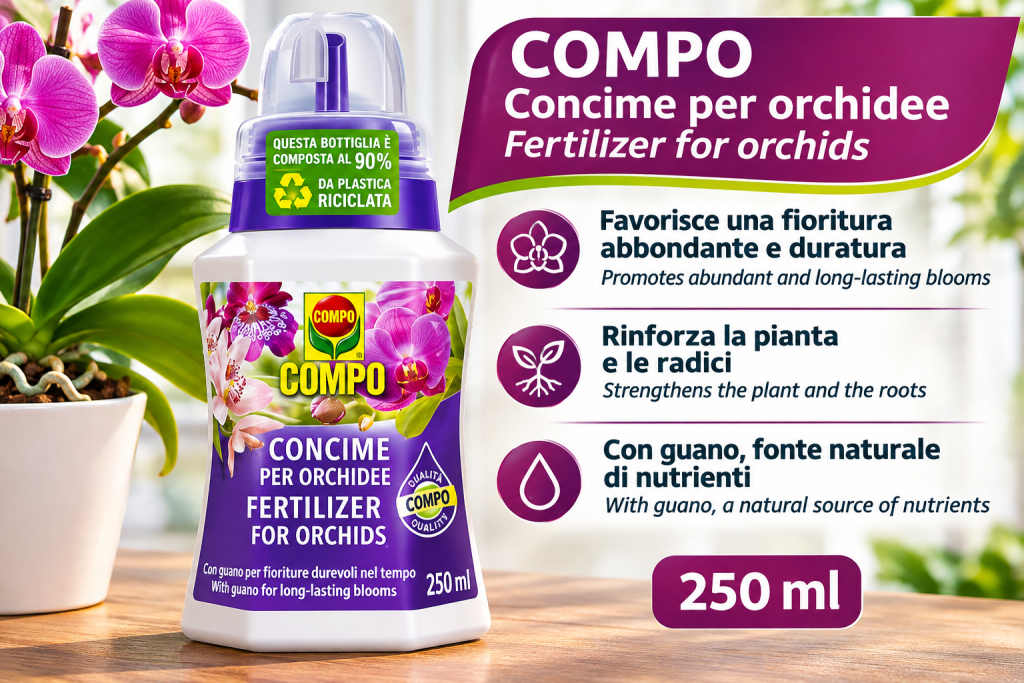
Compo Liquid Fertilizer for Orchids
Product specifically for Phalaenopsis orchids. Always follow the dilution and frequency instructions on the package.
See on Amazon →
Cacti and succulents: generally less fertilizer is needed
Many cacti and succulents are slow growing and do not require large amounts of fertilizer.
La RHS Guide to Indoor Cacti and Succulents, indicates that monthly fertilization, generally from April to September, may be sufficient.
For various species, a specific cactus fertilizer or a suitable liquid product with a good potassium content is suitable.
During the winter rest, it is often preferable to suspend fertilization.
But be careful: there are tropical cacti, like epiphytic ones, with different needs. Not all succulents follow exactly the same calendar.
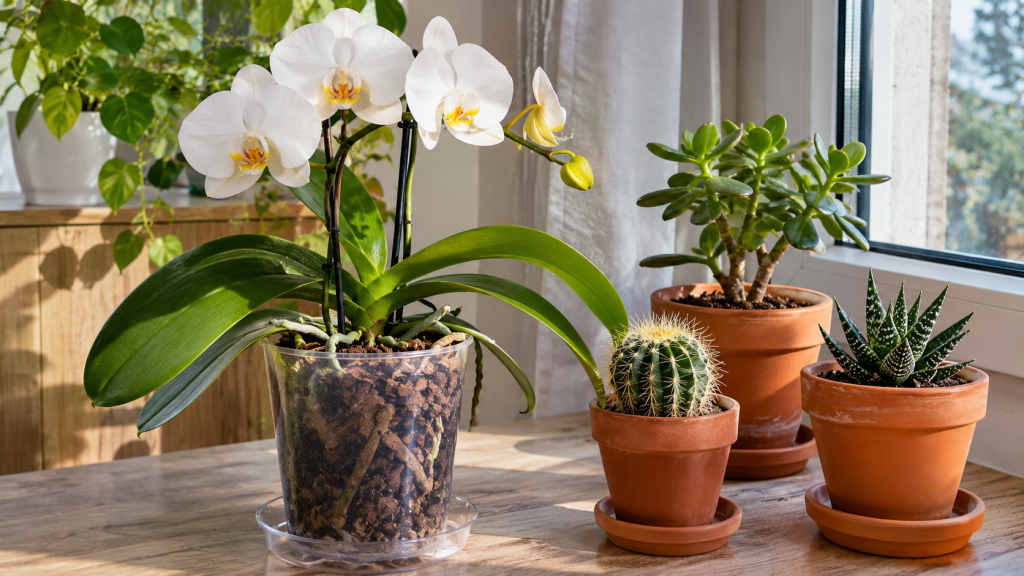
When to fertilize houseplants throughout the year
For many houseplants, growth increases with the arrival of spring and brighter days.
La RHS, in the general guide to houseplants, recommends concentrating fertilization during the growing season and limiting it during the winter.
| Season | What to do |
|---|---|
| Spring | Resume when the plant shows active growth |
| Summer | Fertilize according to the needs of the species |
| Fall | Reduce gradually as growth slows |
| Winter | Often suspend; evaluate exceptions |
And what about plants that grow in winter too?
Some tropical plants kept in warm, bright environments continue to produce new leaves.
In these cases, limited fertilization may be necessary, always respecting the characteristics of the species.
The presence of heating, however, does not automatically mean that a plant needs more fertilizer.
How to dose fertilizer correctly
One of the most important differences between products is concentration.
Two liquid fertilizers may have different compositions and require different amounts per liter of water.
What does NPK mean?
Fertilizer packaging often contains three numbers that represent the declared content of the main nutrients:
N — Nitrogen: important for vegetative growth.
P — Phosphorus: involved in the development and energy processes of the plant.
K — Potassium: contributes to numerous physiological functions.
A fertilizer with different NPK values is not automatically better or worse: it must be suitable for the plant and the growing conditions.
La RHS, in the guide to plant nutrition, explains the importance of nutrients and invites us to avoid unnecessary fertilization.
An example of dosage
Let's say the label says:
5 ml of fertilizer per 1 liter of water.
If you need to prepare half a liter of solution, the proportional amount would be 2.5 ml.
This is just a mathematical example, not a recommended dose for all plants.
The correct dose is always the one indicated by the product for the specific use.
Before fertilizing:
Read the label.
Check that the product is suitable for the plant.
Check the recommended dose and frequency.
Use a measuring cup.
Don't increase concentration to speed up growth.
Mistakes to avoid
1. Fertilizing a plant that receives little light
If a plant grows slowly due to lack of light, adding fertilizer will not solve the problem.
Check the position of the vase first.
2. Use the same product for all plants
A balanced fertilizer may be suitable for many green plants, but it is not necessarily the best solution for orchids or cacti.
3. Increase the doses
Excess fertilizer can cause salt buildup in the substrate and damage the roots.
Do not exceed the quantities indicated on the label.
4. Fertilize automatically even in winter
Many plants slow down growth during the cold months.
Continuing with the same summer frequency can be useless or harmful.
5. Confusing a nutritional deficiency with other problems
Yellow leaves, slow growth, or a distressed appearance do not necessarily indicate a lack of fertilizer.
Improper watering, damaged roots, and insufficient light can produce similar symptoms.
Before adding fertilizer, check the general condition of the plant.
In summary
To choose the right fertilizer for indoor plants:
Pothos: balanced liquid fertilizer, monthly during growth.
Monstera: balanced liquid fertilizer, monthly during growth.
Ficus elastica: fertilizer for green plants, with adequate nitrogen content.
Spathiphyllum: balanced liquid fertilizer every few weeks during growth.
Phalaenopsis: specific product for orchids, with light fertilization.
Cacti and succulents: fertilizations generally limited to the growing season.
The choice depends on the species, while the quantity of product also depends on its concentration.
Never increase doses just because a plant grows slowly.

FAQ - Frequently Asked Questions
What is the best fertilizer for houseplants?
For many green plants, a balanced liquid fertilizer may be suitable. However, check the species' needs and the fertilizer's composition.
Can I use the same fertilizer for pothos and monstera?
Generally, yes. Both can benefit from a balanced liquid fertilizer during growth, following the product's instructions.
Should houseplants be fertilized in winter?
Many require little or no fertilizer when growth slows. Some tropical plants, however, can continue to grow if kept in favorable conditions.
Can orchids be fertilized with a universal fertilizer?
It is best to choose a product specifically for orchids, following the instructions on concentration and frequency.
How do I know if I've given too much fertilizer?
A buildup of salts in the substrate, leaf changes, and root problems may be signs that warrant further investigation. However, these are not exclusive symptoms of excess fertilizer.
Conclusion
Choosing the right fertilizer for indoor plants doesn't mean buying the most concentrated product or using it more frequently.
It means choose the one suitable for your species and fertilize when really necessary.
Observe the growth, monitor the condition of the plant and always follow the instructions on the package.
To learn more about the use of organic fertilizers, read our guide to natural fertilizer for plants.
For more practical advice, visit the category Consutil's Garden and Vegetable Garden.