

Reading time: 6 minutes
Immediate response
To clean your dishwasher, start with the filter at the bottom, remove any food debris, and check the spray arms. Then wipe the door seals and edges with a soft cloth.
If required by the manufacturer, complete maintenance with an empty cleaning cycle and a specific detergent compatible with the model.
Caution: Do not mix different products and do not use vinegar, bleach, or harsh detergents without checking the manufacturer's instructions.
What you will learn:
How to clean the dishwasher filter.
How to check the spray arms.
How to remove dirt from gaskets.
When to run an empty wash.
How often should maintenance be done?.
What mistakes to avoid to avoid damaging your appliance.
Index
The dishwasher washes dishes and glasses every day, but that doesn't mean it cleans itself completely.
Over time, food debris, grease, and mineral deposits can build up in the filter, on the spray arms, and around the seals.
The result? Unpleasant odors, less-than-clean dishes, and, in some cases, drainage problems.
Let's see how to keep it clean with a few practical checks.
Why is it important to clean the dishwasher?
Regular maintenance helps keep the parts that distribute and filter water working efficiently.
The areas to check are above all:
Filter: retains food residue.
Spray arms: distribute water over the dishes.
Seals: Can trap dirt and moisture.
Door edges: often not directly reached by the water jets.
Inner tank: can accumulate grease and mineral deposits.
A dirty dishwasher isn't necessarily a problem. Sometimes a thorough cleaning is enough to improve its performance.
Appliance maintenance is part of kitchen cleaning. You can learn more in the guide. Effective and natural kitchen cleaning.
What to do before cleaning the dishwasher
Before you begin:
Wait until the dishwasher has finished its cycle and cooled down.
Turn it off and unplug it from the power supply when required by the manual or necessary for safe operation.
Remove the lower basket to access the filter.
Prepare a soft cloth, a non-abrasive brush and warm water.
Consult the manual to see which components can be removed.
Caution: Do not disassemble electrical panels, pumps, or internal components not intended for user maintenance.
How to clean the dishwasher filter
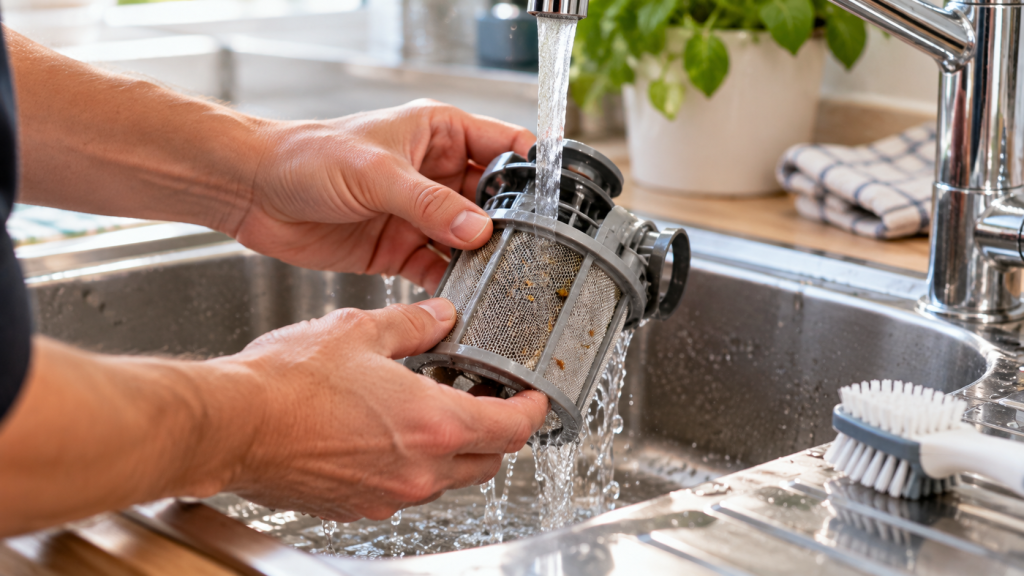
The filter is usually located at the bottom of the tub, under the lower basket.
It is one of the most important parts to check because it can retain food residue and dirt.
Step-by-step procedure
Remove the lower basket.
Locate the filter.
Unlock it by following the manufacturer's instructions.
Remove food debris.
Rinse it under warm running water.
If necessary, use a soft brush.
Reassemble the filter and check that it is locked correctly.
Do not use metal brushes or sharp objects that could damage the filter mesh.
Important: Do not run the dishwasher without a filter unless otherwise specified by the manufacturer.
When to check the filter
It's worth checking if you notice:
Food residues after washing.
Water flowing slowly.
Persistent odors.
Visible dirt on the bottom.
If water remains in the tub even after cleaning, there may be a drain problem.
How to clean the spray arms
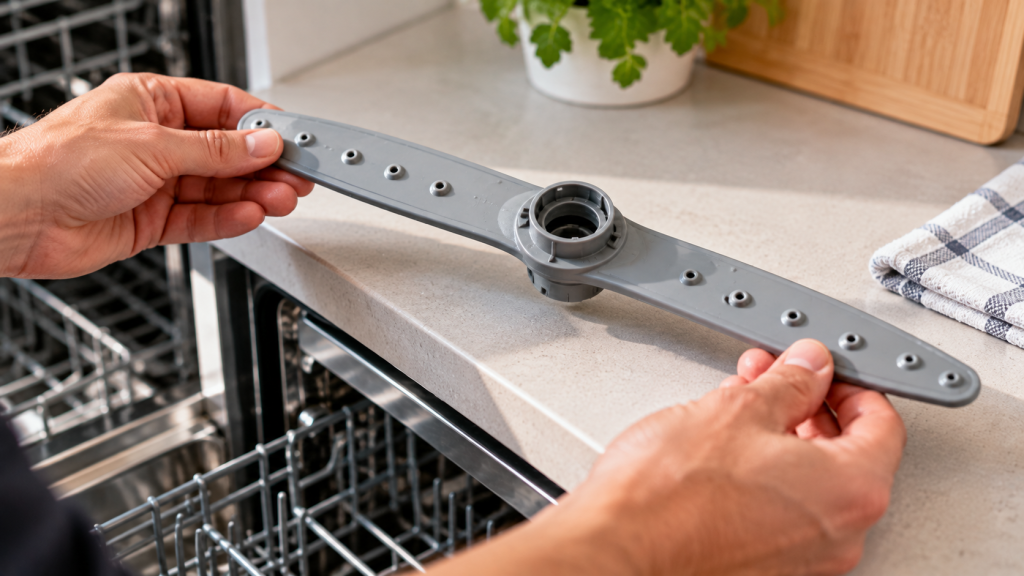
The spray arms distribute water through small holes.
If these become clogged with residues or deposits, washing may become less effective.
What to check
Check that the arms can rotate freely and that the holes are not blocked.
If the manual allows you to remove them:
Disassemble them following the model instructions.
Rinse them under running water.
Gently remove any visible residue using the manufacturer's recommended tools.
Reassemble them and check that they turn freely.
Do not force the arms or enlarge the holes with metal objects.
How to clean gaskets and doors
Seals can trap small amounts of food debris and moisture.
The lower edge of the door also tends to get dirty because it is not always directly reached by the jets.
How to proceed
Wipe a soft, slightly damp cloth over the seals, in accessible folds, and along the edges of the door.
If necessary, use a mild detergent compatible with the materials and recommended by the manufacturer.
Finally, dry the surfaces.
Avoid abrasive sponges, solvents and corrosive products that could damage the rubber or finishes.
How to clean the inside of the dishwasher
After the filter, arms and gaskets, you can take care of the internal tank.
Remove any visible residue and check for grease or limescale deposits.
When to run an empty wash
Many models have a specific machine cleaning program or a cycle suitable for maintenance.
Follow the manufacturer's instructions for temperature, frequency, and detergent.
A specific product for dishwashers can be useful against grease and deposits, as long as it is compatible with the model.
If the manual allows the use of a detergent for internal cleaning, choose a product formulated for dishwashers and follow the instructions on the package.
HELPFUL TIP
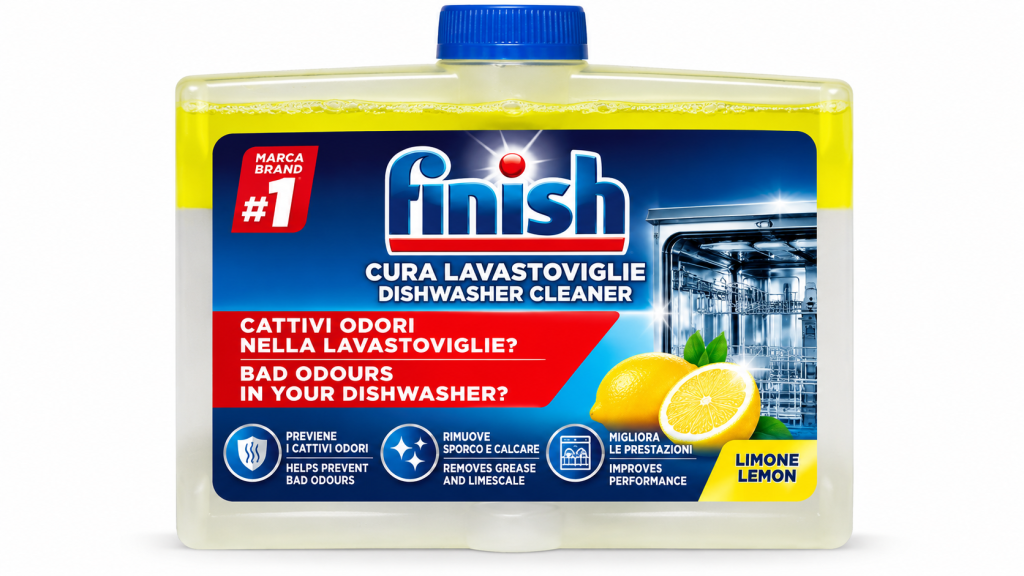
Dishwasher detergent
For internal maintenance of the machine, if compatible with the model. Follow the manufacturer's instructions.
See on Amazon →
Vinegar and baking soda: can they be used?
They are not a one-size-fits-all solution.
Vinegar, especially if used frequently or inappropriately, may be unsuitable for some components. Baking soda isn't necessarily a substitute for a specific product.
It is best to follow the instructions in the manual and not mix substances or detergents.
How often should you clean the dishwasher?
Frequency depends on usage, residue left on dishes, and the manufacturer's instructions.
Component | When to check it |
|---|---|
Filter | Regularly, even every week with heavy use |
Seals and edges | When dirt appears, approximately every 1–2 weeks |
Spray arms | If the flushing gets worse or the holes seem clogged |
Internal tub | Periodically, according to the manual |
Maintenance cycle | According to the manufacturer's instructions or the machine's warning |
These intervals are indicative: your model's manual always takes precedence.
Mistakes to avoid
Never clean the filter. Residues can build up and prevent proper operation.
Use hand dish soap. It can produce excessive foam and cause problems.
Force disassembly of components. The fastening systems change from one model to another.
Use sharp objects in the arm holes. They can damage them.
Mix detergents. Some combinations can be dangerous.
Ignore limescale deposits. Check the water softener settings and whether specific salt is required, according to the manual.
If limescale is already present and the manufacturer allows for specific treatment, you can consider a dishwasher descaler compatible with your model. Do not use it in conjunction with other detergents.
HELPFUL TIP
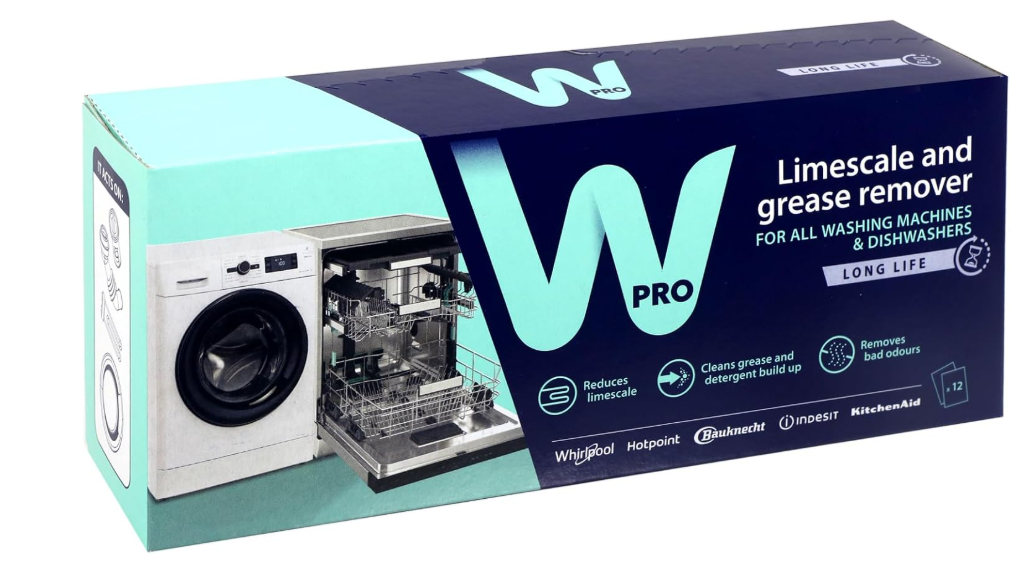
Specific descaler for dishwashers
To treat limescale deposits when recommended by the manufacturer. Check compatibility and instructions for use.
See on Amazon →
In summary
To clean your dishwasher properly, first focus on the filter, spray arms, seals, and door edges.
Complete maintenance with a cleaning cycle when specified by the manufacturer.
Regular cleaning helps prevent dirt build-up and keep the appliance running efficiently.

FAQ - Frequently Asked Questions
How to clean the dishwasher without ruining it?
Use soft cloths, warm water, and products compatible with your model. Follow the manual to remove the filter and spray arms.
Can you clean the dishwasher with vinegar?
Only if the manufacturer allows it. It's not a one-size-fits-all solution.
Why does the dishwasher smell even after washing?
There may be debris in the filter, dirt on the seals, or standing water. If the problem persists after cleaning, check the drain.
Should the dishwasher filter be cleaned every week?
It depends on usage. With frequent washing and heavy residue, it may be helpful to check it weekly.
How to remove limescale from the dishwasher?
Check the water softener settings and use specific salt when recommended. To remove existing deposits, follow the manual and use only compatible products.
Conclusion
Cleaning your dishwasher doesn't necessarily require expensive products or complicated procedures.
Often, a few regular checks are enough to prevent dirt and debris from building up.
Start with the filter, check the spray arms, and don't forget the gaskets and door.
Simple maintenance, done correctly, helps your dishwasher work better and longer.
To continue the maintenance of your kitchen appliances, also discover How to clean your refrigerator naturally.