Reading time: 6 minutes
Immediate response
The Fiat Ducato AdBlue system uses a solution of urea and demineralized water to reduce nitrogen oxides (NOx) produced by the diesel engine.
A pump feeds the circuit, an injector doses the AdBlue into the exhaust and the SCR catalyst allows most of the NOx to be transformed into nitrogen and water.
If an anomaly appears, the causes may be:
- Insufficient fluid level.
- AdBlue pump.
- Circuit pressure.
- Dosing injector.
- Sensors or electronic components.
An SCR fault message does not automatically mean that the AdBlue tank needs to be replaced.
What you will learn:
- How the Fiat Ducato's SCR system works.
- What are the main components.
- How AdBlue is used while driving.
- What problems can compromise its functioning.
- What can low AdBlue pressure indicate?
- When a workshop diagnosis is needed.
Index
On Fiat Ducato diesel engines equipped with an SCR system, AdBlue is required for the correct functioning of the emissions treatment.
Many drivers are familiar with this fluid only because they have to top it up periodically.
In reality, behind the fuel cap there is a system consisting of a pump, pipes, injector, sensors and electronic components.
Understanding how it works helps distinguish a simple request for top-up from a possible fault.
Let's see how the system works and what controls are useful when an anomaly appears.
How the AdBlue and SCR systems on the Fiat Ducato work
The SCR system, acronym for Selective Catalytic Reduction, is mainly used to reduce nitrogen oxides in exhaust gases.
These substances are formed during the combustion of diesel fuel.
To reduce them, AdBlue is used, a solution composed of:
- 32.5% high purity urea.
- 67.5% demineralized water.
The liquid is dosed into the exhaust system, where through various chemical transformations it makes the ammonia necessary for the SCR process available.
Inside the catalyst, nitrogen oxides are mainly converted into nitrogen and water.
It is the principle also described in the technical documentation of Fiat Professional and Bosch.
AdBlue is not added to diesel fuel and does not enter the combustion chamber directly.
Are AdBlue and DPF filter the same thing?
No.
The particulate filter, called DPF or FAP, traps the soot particles present in the exhaust gases.
The SCR system instead intervenes on nitrogen oxides.
Both contribute to emissions control, but perform different functions.
What are the main components?
The AdBlue system comprises several elements that must function correctly.
1. AdBlue tank
The tank contains the liquid needed to treat exhaust gases.
It is separate from the diesel tank.
Depending on the vehicle version, it may include components dedicated to controlling the level, temperature and supply of the liquid.
On some configurations, several elements are integrated into the tank assembly.
2. AdBlue pump
The pump feeds the circuit and allows the pressure conditions required for dosing to be reached.
When the system requires it, the liquid is sent through the pipes to the injector.
If the pump is unable to guarantee the expected conditions, the control unit can detect an anomaly.
3. Pipes and heating system
The AdBlue flows through a dedicated circuit.
Because the liquid freezes at temperatures around −11 °C, some parts of the system are equipped with heating systems.
Their operation is managed according to the strategies envisaged by the manufacturer.
Any leaks, blockages or electrical anomalies can compromise the circuit's power supply.
4. AdBlue injector
The injector introduces a controlled amount of liquid into the exhaust gas flow.
The quantity dosed varies according to the engine conditions and the control unit strategies.
A clogged or malfunctioning injector can compromise the efficiency of the system.
5. SCR catalyst
It is the component in which the catalytic reduction of nitrogen oxides occurs.
Thanks to the reactions involving the ammonia produced from AdBlue, NOx are mainly transformed into nitrogen and water.
6. NOx sensors and control unit
NOx sensors detect nitrogen oxides in exhaust gases.
Their signals contribute to the management and control of treatment efficiency.
The sensor configuration changes depending on the vehicle version.
Not all Fiat Ducatos use exactly the same component layout.

To understand how the SCR system integrates with the other engine components, also read our guide dedicated to the Fiat Ducato 2.2 Multijet Euro 6.
What happens during engine operation
When the engine is running, the SCR system goes through several control stages.
1. The control unit checks the conditions
Electronic management considers information such as:
- Exhaust gas temperature.
- Engine operating conditions.
- AdBlue circuit status.
- Sensor signals available.
Dosing does not necessarily occur at all times.
2. The pump feeds the circuit
When conditions allow, the system feeds the AdBlue circuit.
The pump must guarantee the pressure conditions required for the operation of the injector.
If insufficient pressure is detected, the system can store a fault.
3. The injector doses the AdBlue
The injector introduces the required amount of liquid into the exhaust system.
The dosage changes depending on the operating conditions.
The same amount of AdBlue is not always used.
4. The SCR catalyst intervenes
The exhaust gases pass through the treatment system.
In the SCR catalyst, reactions take place that allow the reduction of nitrogen oxides.
5. The control unit checks the result
The system checks its functioning through the available signals.
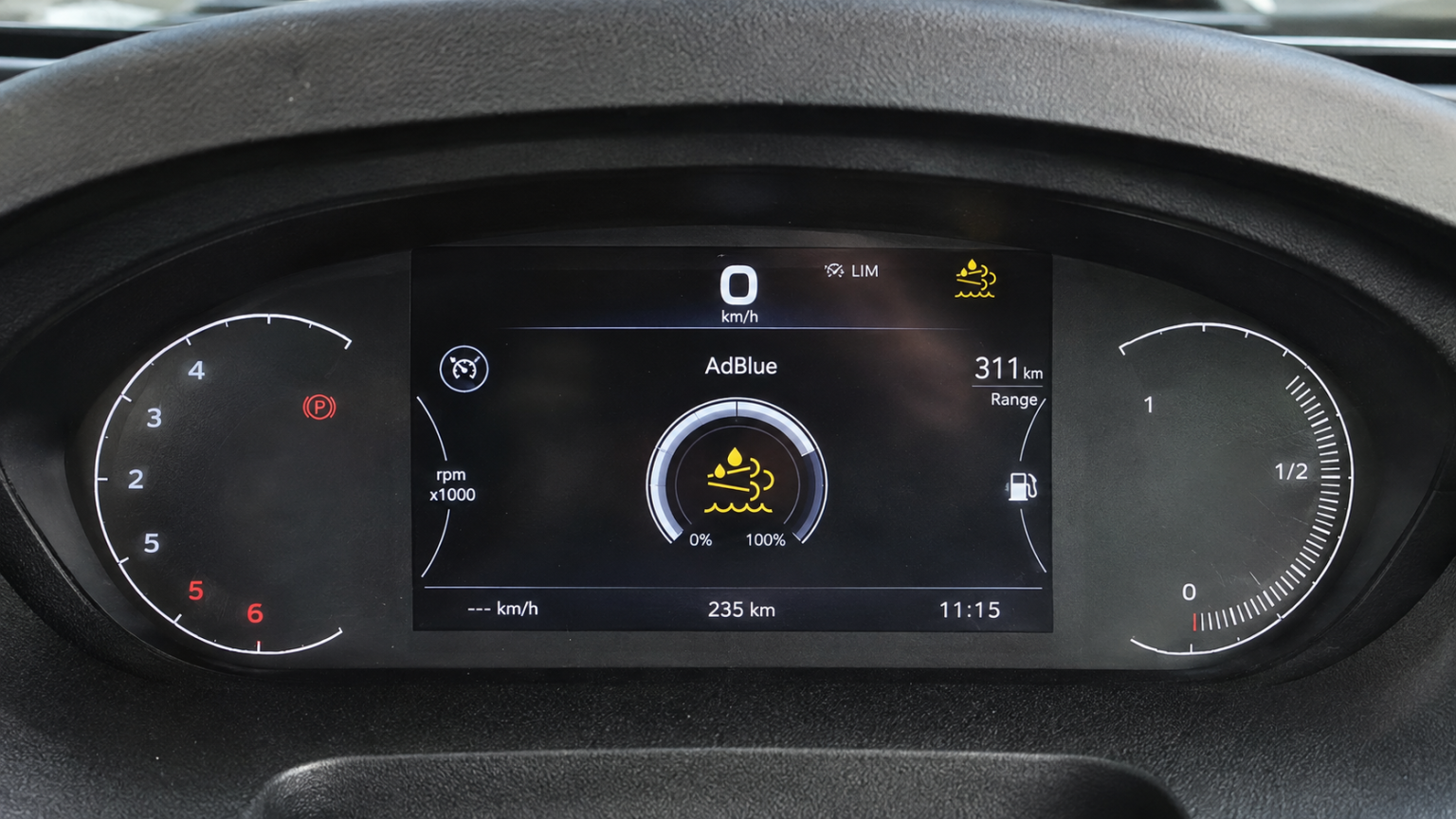
If a problem is detected, a fault code may be stored and a warning may appear on the instrument panel.
The warning methods depend on the Ducato version.
AdBlue and SCR: what problems can occur?
Not all anomalies have the same origin.
| Problem observed | Possible cause | What to do |
|---|---|---|
| Top-up request | AdBlue level insufficient | Check the level and follow the manual |
| Low AdBlue pressure | Pump, leak or blockage | Circuit diagnosis |
| Incorrect dosage | Injector or power supply | Workshop check |
| NOx anomaly | SCR sensor or efficiency | Checking codes and parameters |
| Failure to restart warning | Insufficient level or SCR failure | Intervene promptly |
These symptoms alone do not allow you to identify a faulty component.
For example, insufficient pressure does not automatically mean that the pump is defective.
It is necessary to check the system according to the procedures provided by the manufacturer.
AdBlue deposits and crystallization
Under certain conditions, AdBlue can leave crystalline deposits.
If these affect critical points of the circuit, they can interfere with correct operation.
However, not every deposit should be considered as evidence of a fault.
The inspection must concern the component concerned and the functioning of the system.
Real case: Fiat Ducato 2.2 Euro 6d with low AdBlue pressure
This example comes from a problem encountered in the workshop on a Fiat Ducato 2.2 Euro 6d.
During the intervention, an insufficient pressure condition in the AdBlue system was reported.
The problem identified concerned the pump integrated into the tank group.
Why is this issue important?
The case demonstrates that the presence of liquid in the tank does not necessarily guarantee the correct functioning of the circuit.
If the pump is unable to supply the system under the required conditions, dosing may be compromised.
The control unit can then recognize an anomaly.
Does the tank always need to be replaced?
No.
Insufficient pressure can depend on different causes:
- Faulty pump.
- Leak in the circuit.
- Obstruction.
- Power supply anomaly.
- Regulation or control problem.
In the observed case, the fault was associated with the pump inside the tank.
On another vehicle, a similar report may have a different origin.
Diagnosis must identify the responsible component before deciding which part to replace.
Technical note: This case study is based on information collected during the actual intervention. The exact fault code and measured pressure values are not yet available for publication.

What to check before replacing components
When an AdBlue fault appears, it is important to distinguish simple checks from checks that require diagnostic tools.
Checks that the owner can carry out
Before contacting the workshop:
- Read the message on the instrument panel carefully.
- Check the AdBlue level following the instructions in the manual.
- Check if the problem appeared after topping up.
- Note when the alert appears.
- Check if there are any other fault messages.
For topping up, only use a product that complies with the specifications provided for the vehicle.
Do not add water, improvised additives or other liquids.
Checks reserved for the workshop
A diagnosis may include:
- Reading fault codes.
- Check available parameters.
- Checking the power supply.
- Check the circuit and for any leaks.
- Checking the pump operation.
- Checking the dosing system.
The tests available depend on the vehicle version and the diagnostic tool used.
It is not advisable to disconnect pipes or directly power the pump without knowing the manufacturer's specific procedure.
When to contact the workshop
It is appropriate to request a diagnosis when:
- The warning remains present after correct topping up.
- An SCR failure message appears.
- The problem occurs again after being deleted.
- A warning appears that the restart may not work.
- There are other engine system anomalies.
Can you continue driving?
It depends on the message displayed.
A top-up request is not equivalent to an SCR system failure.
On some versions of the Fiat Ducato, in the event of insufficient fuel level or particular anomalies, strategies can be activated that prevent the engine from being restarted.
The specific indications are given in the Fiat Ducato manuals.
If you see a countdown about the failure to restart, do not delay checking.
In summary
The Fiat Ducato AdBlue system helps reduce nitrogen oxides in exhaust gases.
Its operation depends on several components:
- The tank contains the liquid.
- The pump feeds the circuit.
- The injector doses the AdBlue.
- The SCR catalyst allows the reduction of NOx.
- Sensors and the control unit control the system.
Insufficient AdBlue pressure can compromise dosing, but does not automatically identify a faulty pump.
Before replacing expensive components, it is essential to identify the cause through a correct diagnosis.

FAQ - Frequently Asked Questions
What is AdBlue used for in the Fiat Ducato?
AdBlue is used by the SCR system to reduce nitrogen oxides produced by the diesel engine. It is not added to diesel fuel.
Where is the AdBlue pump on the Fiat Ducato located?
The location and configuration depend on the version. In some models, the pump is integrated into the AdBlue tank assembly.
If the AdBlue pressure is low, should the tank be changed?
Not necessarily. The cause could be the pump, a leak, a blockage, or other components. A diagnosis is required before choosing a replacement.
Can the Fiat Ducato run without AdBlue?
The engine uses diesel, but on versions equipped with SCR, the system requires AdBlue for emissions treatment. A lack of this fluid can cause warnings and limitations, up to the point of making it impossible to restart the engine according to the planned strategies.
Do all Fiat Ducato diesel engines have the SCR system?
No. The presence and configuration of the system depend on the year, engine type and version of the vehicle.
Conclusion
The AdBlue and SCR system of the Fiat Ducato includes mechanical, hydraulic and electronic components that must work together.
Knowing how the tank, pump, injector, and catalytic converter work helps you better understand possible problems.
The real case of the Fiat Ducato 2.2 Euro 6d with insufficient AdBlue pressure shows why you shouldn't stop at the message displayed on the instrument panel.
A correct diagnosis allows us to identify the cause and avoid unnecessary replacements.
On Consutil, you'll find practical guides on how vehicle systems work, common faults, and the checks you should perform.
Explore the other guides in the section Fiat Ducato, visit the category Cars and Motorcycles and discover all the advice available on Consutil.com.